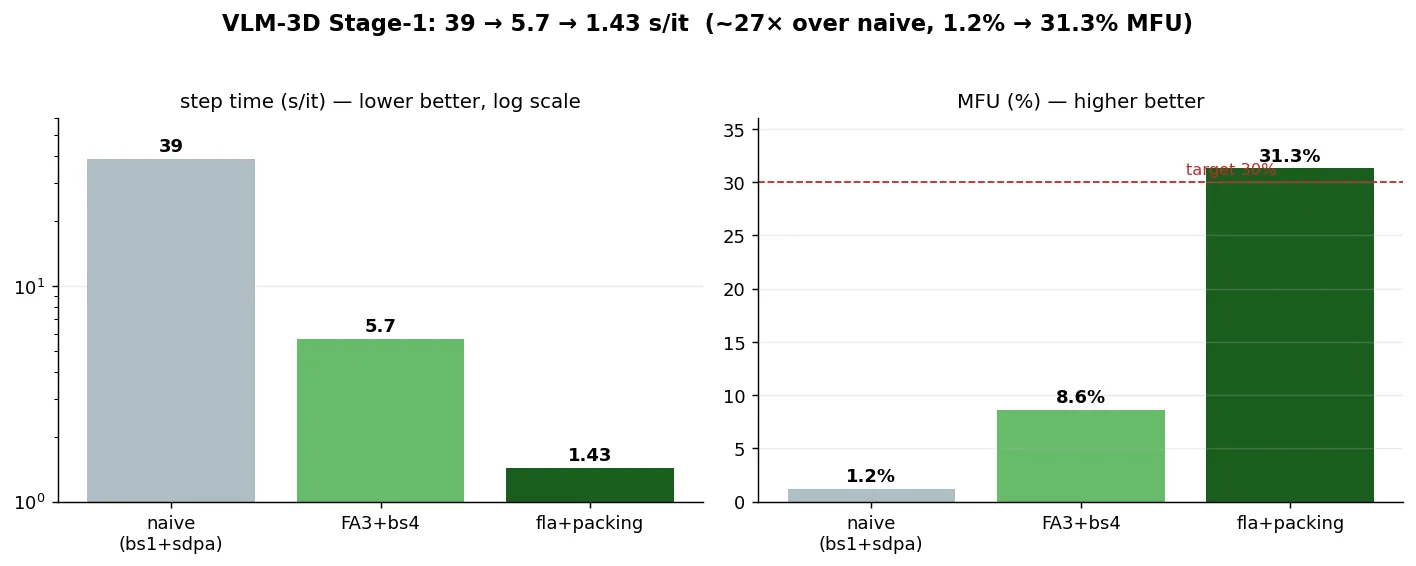
Qwen3.5-2B AR pretraining on discrete 3D tokens · 8×H200 · 2026-06-30
trainingoptimizationstage-1mfu
1 · What Stage-1 is
Autoregressive pretraining of Qwen3.5-2B (native hybrid VLM: full-attention + linear-attention
gated-delta-net layers) to predict discrete 3D tokens — a representation-shaping pretrain (VP1).
The AR head is dropped at inference; a flow model generates in Stage-2. Bidirectional multi-task:
understanding (3D→text) + generation (image/text→3D), with multimodal replay data mixed in to
preserve the base VLM (anti-forgetting).
3D tokenizer: 3 codebooks — SS (1728), shape (2048), tex (2048) ≈ 5824 codes/asset; vocab extended 248k→272k.
Sequence packing (uniform 8192-token sequences) — kills the DDP straggler & padding waste from the huge length variance (467↔6882 tokens), and gives fla a finite set of shapes so its kernels compile once.
flash-linear-attention (fla) — fast-path kernels for the gated-delta-net layers; without it those layers fall back to a slow torch path (the real compute bottleneck).
Triton cache on node-local NVMe — fla's compile cache off Lustre; the default ~/.triton on Lustre causes 8-rank contention that stalls the compile (D-state hangs).
Clean GPU allocation — the node's keepalive holder yields only to a real Slurm job, not ssh/bash launches.
4 · The diagnostic journey (the lesson)
A clean per-step profile overturned the initial guess:
The run was compute-bound, not data-bound. Tokenization is 9 ms; image preprocessing is hidden behind compute by prefetch (13× headroom). The data→NVMe migration treated the wrong problem.
The compute was inflated by the missing fla fast-path (linear-attention torch fallback).
fla alone (variable shapes) → recompile hell (15 s/it; Triton re-autotunes every shape). Packing → uniform shape → fla compiles a finite set once, then converges to 1.43 s/it.
fla's first-step autotune is heavy (~2900 kernels, one-time) — cache it on NVMe and it's free on every relaunch.
5 · Takeaways
Profile the actual training step (data vs compute) before optimizing — guessing sent the first effort at IO that was never the bottleneck.
For hybrid linear-attention models, fla fast-path + uniform shapes (packing) are essential to reach high MFU.
Keep compile/data caches on node-local NVMe; env-on-Lustre cold imports are a real startup tax and can D-state-hang.