Stage-1 v2.3 (Qwen3.5-2B + 1536 discrete 3D codes, 3 epochs over 1.87M assets) came out of training with an ability its predecessor had: it could no longer say what a 3D asset is. Fed the ground-truth codes for a rifle, v2.2 answered "a Star Wars stormtrooper" for a stormtrooper and named objects correctly in general; v2.3 wrote fluent, well-structured 200-word prose about an "anthropomorphic fox". An F1 car came back as a "cargo ship". The prose was better than v2.2's. The identity was invented.
This note is the debugging trace: four hypotheses, three of which were wrong and one of which was wrong in an instructive way, plus an eval-hygiene bug found along the way that turned out to matter more than the original question.
The obvious suspect was a change I had made: the [3D Und] target went from v2.2's
32-word identity-dense caption to a 200-word structural recap. Cross-entropy averages over tokens,
so identity is ~3 words of 200 instead of a large share of 42.
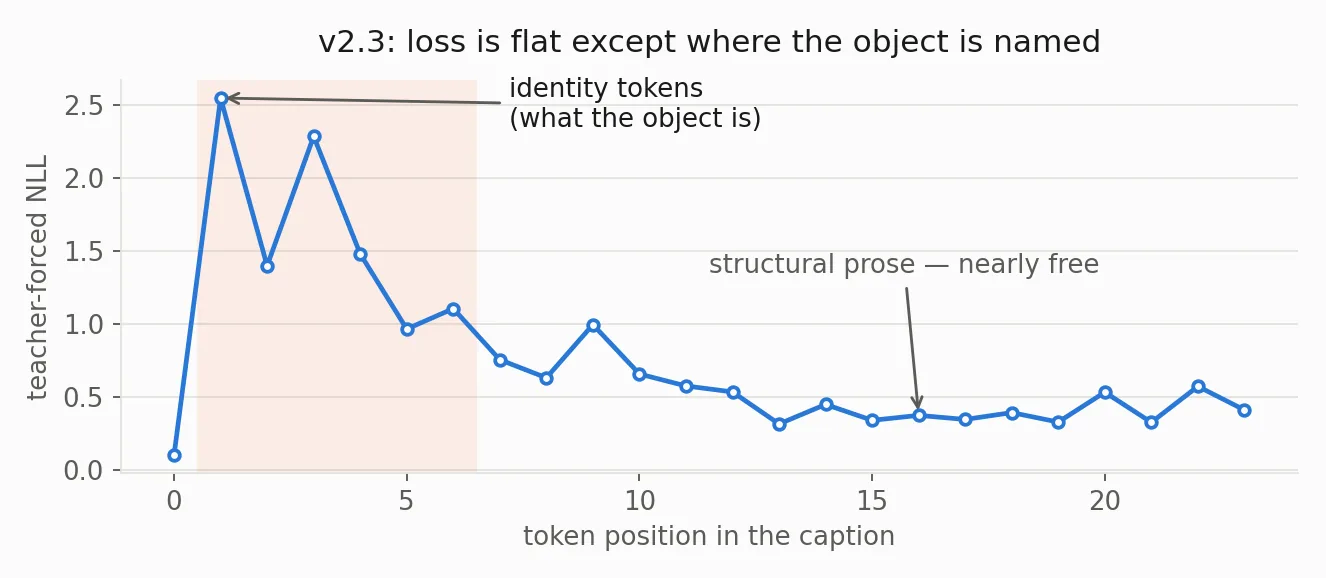
The first measurement refuted this: teacher-forced NLL on the first sentence was 0.839 vs 0.744 on the rest — a ratio of 1.13×, nothing. But that measurement repeated the very mistake it was testing: the recap's first sentence is ~20 words, of which identity is 2–3, so the average buried the signal. Per-token the picture is unambiguous.
Low loss on the prose is ambiguous — it could mean the codes make it easy, or that the model is reciting a language prior and never reads the codes at all. Those predict opposite fixes, so: re-run the same NLL with the code tokens destroyed (shuffled within family, and replaced by a single constant), keeping the prompt shape identical.
| v2.3 | intact | shuffled | constant |
|---|---|---|---|
| structural prose | 0.730 | 0.732 | 0.739 (+1.2%) |
| identity token (pos 1) | 2.587 | 2.644 | 3.475 (+34%) |
| identity token (pos 3) | 2.255 | 2.821 | 3.524 (+56%) |
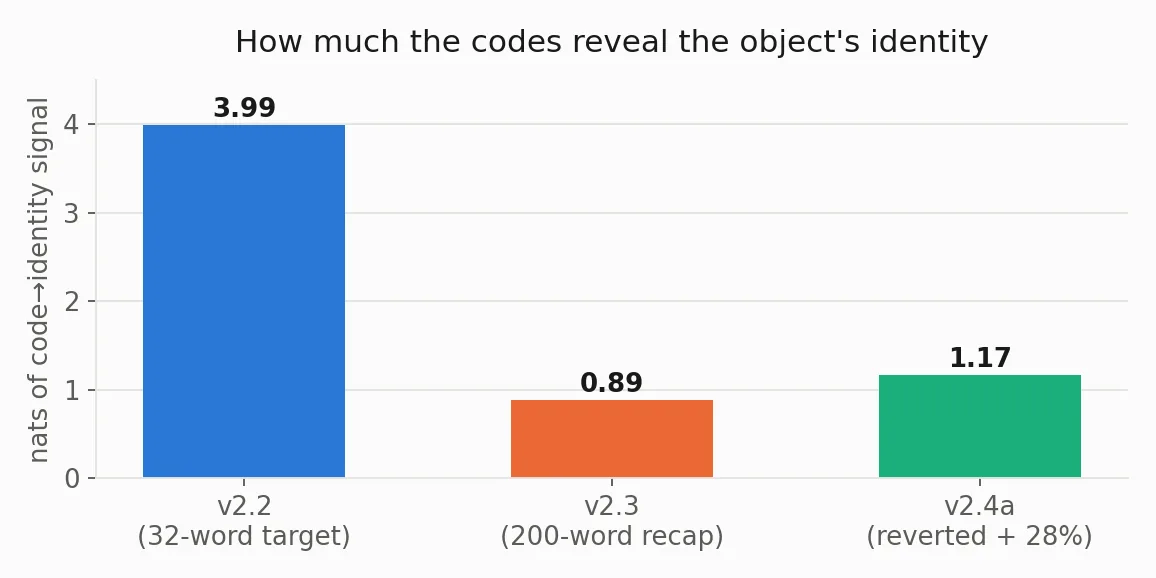
So the codes enter the caption almost entirely through the first few tokens. Expressed as
information, the whole 1536-code sequence buys
ln(32.3 / 13.3) = 0.89 nats on the identity decision. Running the identical probe on
v2.2 — its own checkpoint, its own 512-code cache, its own data — gives ln(145.9 / 2.7) =
3.99 nats.
The constant column is the tell. Without codes, v2.2 is at ppl 146 — it genuinely
cannot guess. v2.3 is at ppl 32 — it can. That difference is a property of the text, so it
is checkable on CPU with no model at all. Measuring the prior entropy of the opening two words over
1.67M captions:
| und target | H (nats) | eH | most common opening |
|---|---|---|---|
| v2.3 recap | 3.63 | 38 | "a stylized" ×672,917 (40%) |
| v2.2 short caption | 4.27 | 71 | "a stylized" ×309,630 (19%) |
| object noun first | 8.41 | 4,508 | "3d character" ×86,265 (5%) |
Mechanism: the recap was written as a structural description, so it opens with shape adjectives — "A stylized…", "A flat, elongated…". Two in five start with the same two words. A language prior therefore answers the one position where identity is decided, the code→identity pathway is never required to reduce loss, and it does not develop. Classic shortcut learning. At generation time the model commits to a wrong noun at position 1 and then elaborates coherently on that wrong commitment for 200 words — which is exactly why the output looks confidently insane rather than merely poor.
Two hypotheses died here and are worth recording. (a) The recap isn't diverse enough —
false: whole-caption vocabulary is 13,025 vs v2.2's 4,252 and boilerplate is 2.2% vs 3.1%. It is
more diverse overall and stereotyped only at the opening. (b) The und share collapsed —
true but secondary: 17.8% → 6.2%, because the export subsamples und with #320000 while
everything else grew 4×. Raw jsonl line counts say the share barely moved; they are not what
training sees.
Revert the und target to v2.2's 32-word caption, raise its share 6.2% → 28%, and continue-train
from checkpoint-9808 — 711,714 samples, 2 nodes, ~85 min. Acceptance was deliberately
not loss (the mixture changed, so loss is not comparable) but three behavioural checks.
| check | before | after | verdict |
|---|---|---|---|
| channel width | 0.89 nats | 1.17 nats | partial — v2.2 is 3.99 |
| identity, rifle | "anthropomorphic fox" | "futuristic sci-fi pistol" | category recovered |
| identity, F1 car | "cargo ship" | "futuristic hovercraft" | still wrong, now a vehicle |
| image→3D IoU (clean set) | 0.089 | 0.090 | no cost |
Real but incomplete, and the reason is visible in the same measurement: with codes destroyed the identity token still sits at ppl 32 rather than v2.2's 146. Three epochs of recap training baked in the "a stylized / sleek…" opening habit and one epoch of the corrected target does not erase it. Two different cars still produce verbatim identical und text — the readout is category-level, not instance-level. Closing the rest needs a longer or fresh run, not another recipe tweak.
Mid-investigation, a sanity check on the 22-asset held-out set: 19 of them are inside
v2.3's 1.67M pretrain pool. The seen/unseen column was computed
against v2.2's training list (856k) and silently stopped meaning anything when the pool
grew. Nothing errored. The numbers kept printing.
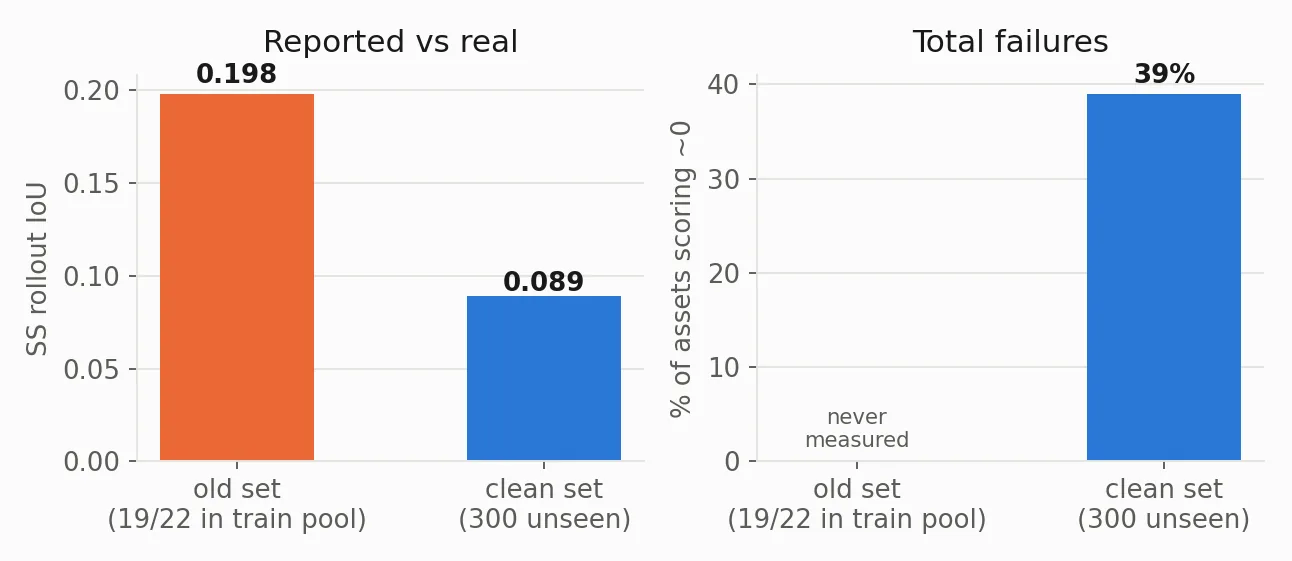
Fixed so it cannot recur: ROLLOUT_MANIFEST / ROLLOUT_TRAINSET
across the three eval scripts, a new 300-asset set at manifests/heldout_v23/ (drawn from
~200k pool-external assets, each with an SS latent, a good-band render and a caption ladder), and an
unconditional banner on every run:
[eval] 300 assets vs trainset pretrain_clean.jsonl (1,667,854)
[eval] !!! CONTAMINATED: 19/22 (86%) of the eval assets are IN the train set
— this measures fit, not generalisationWith a clean set the same question could finally be asked properly: does writing a 200-word description before emitting codes help generation? Answer, on 300 unseen assets, greedy:
| mean | median | total failures | paired t | |
|---|---|---|---|---|
| image→3D direct | 0.089 | 0.042 | 39% | +1.34 (n.s.) |
| image→3D CoT | 0.094 | 0.046 | 35% | |
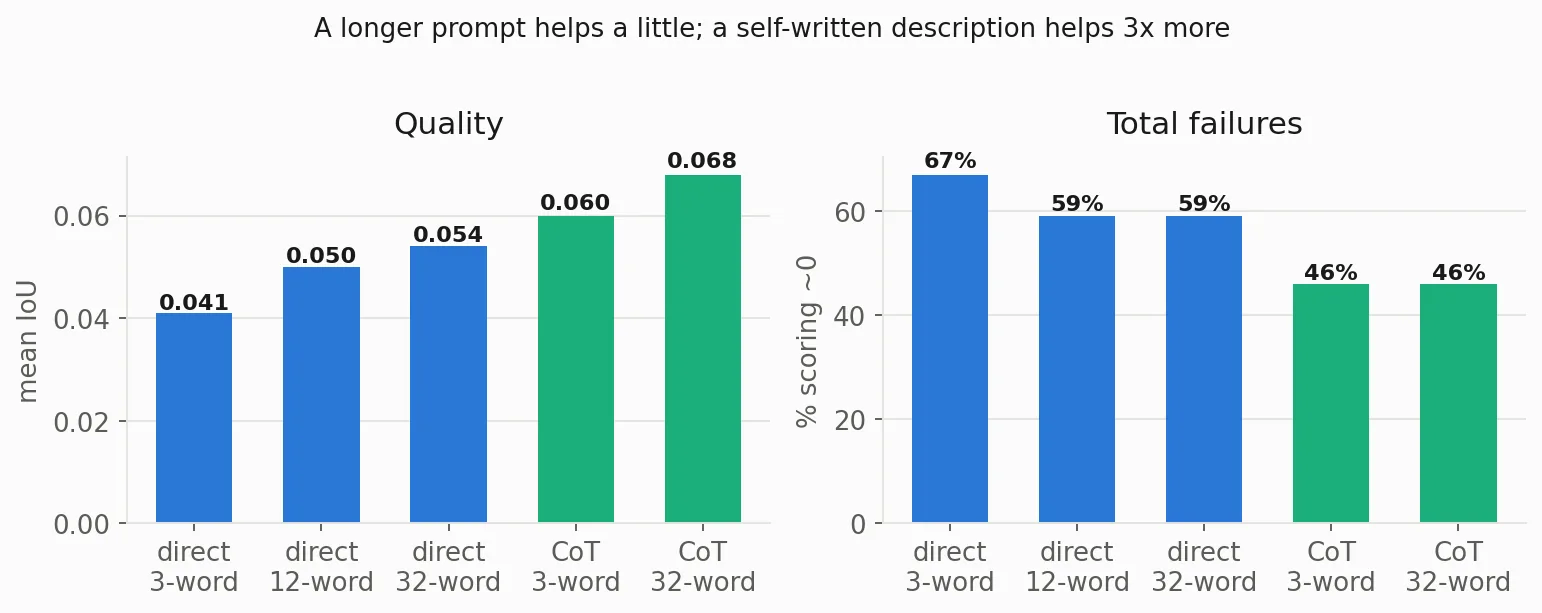
| text→3D direct | 0.041 | 0.000 | 67% | +5.30 |
| text→3D CoT | 0.060 | 0.015 | 46% |
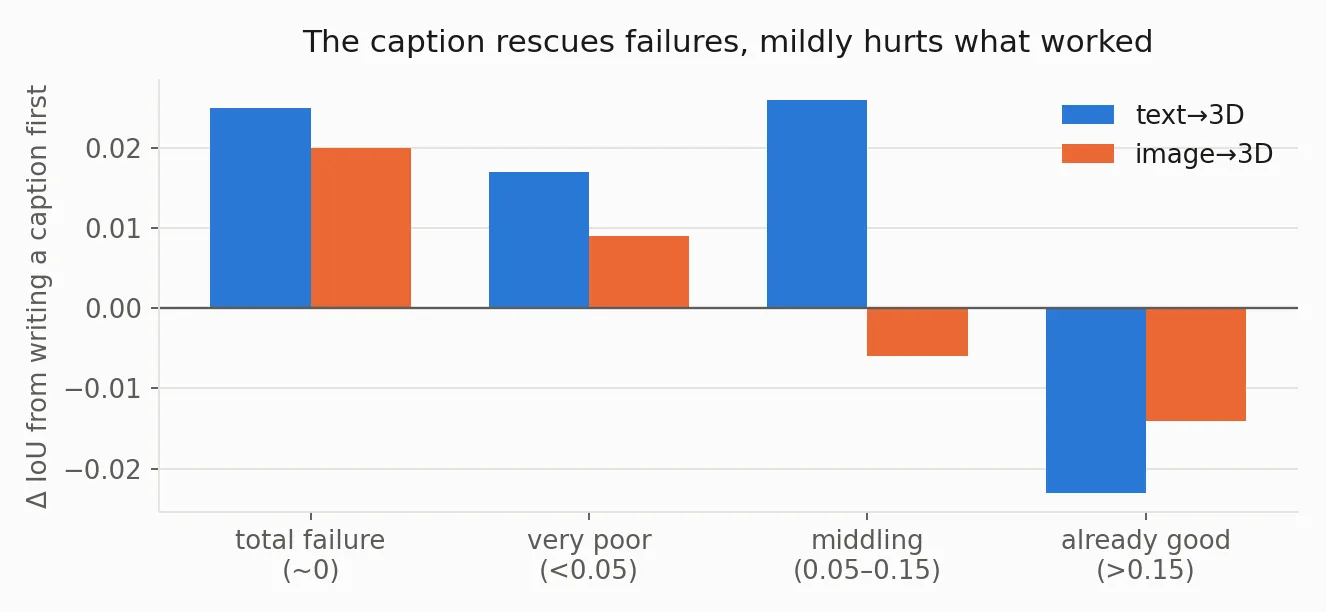
The band split is the mechanism. On assets the direct arm already handles, writing a caption
first hurts (−0.014 image, −0.023 text): the model already knows what it is making, and
200 words of self-generated prose only adds one more chance to commit to something slightly wrong.
On assets the direct arm fails outright, it is the whole difference between nothing and something.
Net benefit is therefore failure rate × rescue size — which is why text→3D (67% base
failure) wins decisively and image→3D (39%) comes out a wash.
Is it just that a 3-word prompt is too short? Partly, but that is not the mechanism.
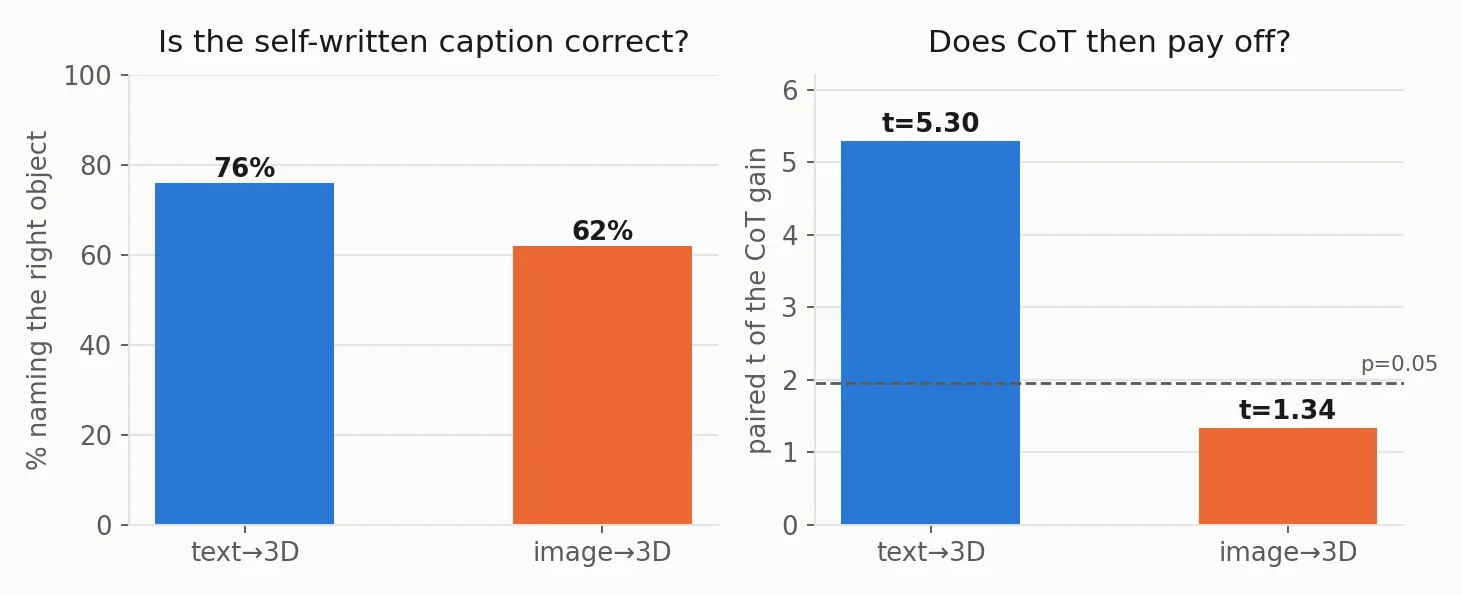
The CoT text the model writes is itself a generation, so it can be scored. Dumping it for all 300 assets and checking whether it names the ground-truth object:
| direction | names the right object | typical miss |
|---|---|---|
| text→3D | 76% | synonyms — vase → "ceramic amphora",
wooden cabin model → "single-story house" |
| image→3D | 62% | real misidentification — crystal geode
→ "human skull model", stackable crate system → "a human figure pushing a cargo cart" |
text→3D is handed the object in its prompt, so its caption is essentially clean signal and the rescue effect survives intact. image→3D has to infer identity from the render, gets it wrong in nearly two of five cases, and those cases inject a confidently wrong identity that the following 512 codes are then conditioned on. The rescue gains and the misidentification harms cancel — which is precisely the wash the paired test reports.
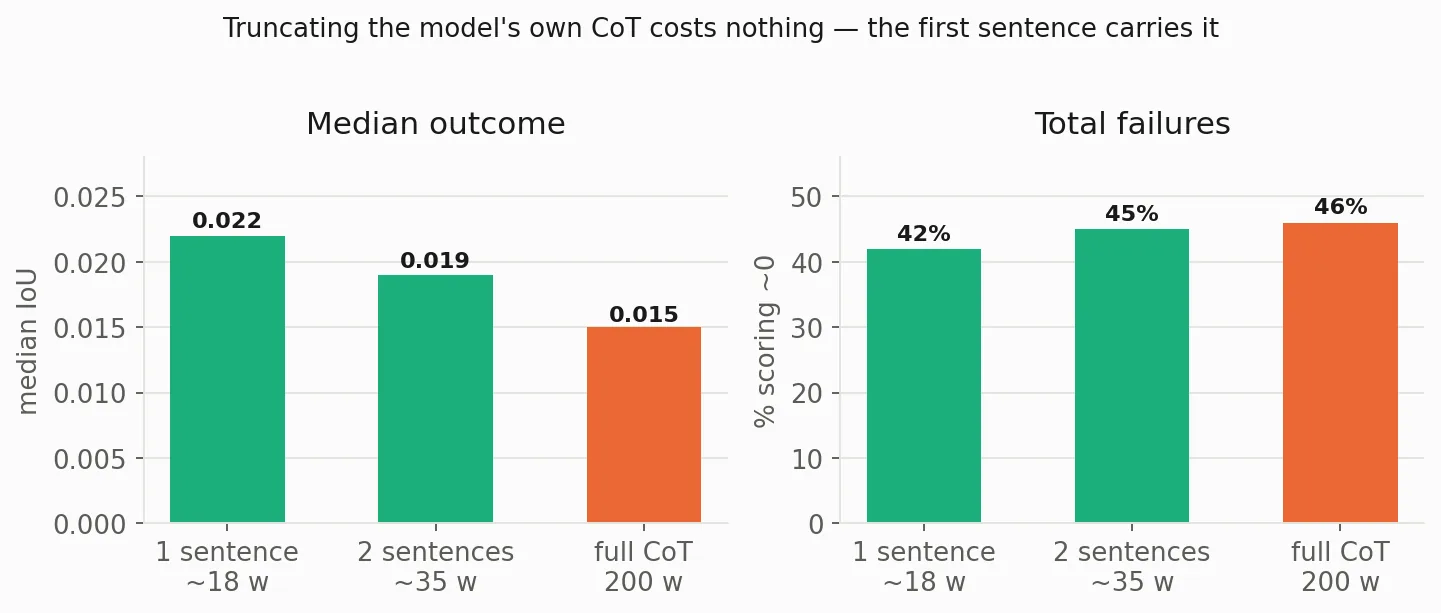
If the mechanism is "commit to a global shape before emitting codes", the commitment lives in the first sentence — what it is and roughly what proportions — and the remaining 180 words describe edges and finish, which the geometry codes do not encode. Testable without retraining: take the model's own CoT text, truncate it, force the code block to start, and generate.
| CoT prefix | mean | median | total failures |
|---|---|---|---|
| 1 sentence (~18 words) | 0.059 | 0.022 | 42% |
| 2 sentences (~35 words) | 0.062 | 0.019 | 45% |
| full CoT (200 words) | 0.063 | 0.015 | 46% |
Full vs one sentence: Δ +0.003, t = +0.80 — nothing, on n = 256 paired. The mean nudges up with length while the median and the failure rate move the other way, which is the signature of no real effect. One sentence is at least as good on the metric that matters most (does anything usable come out at all).
| arm | decision | evidence |
|---|---|---|
[3D Und] 3D→text | v2.2's 32-word caption; share 6.2% → 28% | channel 0.89 vs 3.99 nats |
| text→3D CoT | keep at 0.7, but shorten the target to ~1 sentence | Δ +0.020, t = +5.30; failures 67% → 46%. 200 w vs 18 w: Δ +0.003, t = 0.80 |
| image→3D CoT | 0.7 → 0.3, as a fallback path | Δ +0.005 (n.s.); +0.017 on hard cases |
| 200-word recap | still the und-free expansion source, but only its opening sentence is load-bearing for generation | see §6.3 |
[3D Und] is destroyed by it. Image→3D is indifferent — the
control that confirms the mechanism, since the image already supplies what the caption would.Four separate silent failures cost more wall-clock than the science did. All four share a shape: a default that was correct when written, expiring as the system around it grew.
| path | SS IoU (clean held-out) |
|---|---|
| v2.3 discrete-token rollout | 0.089 |
| SS tokenizer reconstruction ceiling | 0.197 |
| qwen-only flow conditioning | 0.256 |
| fusion conditioning | 0.403 |
The caption recipe is settled and the remaining headroom in it is small. The discrete-token path generalises to 45% of its own tokenizer's ceiling and sits 4.5× below the conditioning path that does not route geometry through tokens at all. The bottleneck named by the earlier grounding probe still stands: codes are arbitrary symbols to the LLM, cross-entropy penalises a geometric neighbour exactly as much as an unrelated code, and RoPE never writes position into the residual stream. That is where the next effort belongs — codebook-tied embeddings plus a geometric auxiliary loss, or letting the VLM emit conditioning only and leaving geometry to the flow — not in further data-recipe tuning.
[VQA] path identifies objects markedly better than the
[3D Gen … CoT] path does (62% object accuracy, §6.2), which is the whole reason
image→3D CoT nets out to a wash. Lift that number and the arm should move from neutral to positive
without any change to the architecture.manifests/heldout_v23/ and read the [eval] contamination banner before
believing any number. Two of the conclusions in this note were wrong until that was fixed.