how v12 was trained, and where it stands vs TRELLIS.2 / TRELLIS-text / TIGON · 2026-09-15
trainingbenchmarkimage-to-3Dtext-to-3Dv12
TL;DR
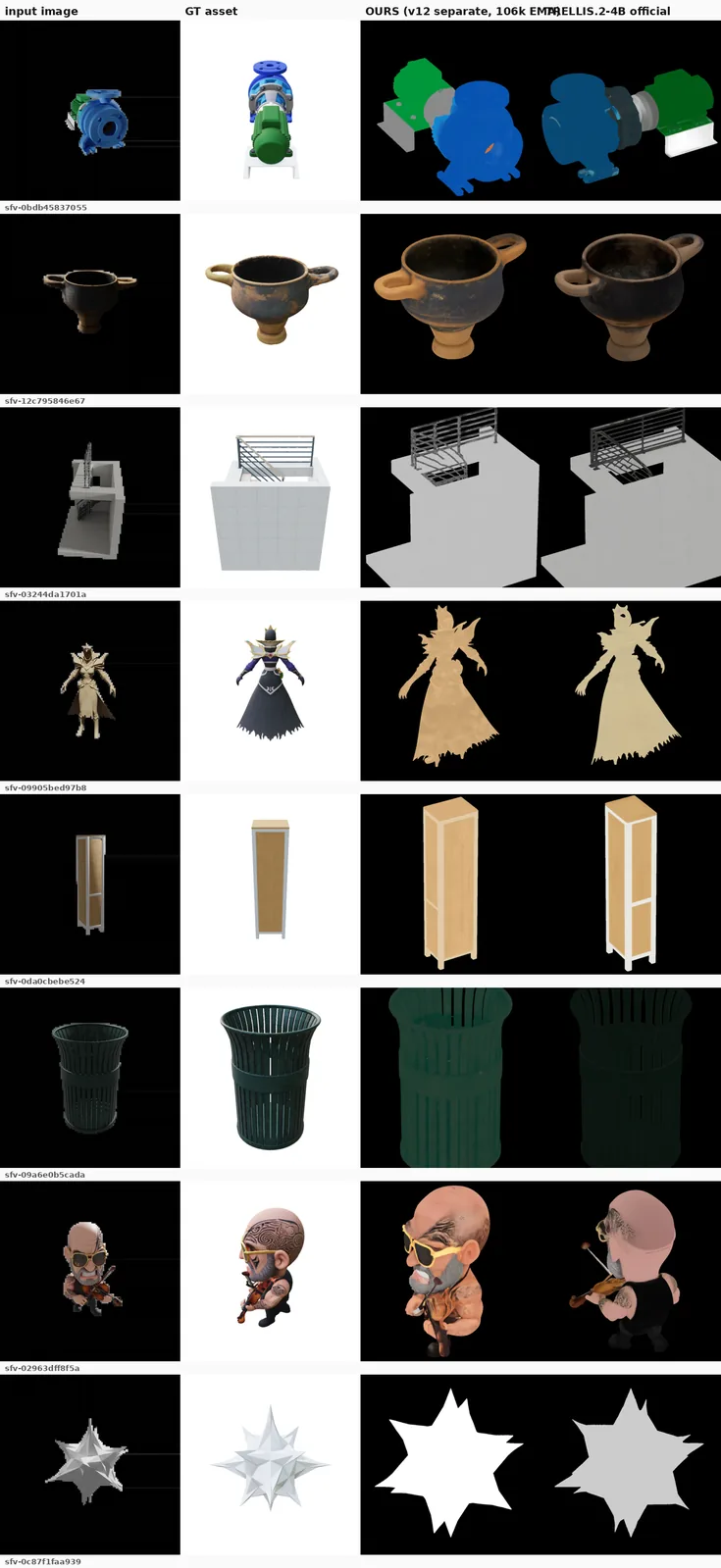
Image-to-3D: on par with TRELLIS.2-4B end-to-end and on geometry; materials clearly better (LPIPS −18%, PSNR +5 dB, wins 64–74% of cases).
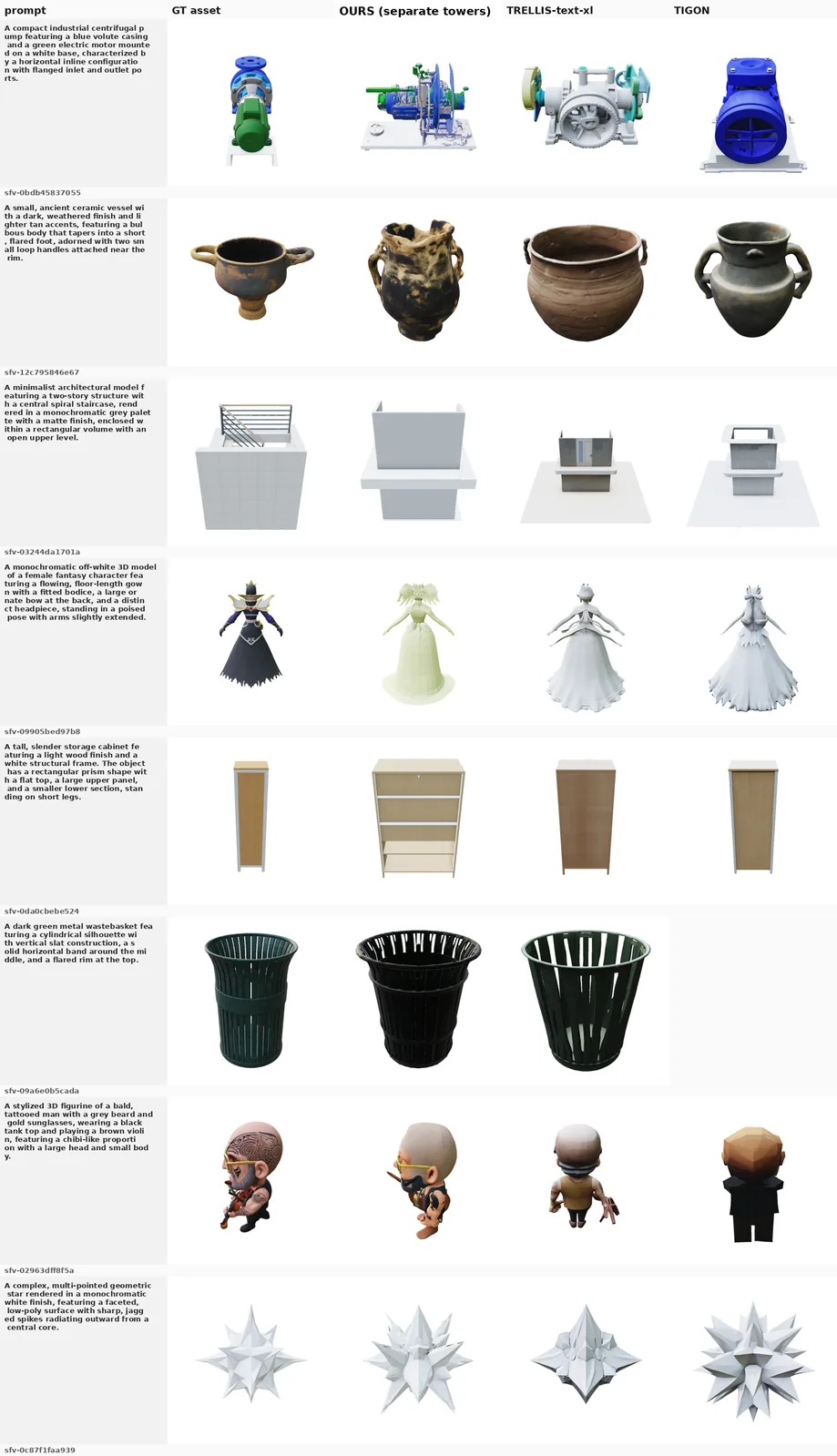
Text-to-3D: ~0.9 CLIP-T behind TRELLIS-text / TIGON. Cause: the SS tower barely reads text (sensitivity 1.28 vs 2.1 for images). Not a sampler issue, not a pipeline issue.
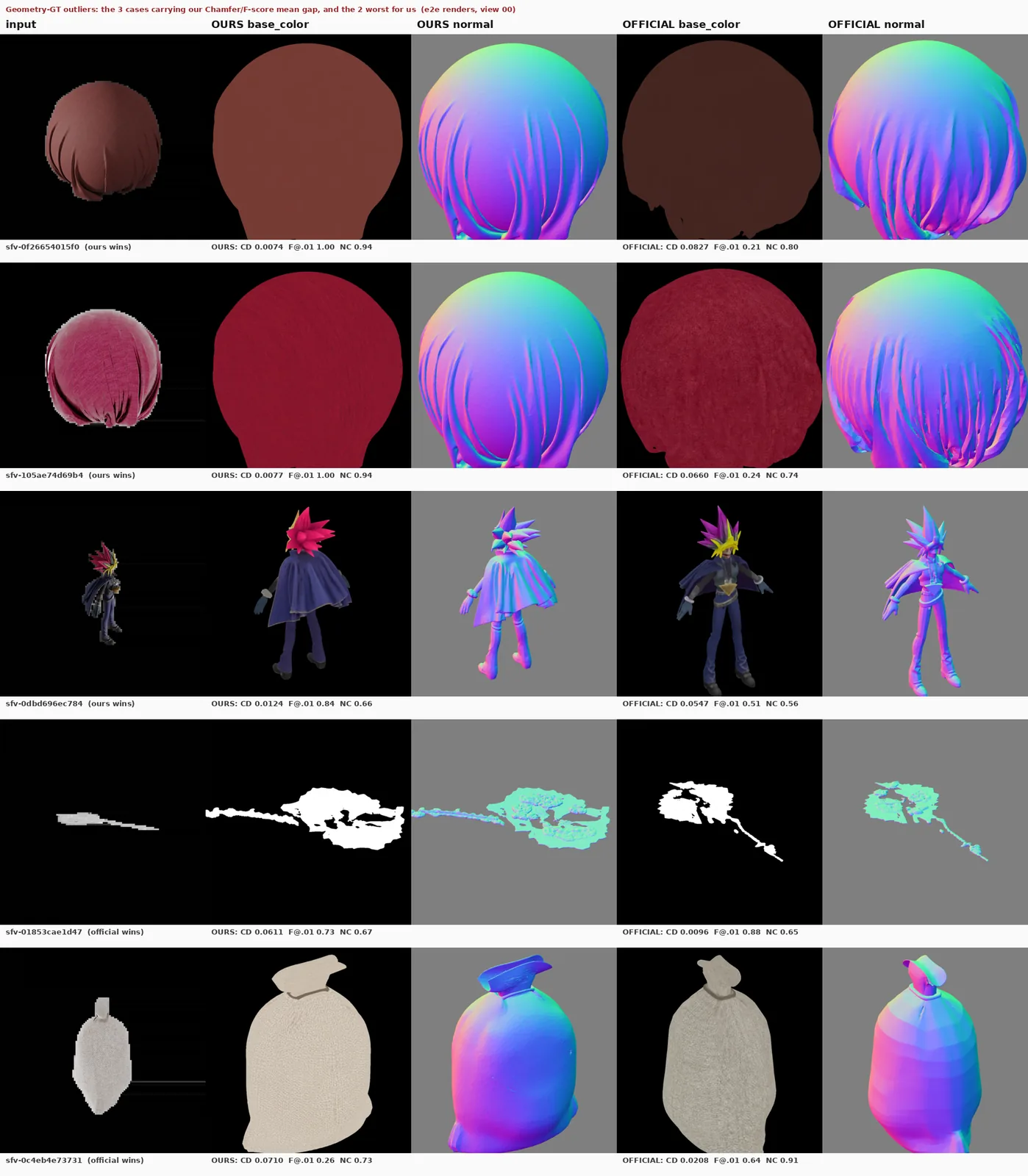
8 of the 50 eval meshes exist verbatim in the training pool under other ids (one mesh 2,163×). Geometry numbers exclude them; eval split needs a geometry-hash rebuild.
1 · Stages
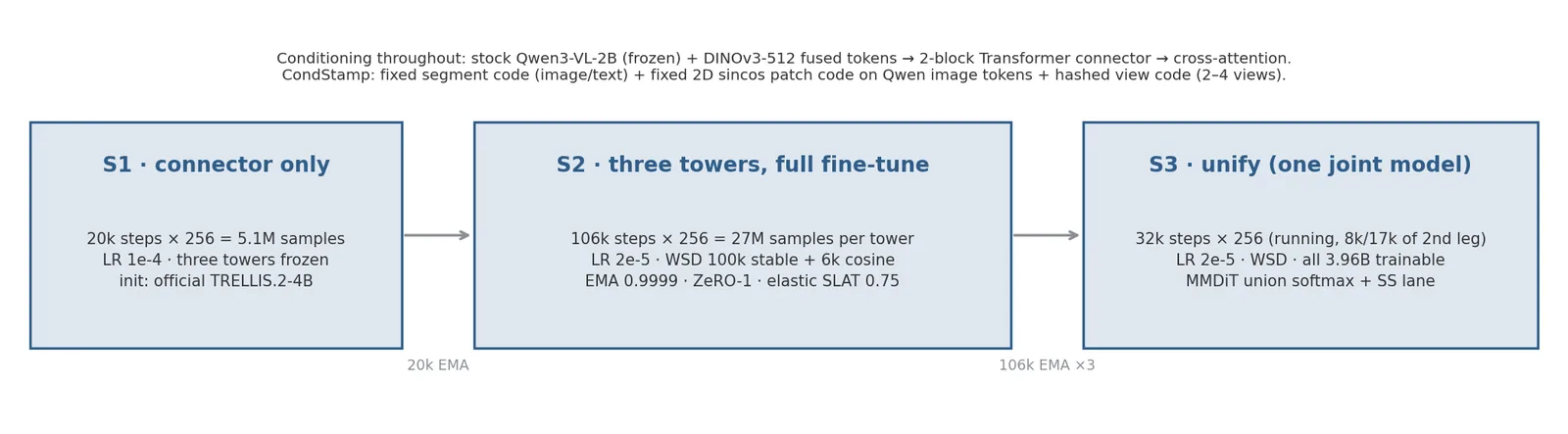
S1 = train the connector only. S2 = unfreeze the three towers. S3 = merge the three towers into one joint model (running).
Condition: stock Qwen3-VL-2B (frozen) + DINOv3, fused tokens → cross-attention. Same in every stage.
S1 20k → S2 106k per tower → S3 32k. Effective batch 256 everywhere; WSD schedule; EMA 0.9999.
2 · Data
1.47M real assets (TexVerse, Sketchfab, ObjaverseXL, HSSD, ABO, Toys4k, SWH) + 0.48M synthetic (text→image→3D). Eval assets removed by sha.
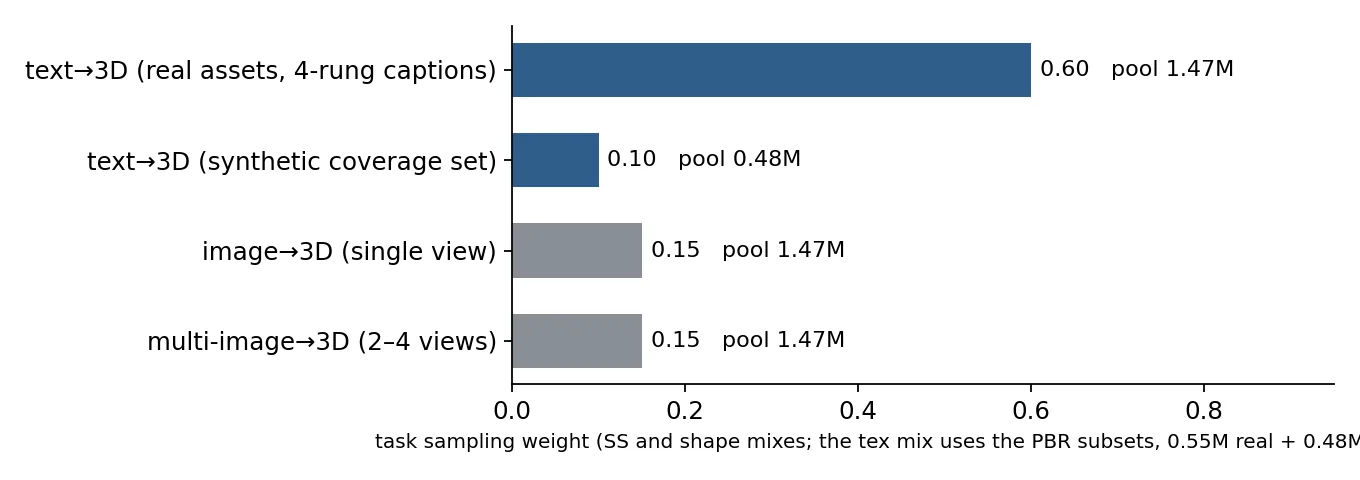
27M samples per tower in S2 (106k steps × 256). Text tasks get 70% of batches.
Per-batch task mix. The tex tower uses only assets that have PBR latents (0.55M + 0.48M).
3 · ROAD
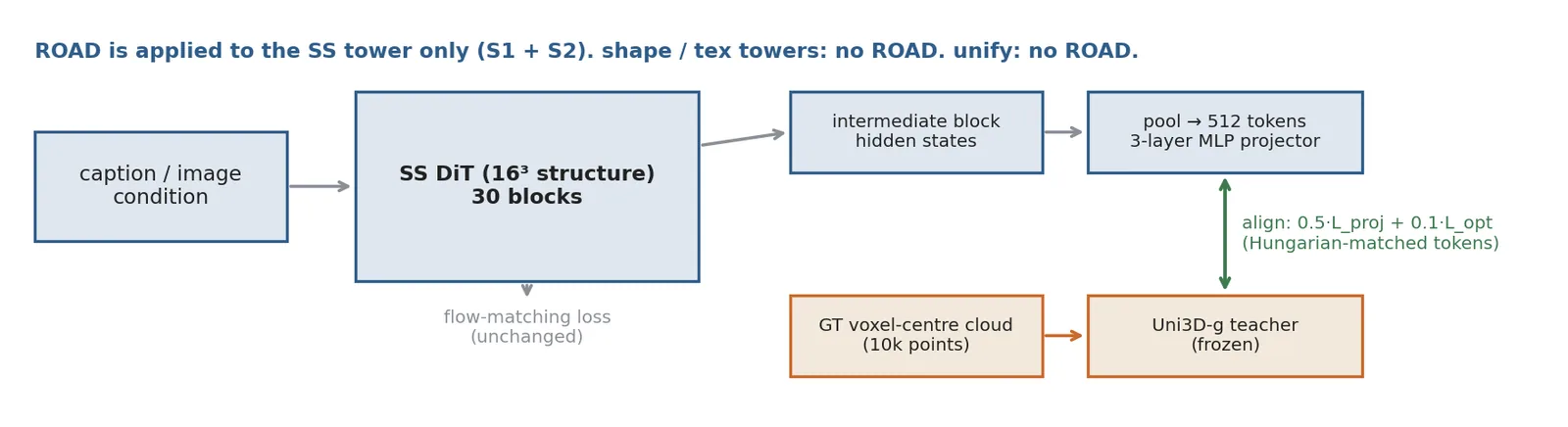
Only on the SS tower. Aligns SS hidden tokens to a frozen Uni3D-g teacher on the GT point cloud (ROAD, arXiv 2607.28581, vendored verbatim).
Loss = flow matching + 0.5·L_proj + 0.1·L_opt. shape / tex / unify: no ROAD.
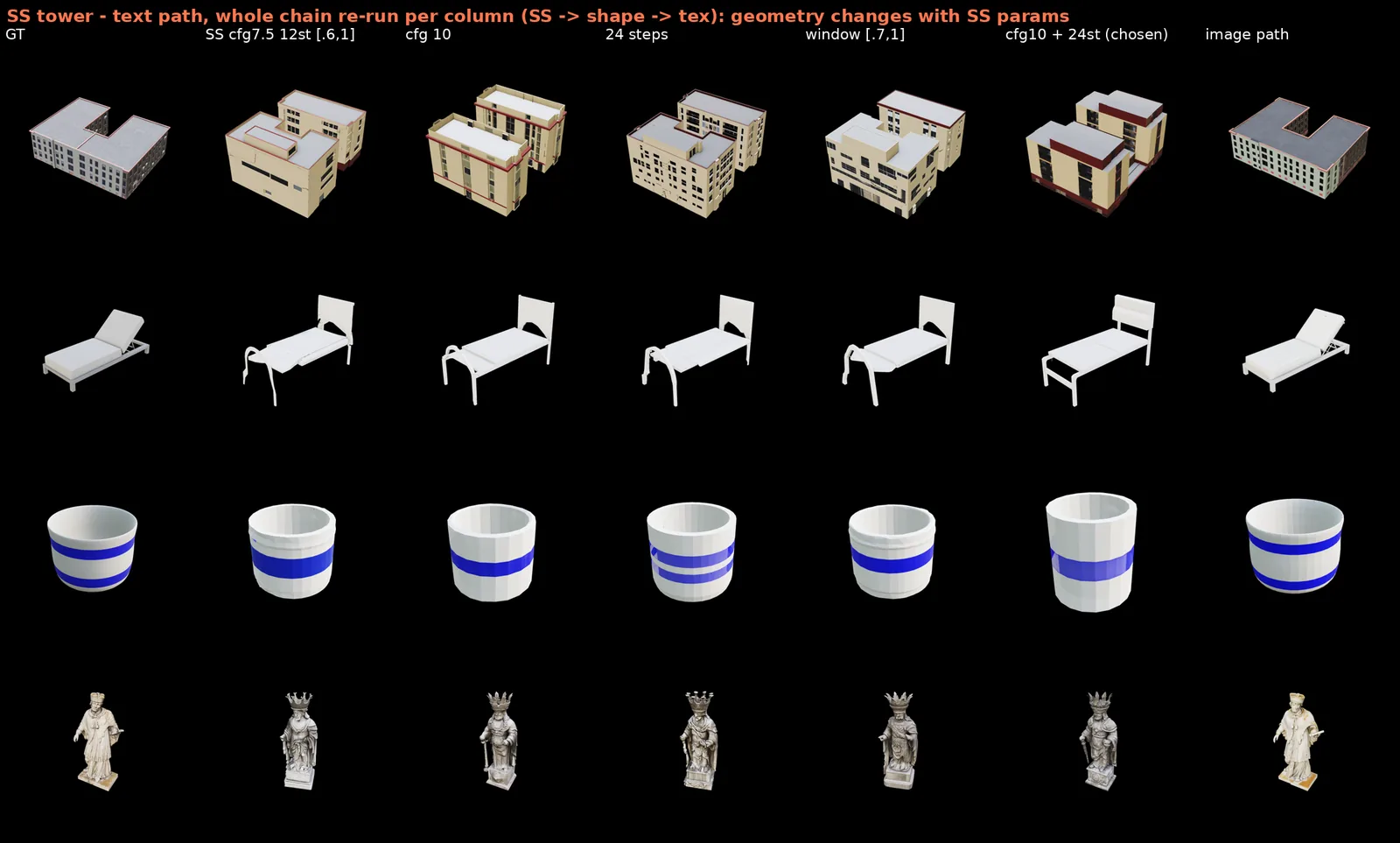
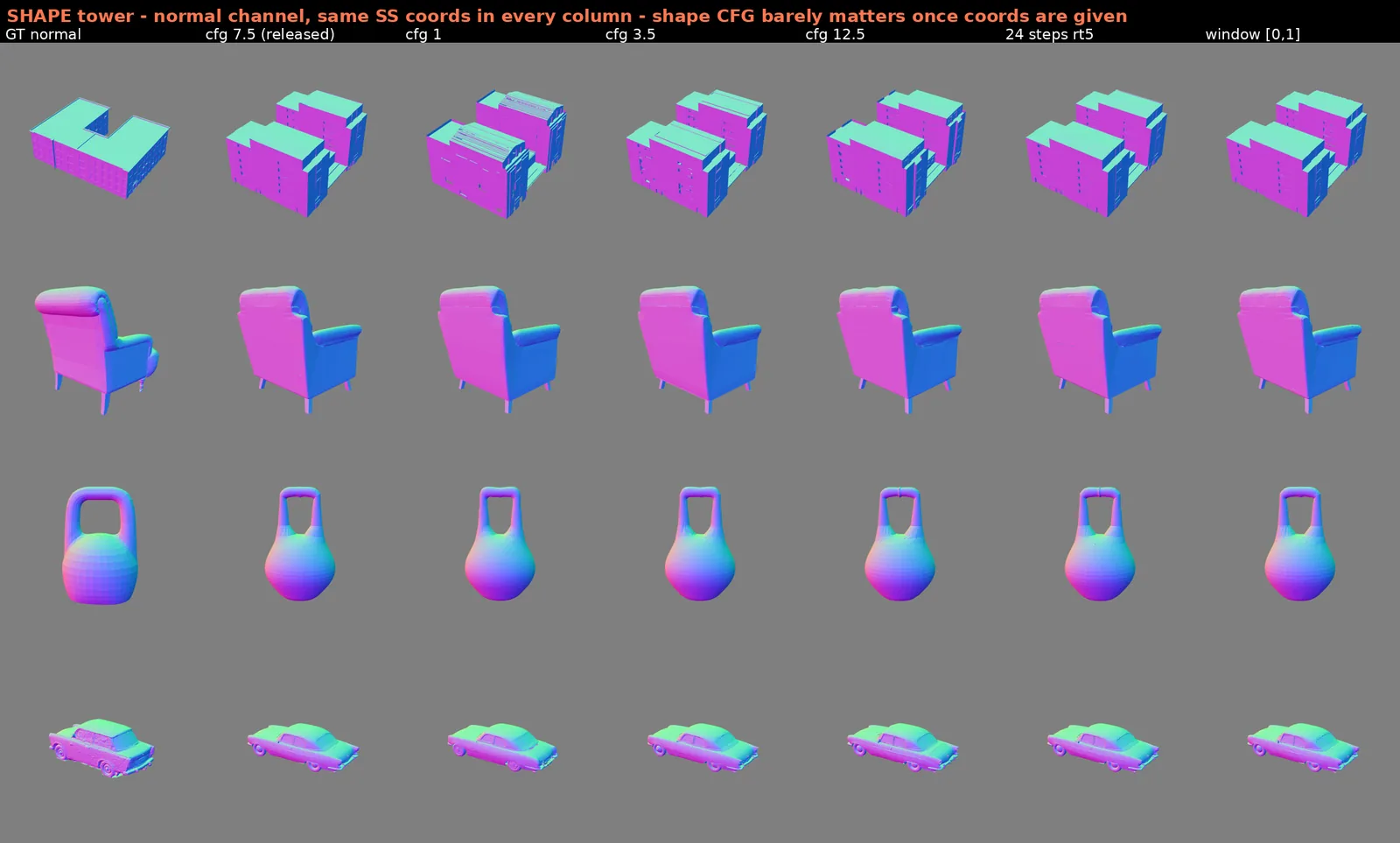
4 · CFG sweeps (per tower, text path, 8 pinned assets, picked by eye)
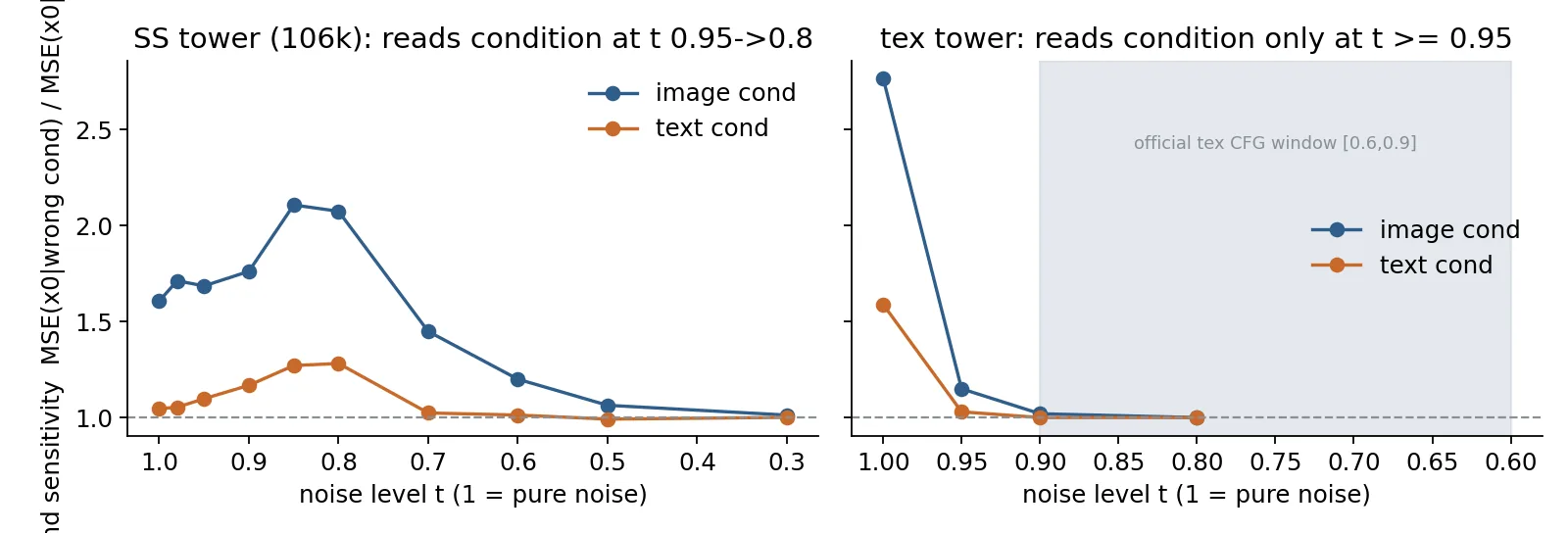
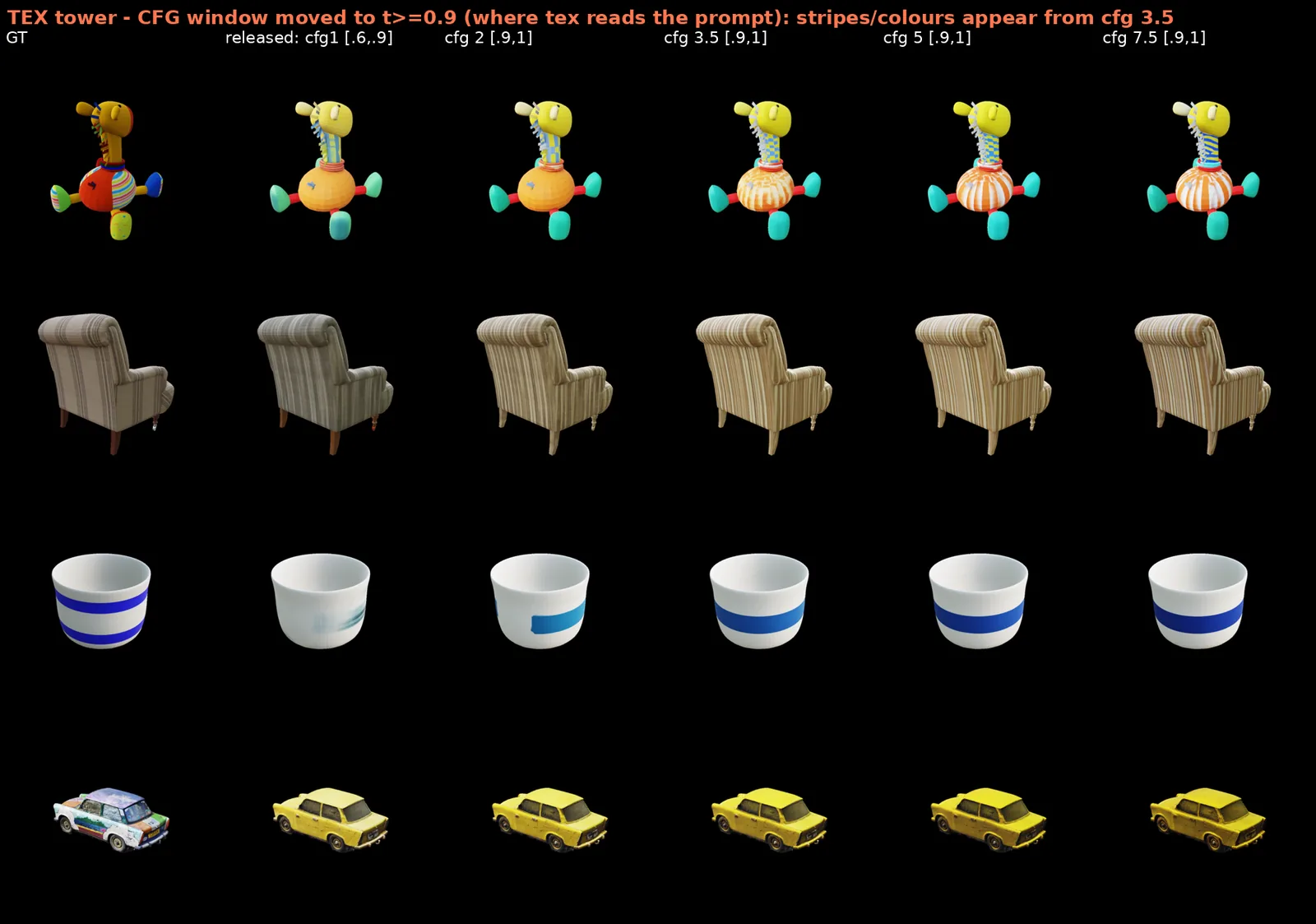
Probe first (fig. a): a wrong-vs-right condition test shows when each tower reads its condition. tex only at t ≥ 0.95 → the official tex window [0.6, 0.9] never applies text CFG.
Then sweep each tower alone with the other two fixed (figs. b–d).
tower
image path
text path
SS
24 steps · cfg 10 · rescale 0.7 · [0.6, 1] · rt 5
same
shape
official: 12 · 7.5 · 0.5 · [0.6, 1] · rt 3
same
tex
official: 12 · cfg 1.0 (off) · [0.6, 0.9] · rt 3
24 · 7.5 · 0.5 · [0.9, 1] · rt 5
(a) Condition-sensitivity probe. SS reads at t 0.95→0.8 (text ~4× weaker than image); tex reads only at t ≥ 0.95, outside the official window (shaded).(b) tex tower, GT geometry locked. Released setting (cfg 1, [0.6,0.9]) loses the prompt's stripes/colours; window [0.9,1] + cfg ≥ 3.5 brings them back; cfg 7.5 rs 0.5 chosen.(c) SS tower, whole chain re-run per column. cfg and step count change the structure itself (building, bed, mug); cfg 10 + 24 steps chosen. Text path stays worse than the image path on the same asset.(d) shape tower, same SS coords in every column, normal channel. cfg 1 → 12.5 and window changes barely move the surface → kept the official setting.
5 · WilD3D benchmark scores
Held-out Sketchfab assets, same image / prompt / camera / seed for every model. TRELLIS.2-4B at the 512 pipeline. Image path n=42 (8 cases whose exact mesh exists in the training pool removed). Bold = better; * = paired t-test p < 0.05.
Image-to-3D
scorecard
metric
TRELLIS.2-4B
ours (separate towers)
E2E
CLIP ↑
0.867
0.866
E2E
ULIP-I ↑
0.454
0.454
E2E
Uni3D-I ↑
0.395
0.389
Geometry-GT
Chamfer ↓
0.0409
0.0393
Geometry-GT
F@0.01 ↑
0.547
0.568
Geometry-GT
F@0.02 ↑
0.727
0.746
Geometry-GT
Normal cons. ↑
0.675
0.694*
Texture-GT (on GT geometry)
LPIPS ↓
0.189
0.155*
Texture-GT (on GT geometry)
PSNR ↑
17.3
22.4*
Texture-GT (on GT geometry)
SSIM ↑
0.606
0.664*
Texture-GT (on GT geometry)
CLIP-I ↑
0.951
0.962*
Texture-GT set-level
FID ↓
123
100
Texture-GT set-level
CMMD ↓
0.045
0.024
Text-to-3D
model (n=50, same prompts)
CLIP-T ×100 ↑
ULIP-T ↑
Uni3D-T ↑
Hungarian-CLIP ↑
KD-DINOv2 ×100 ↓
FD-point ↓
GT asset (ceiling)
26.45
0.168
0.271
—
—
—
TRELLIS-text-xl
27.85
0.183
0.292
84.8
29.1
45.9
TIGON
27.74
0.185
0.287
84.5
24.8
43.8
ours (separate towers)
26.98
0.166
0.283
86.0
16.5
38.6
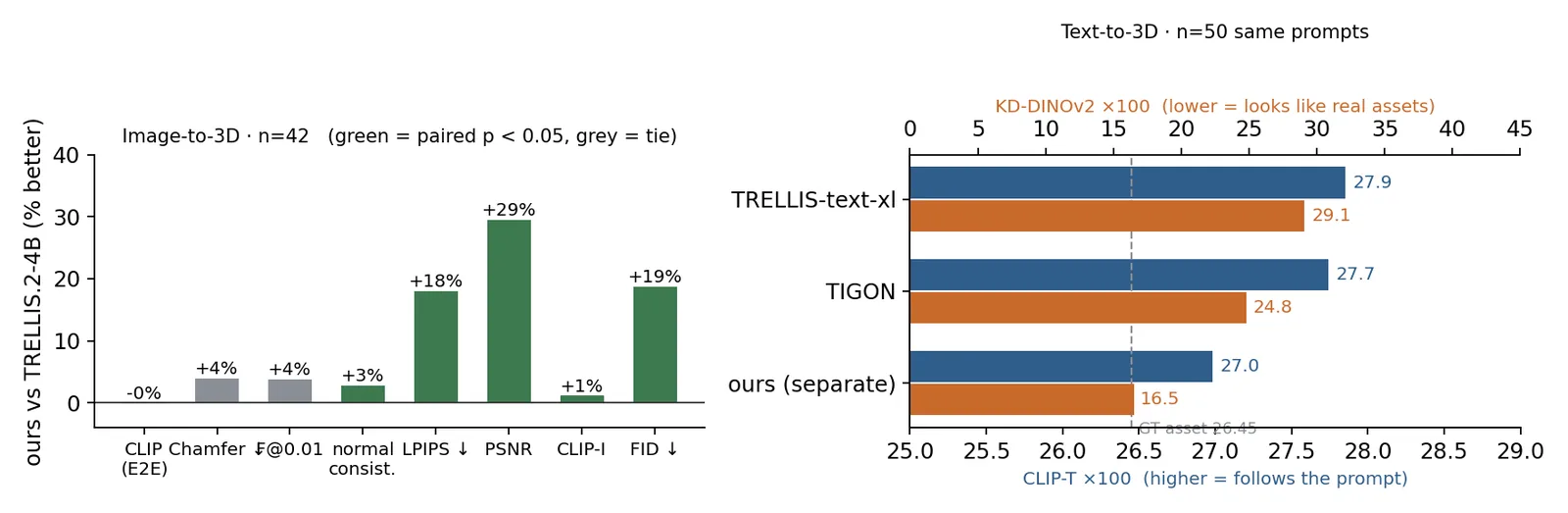
Image: E2E and geometry tie, normals smoother, materials clearly better. Text: baselines follow the prompt better (~0.9 CLIP-T); ours looks more like real assets. Bottleneck is SS text conditioning.
Caveats: single seed; official 512 only; Texture-GT is measured on this dataset's own GT materials.
Left: ours vs TRELLIS.2-4B per metric (% better, n=42). Right: text-to-3D, prompt alignment (blue) vs resemblance to real assets (orange).Image-to-3D examples: input | GT | ours | TRELLIS.2-4B.Text-to-3D examples, same assets: prompt | GT | ours | TRELLIS-text | TIGON. Pump, vessel, building: our structure falls apart; the rest are on par.The duplicate-mesh trap: rows 1–2 are one recoloured mesh present 2,163× in training — memorised (F@0.01 = 1.00), not generated. Excluded from the numbers.
6 · Unified model (S3): three inference modes
One model, all three towers merged (MMDiT union attention + SS lane), initialised from the S2 finals, 32k steps × 256, WSD. Evaluated at the final EMA.
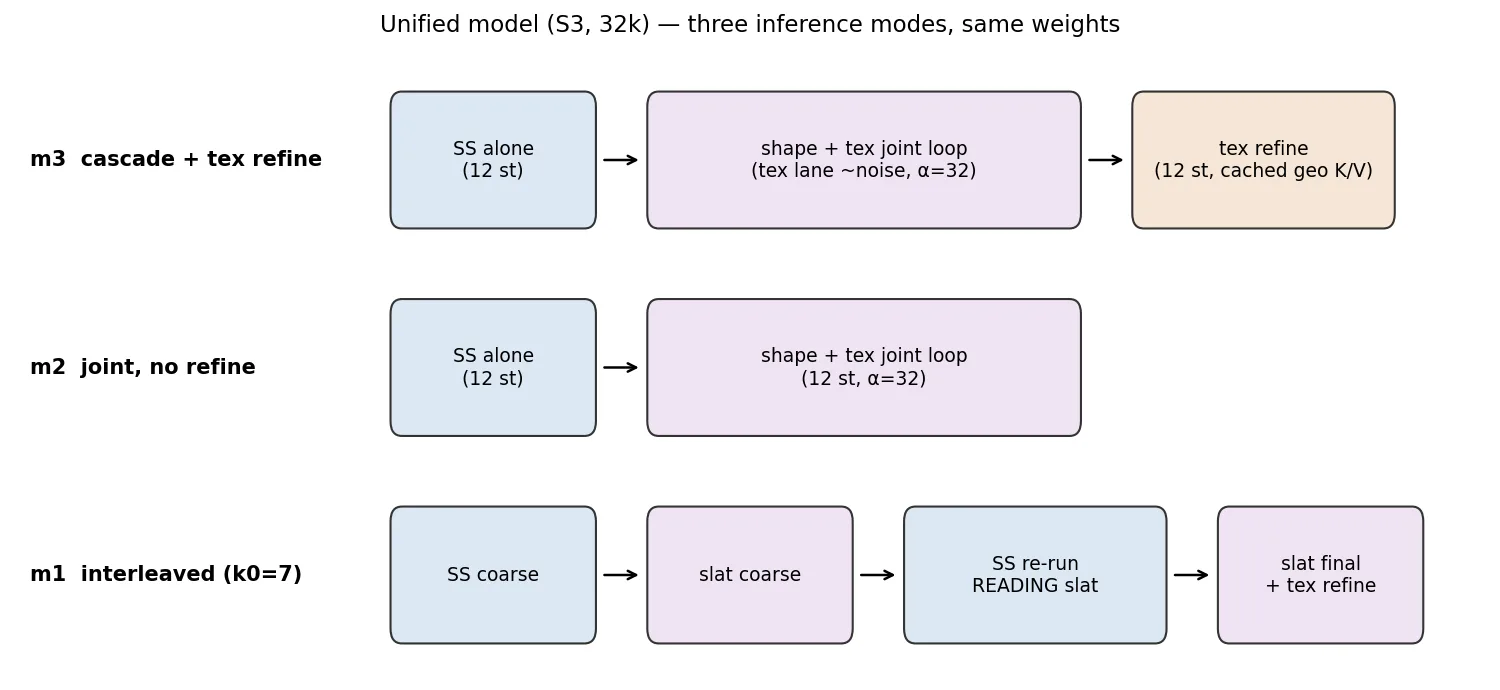
Same weights, three ways to sample; sampler settings copied from the separate towers (not re-calibrated). Texture-GT is identical across modes by construction.
Correction (2026-09-24): the first version of this section was measured with the non-fused attention path, while S3 trained with the fused one. All numbers below are re-measured with the fused path; the conclusion did not change (Chamfer 0.0448 → 0.0435, text CLIP-T within ±0.25).
m3 = SS → joint loop → tex refine (the benchmark default); m2 = no refine; m1 = SS re-reads the slat — the only mode that uses the SS←slat path.
Image-to-3D
metric (n=42)
TRELLIS.2-4B
separate 106k
unify refine
unify joint
unify interleave
E2E CLIP (n=50)
0.867
0.866
0.864
0.861
0.863
Chamfer ↓
0.0409
0.0393
0.0435
0.0435
0.0432
F@0.01 ↑
0.547
0.568
0.572
0.572
0.577
Normal cons. ↑
0.675
0.694
0.693
0.693
0.694
LPIPS ↓ / PSNR ↑
0.189 / 17.3
0.155 / 22.4
0.164 / 22.4
= refine
= refine
FID ↓
123
100
106
106
106
Text-to-3D
model (n=50)
CLIP-T ×100 ↑
ULIP-T ↑
Hungarian-CLIP ↑
KD-DINOv2 ×100 ↓
FD-point ↓
TRELLIS-text-xl
27.85
0.183
84.8
29.1
45.9
TIGON
27.74
0.185
84.5
24.8
43.8
separate 106k
26.98
0.166
86.0
16.5
38.6
unify refine
26.67
0.173
85.7
28.0
34.3
unify joint
26.75
0.173
85.6
28.2
34.9
unify interleave
26.86
0.170
85.6
32.7
34.8
All three modes ≈ separate towers (every paired p > 0.1); differences between modes are within noise.
interleave (SS re-reads the slat) is closest to separate on CLIP-T but worst on KD-DINOv2. All unify modes: KD-DINOv2 worse, FD-point better.
Speed (one H200, generation only): separate ≈ 4.9 s; unify refine 7.7 s, joint 6.7 s, interleave 17.3 s; caching the SS lane's K/V (exact, bit-identical output) cuts refine to 6.5 s and joint to 5.4 s.
Why no gain: with α=32 the tex lane stays at noise until the last step and SS runs alone first — in practice this is a cascade on unified weights, not joint generation.
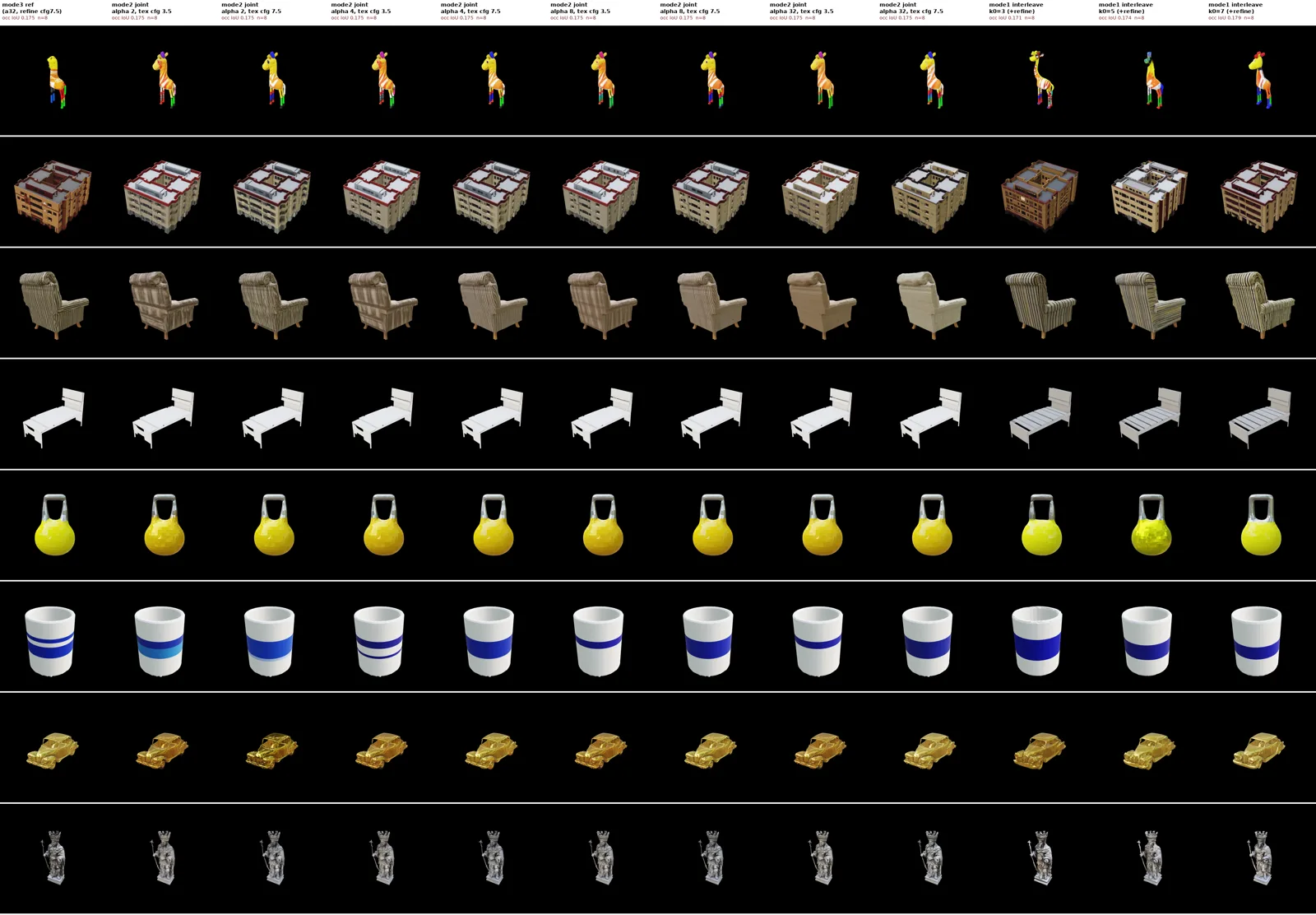
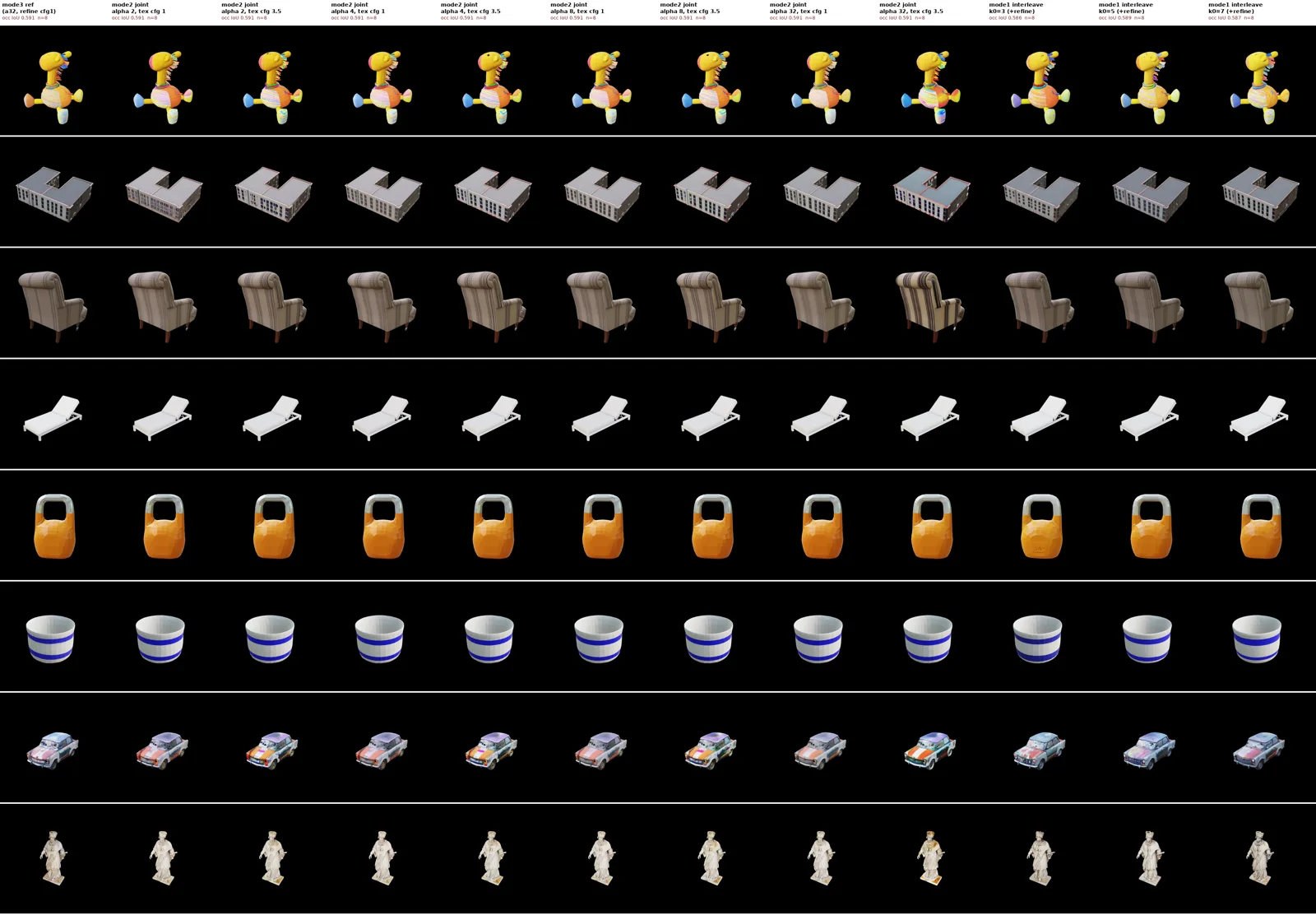
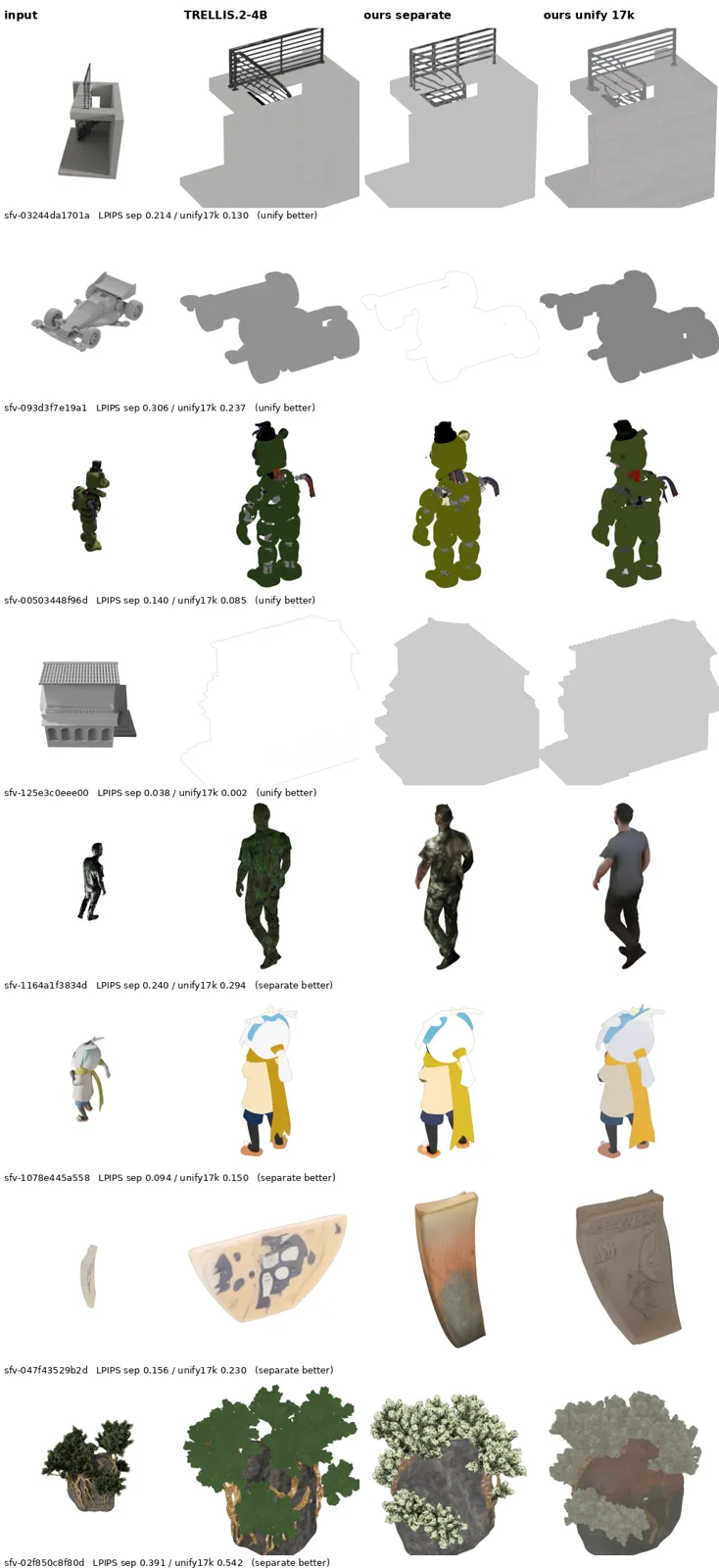
Text path, 8 pinned assets: m3 reference | m2 with α ∈ {2,4,8,32} × joint tex cfg | m1 with k0 ∈ {3,5,7}. α and tex cfg barely change the output; k0 changes structure.Same sweep, image path.Image path: input | TRELLIS.2 | separate | unify m3 — the 4 cases where unify's LPIPS beats separate most, then the 4 where it loses most.
7 · Next
Rebuild the eval split with geometry-hash dedup; dedup the training pool (14.9% duplicates in SketchfabV1).
Fix SS text conditioning (text-focused SS training / dedicated text SS / text→image→3D) — decision pending.
Unify: make inference truly joint (small α, no refine, cached SS K/V) and time it against the cascade.
v12 S2 finals = shape / tex / SS 106k EMA · results: eval_suite results sfv50_sep106k, text_sfv50_v12