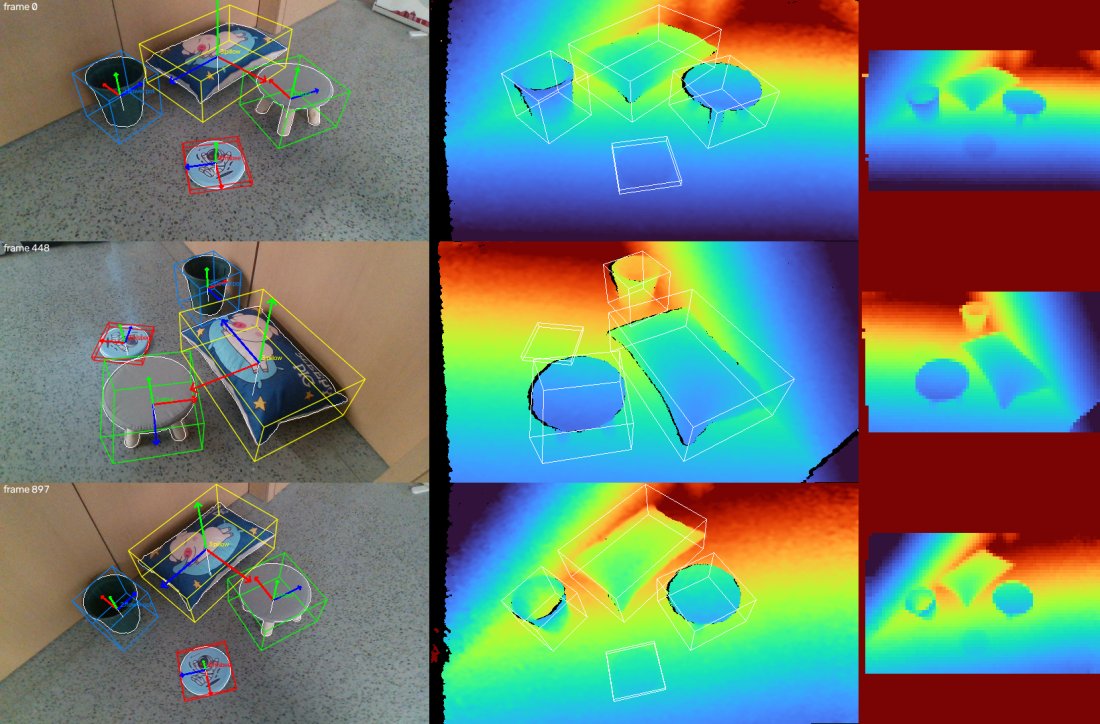
HOT3D (Aria glasses), not used in training. Three objects prompted with 2D boxes on the first frame; boxes are metric, in camera coordinates.
Score: 3D AUC. On each frame where the object is present (≈2 FPS), success at threshold τ if the model says “present” and its 3D box has 3D IoU ≥ τ with the ground truth; τ = 0.05, 0.10, …, 0.50. Averaged over τ, frames, objects, then benchmarks.
1 · Task
More examples from the demo
HOI4D held-out video
Wild6D not used in training
HOT3D not used in training
DynOPETs not used in training
Output of the Gradio demo with the current checkpoint: RGB only, no depth input; prompt = the first-frame 2D box of each object.
2 · Model
What does the model look like?
SAM3.1 tracks the object in 2D. Depth comes from LingBot-Depth (WildDet3D's depth branch) and only enters the 3D part.
Training: stage 1 on 14 image datasets (WildDet3D data + SA-V frames, 1.04M samples), stage 2 on video clips (8 frames at 2 FPS), 4 epochs.
2 · Results
3D tracking on held-out videos of 10 datasets
3D AUC (×100)
SA-V*
HOI4D
ADT
Objectron
ARKit
CA-1M
EmbScan
SAIL-VOS
nuScenes
Waymo
Mean
SAM3.1 + WildDet3D per frame, RGB
15.9
24.9
1.3
69.8
31.2
10.0
14.9
5.7
22.1
19.1
21.5
SAM3.1 + WildDet3D per frame, RGB-D
17.3
40.2
5.4
66.9
33.7
12.2
17.1
16.2
11.5
14.4
23.5
WildTrack3D
61.7
91.0
23.2
64.8
56.3
32.2
45.0
43.5
39.0
31.8
48.9
WildDet3D with ground-truth 2D boxes, RGB-D
20.6
40.0
9.2
73.4
53.7
24.7
35.5
18.9
30.9
24.4
33.1
Mean 3D AUC 48.9 vs 23.5 for SAM3.1 + WildDet3D per frame with the same depth input.
Above WildDet3D with ground-truth 2D boxes (33.1) on 9 of 10 datasets: per-frame lifting is the limit, not 2D tracking.
Objectron is the exception (baseline 69.8 vs 64.8); Objectron images are in WildDet3D's training data.
Same videos for every row (quick evaluation set). *SA-V boxes are pseudo-labels. Kubric MOVi left out (object sizes are not metric).
Checkpoint: s2_alldata epoch 4. Its video data also included DexYCB, HO3D, YCB-V and HO-Cap, which we later kept for 6D zero-shot evaluation; none of them is among these 10 datasets.
2 · Results
WildTrack3D on held-out videos
ADT egocentric
SA-V in the wild
EmbodiedScan indoor
ARKitScenes indoor
WildTrack3Dground truth hidden · press G (or the GT button) to show itmedian video of each dataset · header: 3D IoU
2 · Results
WildTrack3D on held-out videos
HOI4D hand–object
Waymo driving
CA-1M indoor
nuScenes driving
SAIL-VOS 3D synthetic
Objectron objects
WildTrack3Dground truth hidden · press G (or the GT button) to show itmedian video of each dataset · header: 3D IoU
3 · Data
What data is the model trained on?
Training videos per dataset.
in-the-wild video, our 3D pseudo-labels
robot teleoperation, our 3D object tracks
synthetic, rendered by us
public datasets with 3D annotations
Three sources we built: SA-V with 3D pseudo-labels, DROID with 3D object tracks, and Kubric-5D.
Nine public datasets with annotated 3D boxes cover driving, indoor scans, hand–object and egocentric video.
Kubric-5D finished rendering on Oct 26 and is not in the current checkpoint; nuScenes was added after it as well.
Videos used by any benchmark are removed from training.
3 · Data · in the wild
SA-V: 3D pseudo-labels for everyday video
SA-V training videos with their 3D pseudo-labels (each object one colour). 130,646 object tracks over 15.7M frames.
3 · Data · robot
DROID: robot teleoperation with 3D object tracks
One episode: external and wrist camera with the tracked world box of the manipulated object. One object per video; the box comes from our tracking pipeline (pseudo-label), not from motion capture.
3 · Data · synthetic
Kubric-5D: synthetic scenes with exact 3D boxes
20,000 scenes × 4 cameras = 80,000 videos (1,600 held out); 1.22M object tracks; 640×480, 36 frames at 6 FPS.
10–20 objects per scene at real size (36k PBR models + 1k scanned objects), physics simulation.
Objects are pushed, dropped and carried; cameras are fixed, handheld, orbit, walk or dolly with zoom.
Exact 3D boxes, 6D poses, masks and depth.
Rendered in about 11 hours on 32 H200.
Hard · walking camera
Hard · orbit
Each video: boxes on RGB, depth, top view. Not yet used for training.
3 · Data · public
Public datasets with annotated 3D boxes
CA-1M 3,157 · indoor scans
EmbodiedScan 1,857 · indoor scans
Waymo 2,390 · driving
nuScenes 4,114 · driving
HOI4D 1,044 · egocentric hand–object
ADT 214 · egocentric
TACO 20,483 · tool use
FORM-HOI 16,540 · large objects
OakInk2 2,508 · bimanual
SAIL-VOS 3D 1,900 · synthetic (GTA)
One converted training video per dataset (boxes on RGB, depth, top view); number = training videos.
4 · Downstream · robotics
Robot manipulation on WildTrack3D 3D boxes
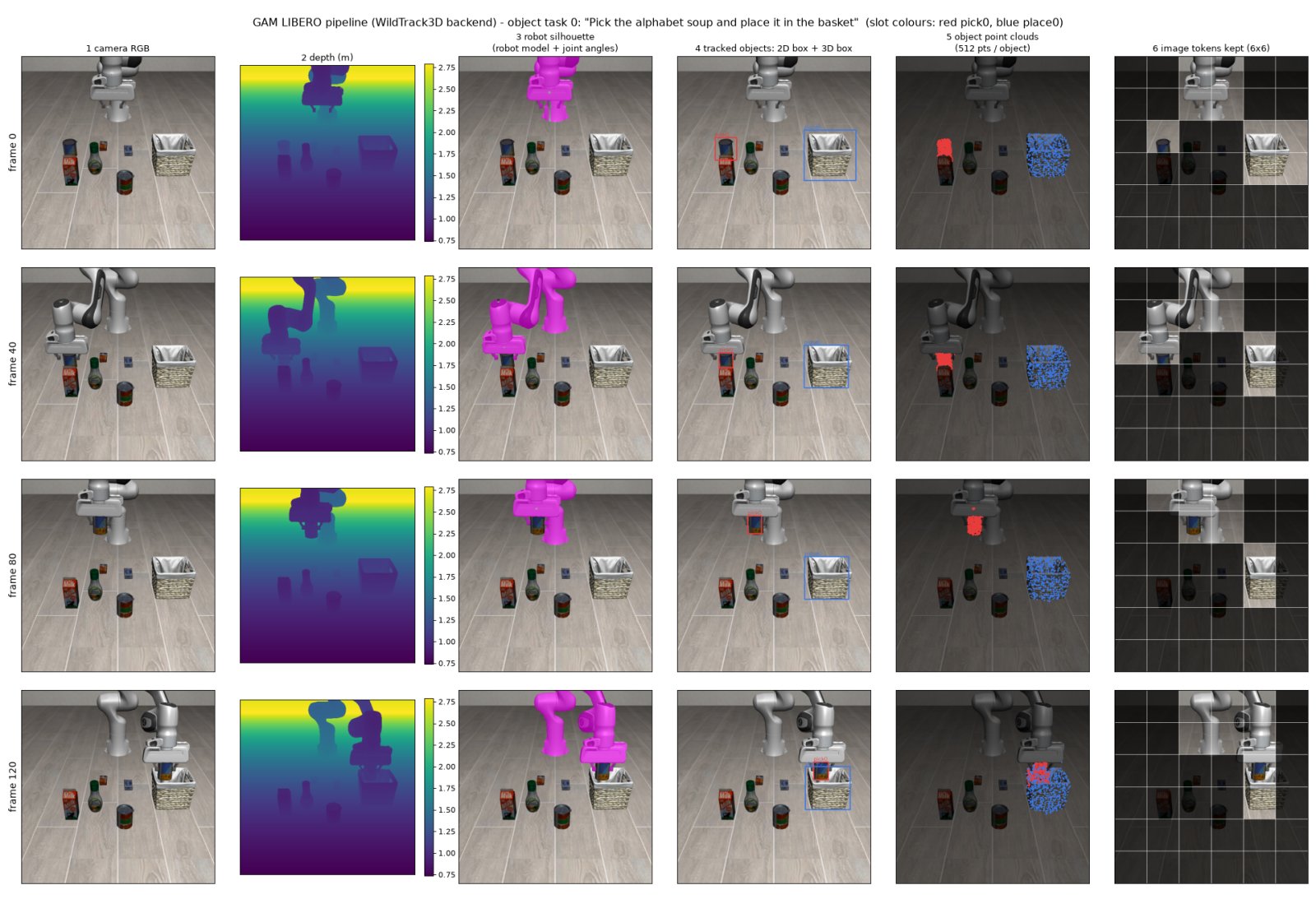
LIBERO-PRO simulation. The policy (GAM architecture) acts on the 3D box and point cloud of each object; the boxes drawn in the video are the ones WildTrack3D tracks and the policy uses.
Episode 0 of eight tasks; WildTrack3D fine-tuned on 1,800 LIBERO demos.
4 · Downstream · robotics
What the policy sees
LIBERO, “pick the alphabet soup and place it in the basket”: RGB, depth, robot mask, tracked 2D/3D boxes, object point clouds and kept image tokens, every 40 frames.
4 · Downstream · 6D pose
Category-level 6D pose: Omni6DPose ROPE
ROPE, single frame
IoU AUC 25
IoU AUC 50
IoU AUC 75
F2G-Pose, released weights (100 epochs)
46.8
28.2
6.2
GenPose++ (own evaluation script, frame subset)
40.5
20.6
2.3
F2G head on frozen RADIO, 10 epochs
41.1
21.9
3.3
F2G head on frozen SAM3.1, 10 epochs
40.6
21.4
3.0
F2G head on frozen WildTrack3D, 10 epochs
41.0
21.9
3.2
Train on SOPE (synthetic) only, test on all of ROPE (real, 149 classes, 1.55M objects) with ground-truth masks.
Same F2G pose head on different frozen backbones: WildTrack3D matches SAM3.1 and RADIO.
The three backbone rows are 10-epoch runs; the released F2G-Pose is trained for 100 epochs.
ROPE ground truth: 3D boxes with object axes, depth.