WildTrack3D v4 head
v4 adds one 3D-context read to the v3 head: a PointNet++ encoding of each object's full-resolution depth points, then a rotation/size prior from the previous frame and an object-frame geometry memory.
Start model, ROPE stride-20 IoU AUC 25/50/75
32.9 / 14.5 / 1.2
rotation 40.3° · F2G 46.7 / 28.2 / 6.2, 27.0°
New parameters (zero-init)
16.4 M
all off: output bit-identical to v3
Training step time, 8×H200
≈ 3.0 s
same as v3 at the same step
Architecture
- v3's four memory point tokens from 72×72 pooled depth are removed.
- ROPE is single-frame, so only ① acts there; ② and ③ need video.
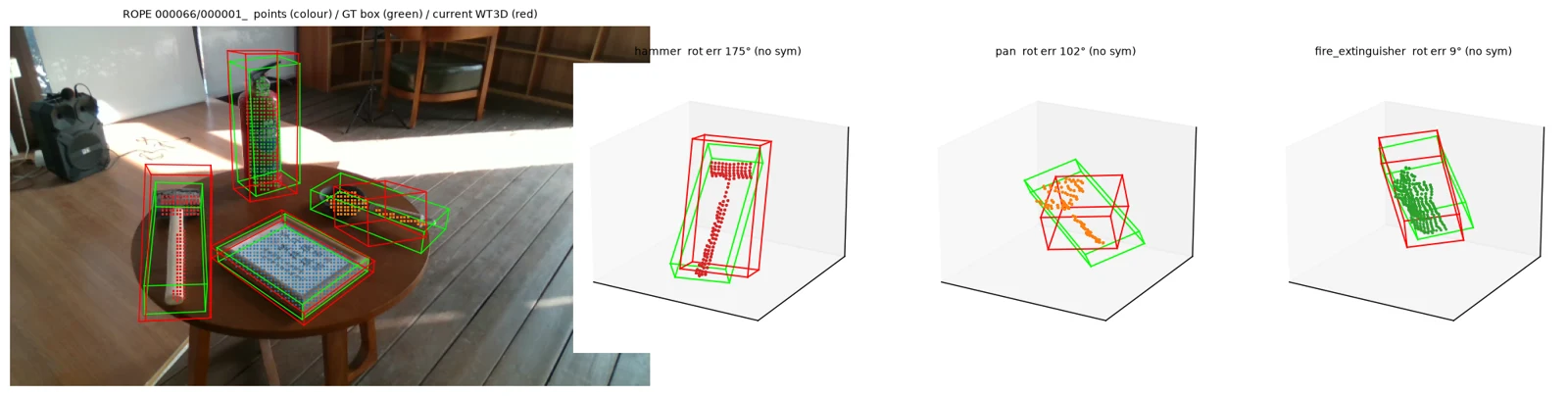
What the geometry branch sees on ROPE
Hammer flipped 175°, yet its T-shaped head is clear in the points
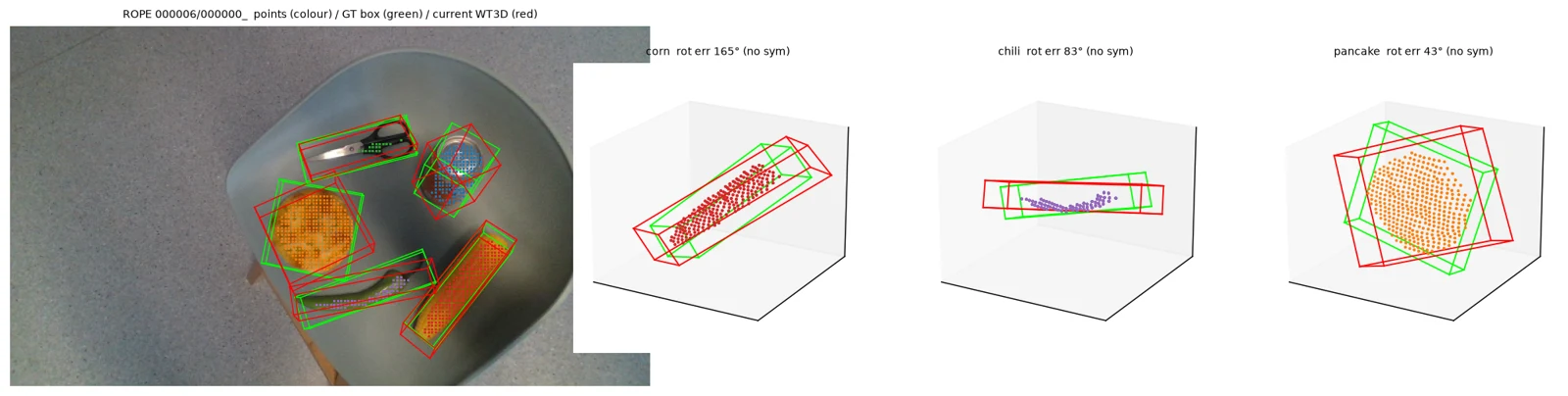
Points: 1024 per object. Green: GT box. Red: start model. Right: the frame's three worst rotations.
Corn flipped along its long axis; chili seen only from above
Bottle upside down; drink box with width and length swapped
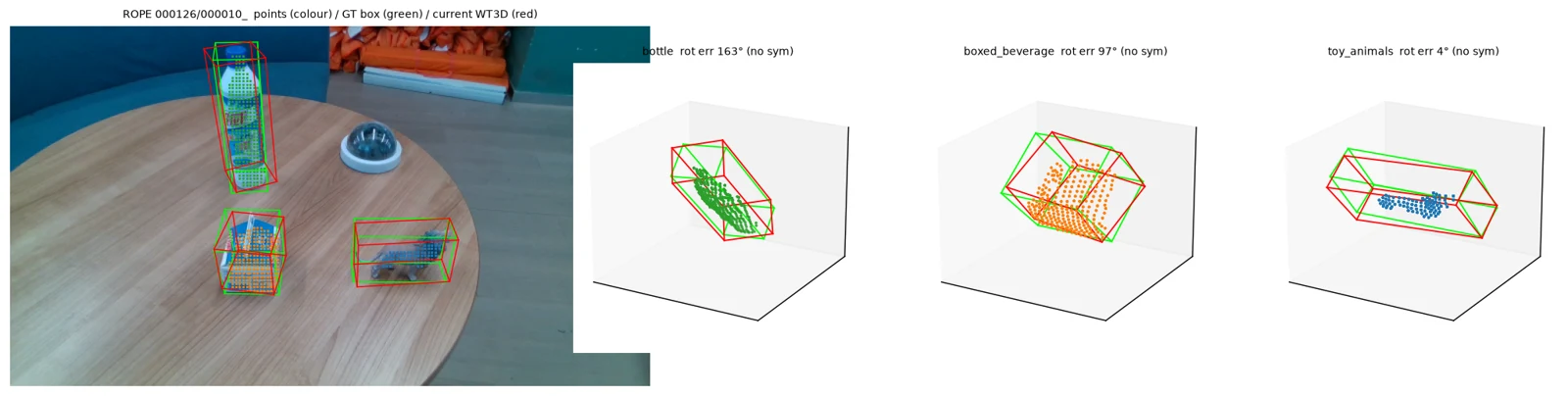
- Rotation errors shown ignore symmetry.
Run record
- Code: wildtrack3d-unified, wilddet3d/unified/context3d.py (uncommitted); flags UNIFIED_GEO_POINTS=pointnet2, UNIFIED_ROT_PRIOR=residual, UNIFIED_GEO_MEMORY=1.
- Step 1 run v4_geo_e4: init pose_v3_sope_angular last.ckpt; SOPE frames, GT-mask prompts, sensor depth; 4 epochs, 8×H200, 64 images per step, LR 1e-4; MEM3D off.
- Control v3_ctrl_e4: same init and steps without the geometry branch. Both are scored on the ROPE stride-20 subset (77,786 objects).
- Points are cell centres of the 288² mask at test time, jittered inside the cell in training; depth is read per point at full resolution.