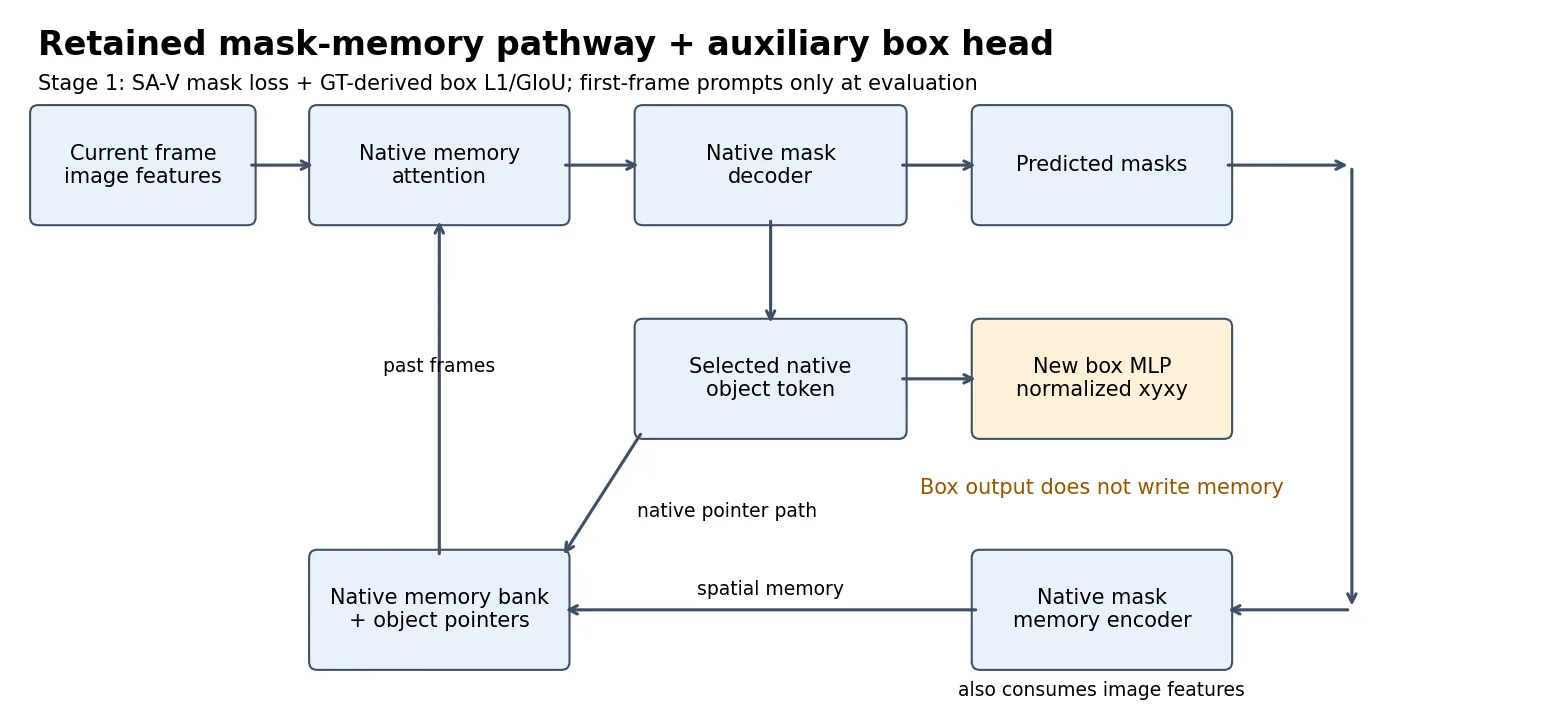
native mask memory retainedjoint mask + box supervisionbox head still below baseline
1 · Corrected architecture and outcome
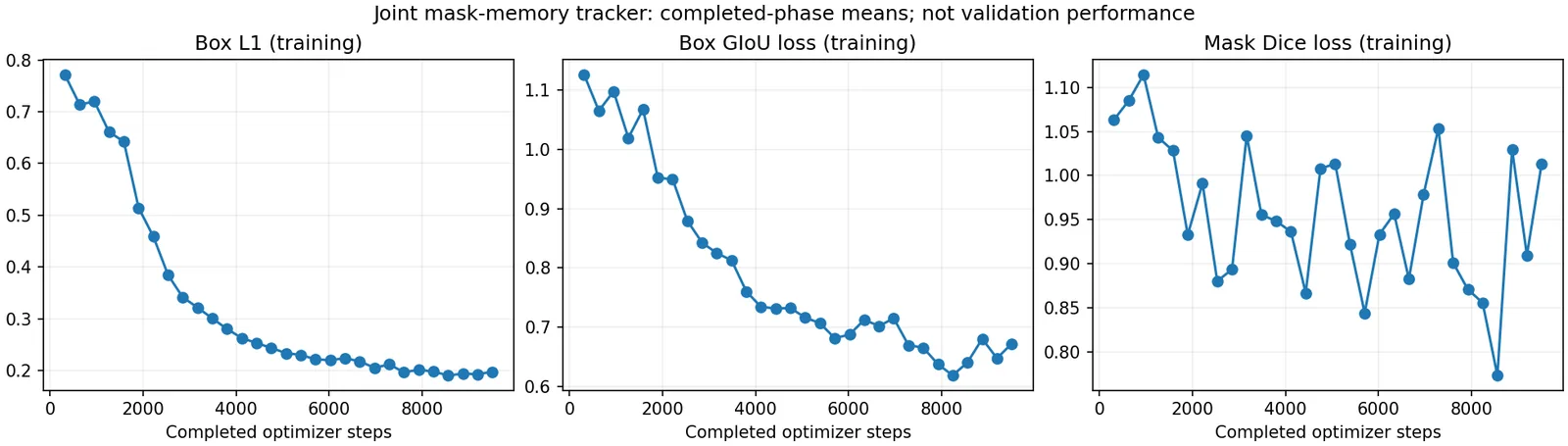
The requested mask-memory architecture was restored and retrained. The auxiliary box head still trails the original mask-to-box baseline; training completion is not performance parity.
Native mask decoder, predicted masks, memory encoder, memory bank and object-pointer pathway remain active. A new MLP projects the selected native mask/object token to a box.
Predicted boxes never write memory. Stage 1 jointly trains native mask losses and GT-derived box L1/GIoU.
Earlier box-memory V2 results concern a superseded model and are not substituted here.
The retained mask-memory loop carries temporal state; the box head reads the selected token.
2 · Matched 155-video results
Output
Box IoU
Presence-gated box IoU
Retained pixel-mask IoU
Presence F1
Absent-object FP
Original SAM3.1 mask-to-box
55.58%
55.58%
58.77%
83.87%
461 / 8542 (5.40%)
Retrained auxiliary box head
24.03%
23.65%
68.10%
91.86%
1311 / 8542 (15.35%)
Retrained mask-to-box
66.22%
66.22%
68.10%
91.86%
1311 / 8542 (15.35%)
Same initial box prompts, 1008 input, annotated 6-fps frames, initial visible object IDs, no later corrections; initialization frame excluded.
Per-video object IDs, scored frame lists and visibility counts match across all three evaluations. Both joint output modes have identical native pixel-mask and presence totals.
Pixel-mask IoU measures native-resolution visible-object Jaccard after bilinear logit resizing. It is not official SA-V J&F. The box-head row reports its retained mask branch separately; that mask score is not box-head accuracy.
Absence false positives must be assessed alongside visible quality. Presence F1 alone can hide false positives on disappeared objects.
This validation set has guided development; it is not an untouched final benchmark.
3 · Training progression
Fixed 32-video cohort
Box IoU
Auxiliary head, 3,169 steps
19.26%
Auxiliary head, 9,507 steps
27.57%
Retained mask-to-box, 9,507 steps
72.05%
The fixed 32-video cohort provides a comparable epoch-one to epoch-three trend; it must not be compared directly with the 155-video aggregate above.
Full manifest: 50,583 unique training videos; three planned epochs, 16 GPUs, global batch 16, eight-frame clips, up to 16 objects, 1008 resolution.
New head LR: 1e-4; pretrained tracker LR: 2e-6; three-epoch cosine decay to one tenth. Image encoder and native memory encoder frozen; native memory remains active.
Sampler audit covers all manifest records per planned epoch, with DDP padding; decoding retries can substitute samples. This does not imply every frame in every video was trained.
Completed-phase training losses through 9,507 steps; these curves are not validation performance.
4 · Complete videos, fixed diagnostic cohort
Panels: auxiliary box head / retained joint mask-to-box / original SAM3.1 mask-to-box.
The same six clips from the earlier failure analysis are reused, without selecting new videos based on final scores.
sav_001826
Box head / retrained mask-to-box / original mask-to-box: 1.74% / 37.29% / 39.99%.
5 · Checkpoint, verification and remaining limitation
Final checkpoint: /fsx/data/weikai.huang/3dgroundingvlm/sam3.1-training/outputs/mask_memory_box_repair_20260922/headlr_train/checkpoints/checkpoint_30.pt.
Configuration: training/configs/sam3_multiplex/sam31_sav_mask_box_headlr_16gpu.yaml; final evaluation revision: c20d6913df4a57e8ff77a8dc10090fd43e49a7bc.
143 tracking regression tests passed. Strict checkpoint reload succeeded in both final evaluation branches. Initial four-frame recurrence parity covered both box and mask prompts, not the entire official video-predictor implementation.
The architecture and retraining repair are complete, but box-head localization remains an unresolved model-quality issue. No claim of parity or readiness for a 3D stage is made.