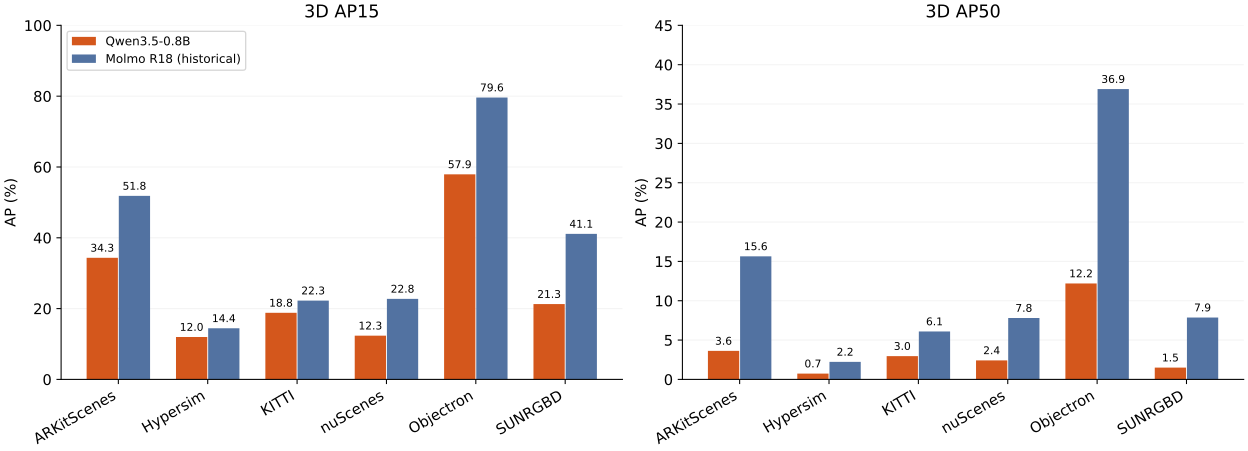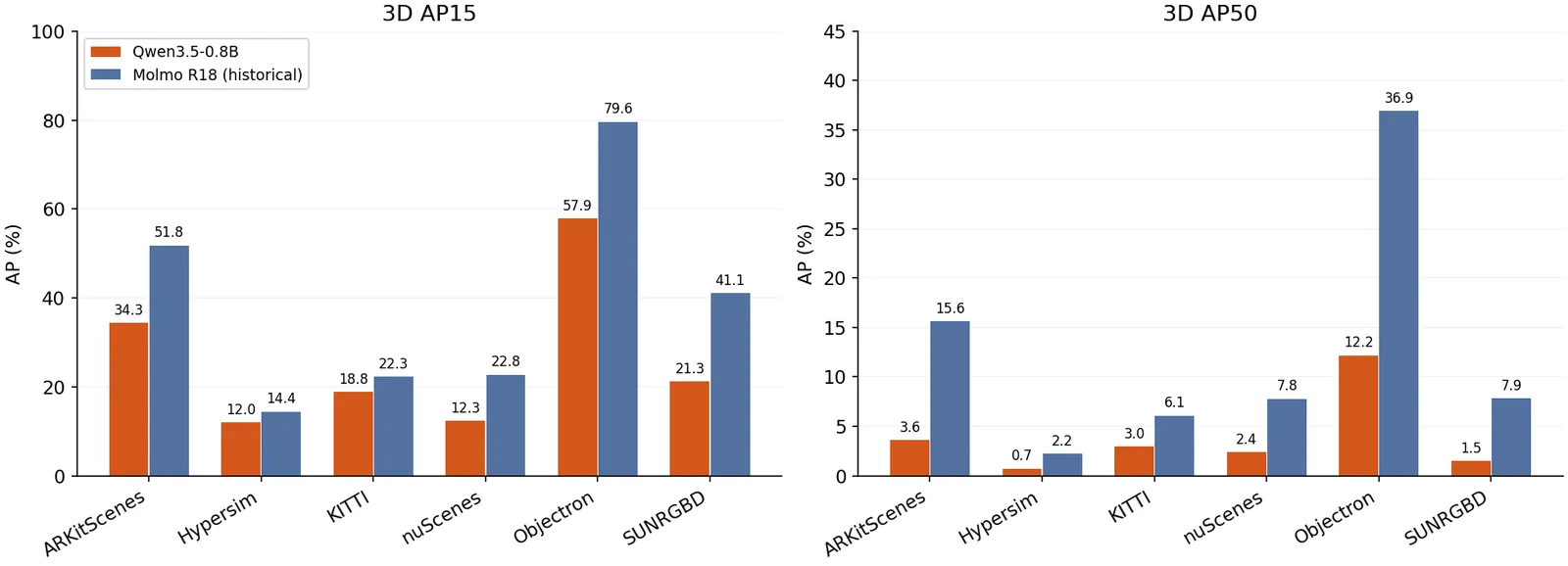
Strict 3D AP50 averages 3.90%; precise box geometry remains weak. This is a supervised baseline under the MolmoRL project. RL experiments are future work.
The comparison uses the repository's historical R18 results. Model scale, initialization and training recipe differ, so it is a reference comparison rather than a controlled size ablation.
Original Omni3Deval scorer; full 39,452-image / 108,081-query coverage across six test domains. Category prompts follow the existing per-image GT-category protocol. All table scores are percentages; the mean is unweighted across six domains.
| Dataset | Qwen 2D AP50 | Qwen 3D AP15 | Qwen 3D AP25 | Qwen 3D AP50 | R18 3D AP15 |
|---|---|---|---|---|---|
| ARKitScenes | 47.08 | 34.34 | 23.65 | 3.62 | 51.83 |
| Hypersim | 37.12 | 11.97 | 7.93 | 0.73 | 14.44 |
| KITTI | 45.10 | 18.80 | 11.75 | 2.96 | 22.26 |
| nuScenes | 32.91 | 12.35 | 8.56 | 2.42 | 22.75 |
| Objectron | 78.81 | 57.92 | 42.73 | 12.19 | 79.62 |
| SUNRGBD | 49.19 | 21.27 | 12.65 | 1.50 | 41.10 |
| Six-domain mean | 26.11 | 3.90 | 38.67 |
| Setting | Completed baseline |
|---|---|
| Model / checkpoint | Qwen3.5-0.8B / checkpoint-5763 |
| Framework | Official MS-Swift 4.5.3 training loop and model adapter; independent environment |
| Hardware / updates | 16 L40S GPUs / 5,763 optimizer updates |
| Packing | 8,192-token target; about 8,032 actual tokens and 8.4 raw task examples per pack |
| Optimizer batch | 1 pack per GPU; accumulation 16; global batch 256 packs (about 2,149 raw task examples) |
| Actual exposure | 12,384,999 raw task presentations; 11,849,473,790 input tokens including images |
| Learning rates | Text 1e-5; vision and projector 5e-6 |
| Scheduler | WSD: 200 warmup, 4,410 stable, 1,153 cosine-decay steps; final LR 10% of peak |
| Execution | BF16; FA2/FLA; Inductor compilation; gradient checkpointing disabled |
| Trainable parameters | Text, vision and projector trainable; text embeddings were not frozen in this completed run |
| Pool | Task | Sampling weight |
|---|---|---|
| h | 2D category detection | 15% |
| a | Joint 2D / 3D category detection | 30% |
| p | Point-prompted 3D localization | 10% |
| g | 2D box-prompted 3D localization | 15% |
| t | Referring-expression 3D localization | 30% |
The five pools repeat indefinitely and are dynamically sampled with fixed weights. Packs contain multiple complete examples; “256 packs” is not “256 images.” The run ended at its fixed WSD target. Exposure counts presentations, not distinct examples.
Evaluation calls the same JSON formatter as training. The category prompt explicitly requests 3D and a JSON array containing bbox_2d, label and box_3d. Official Swift supplies the Qwen3.5 chat/vision template and non-thinking prefix.
| Field | Convention |
|---|---|
| bbox_2d | [x_min, y_min, x_max, y_max], normalized to [0, 1000] |
| center_offset_2d | Projected 3D center minus emitted bbox center, in normalized 2D units |
| log_depth | Natural logarithm of camera-frame depth in meters |
| size_whl | Width, height, length in meters |
| rotation_6d | Original Molmo3Det convention: first two rotation-matrix columns |
| Camera input | Horizontal and vertical FOV derived from K; full K is used for metric geometry decoding |
Training retains the original FOV augmentation: 37.5% of prompts contain FOV; evaluation always supplies FOV. The input does not contain the full intrinsic matrix verbatim. JSON values are adapted to the original a_logz_delta decoder without recomputing or rounding targets.
| Check | Evidence |
|---|---|
| Inference provenance | All 112 shard records match the formatter, adapter and manifest hashes; qwen_json_v1; 1,024 image-token cap |
| Image / prompt audit | 224 image dimensions agree; 220 prompts occur in the training prompt family |
| Raw numeric preservation | 10,000 sampled original task rows: numerical values, object order and labels preserved |
| Original decoder regression | 2,000 source rows / 3,876 decoded predictions exactly equal before and after the JSON adapter |
| Native geometry sample | 810 image-policy-eligible boxes compared with native targets, including 228 cars |
| Gold-box round-trip | Known car target, model bypassed: IoU 0.97394; center error 1.79 cm |
| Waymo input completion | Missing R_cam reconstructed from existing corners/dimensions; all 149,242 original predictions round-trip without changing existing fields |
Geometry checks are sampled, not a whole-corpus label audit. Existing degenerate raw targets were recorded separately. The gold-box round-trip validates the format/decoder chain and does not measure model accuracy.
Generation used temperature 0, a 24,576-token output cap and a 32,768-token inference context. Invalid responses receive no detections; images remain in the evaluation. Model JSON is not repaired, and truncated responses are explicitly counted.
| Domain | Images | Queries | Hit output cap | Invalid / empty decode |
|---|---|---|---|---|
| ARKitScenes | 7610 | 21607 | 246 | 246 |
| Hypersim | 7690 | 37360 | 105 | 109 |
| KITTI | 3769 | 6964 | 2 | 131 |
| Objectron | 9314 | 9296 | 11 | 11 |
| SUNRGBD | 5050 | 16960 | 54 | 54 |
| nuScenes | 6019 | 15894 | 30 | 30 |
| Waymo_val | 20048 | 51858 | 21 | 40 |
Waymo inference covers all 20,048 validation images and 51,858 category queries. CPU scoring is still in progress at this snapshot; no final Waymo AP is reported here.
Waymo uses the existing WildDet3D camera-frame protocol, not native Waymo mAPH, and is excluded from the six-domain Omni3D mean. The initial score coordinator timed out waiting for the second GPU node; completed inference was retained and CPU merge/scoring was recovered.
The requested default is to freeze text embeddings individually through official Swift freeze_parameters. Qwen3.5 ties the input embedding to its output head, so the shared output weight also freezes; other text layers, vision and projector remain trainable. Switching from this unfrozen checkpoint requires model-weight initialization with a new optimizer.
Before attributing the performance gap to one cause, run controlled comparisons of optimizer exposure, batch size, camera conditioning and 3D geometry supervision. This report does not establish a causal explanation.
Download aggregate metrics and audit evidence (JSON) · Download benchmark chart (SVG)
Training repository · 3D evaluation kit