Actual 2FPS frame sequences around I-frame decisions · 2026-08-03
videomotion-searchGOPHEXaudit
TL;DR
The videos below show that cost-triggered I-frames coincide with real scene changes. GOP-cap I-frames are periodic safety boundaries and can occur during a visually continuous shot.
Use the red-boxed frame as the selected I-frame.
All clips are generated from the actual V6+HEX 2FPS RGB timeline, with no synthetic interpolation.
Current long-video gamma still produces many Kmax=16 boundaries; recalibration remains a separate issue.
1 · Cost-triggered scene changes
Example A · opening composition change
At the red-boxed frame, the predictive cost crosses gamma and the image changes from the opening title/logo composition. This is the intended I-frame behavior.
Example B · dark car scene transition
The cost spike marks a real change in the dark exterior/car scene. The neighboring P frames are not visually equivalent to the new composition.
2 · GOP-cap boundary
Example C · forced I after 16 P frames
The red-boxed I-frame is inserted because the GOP reached the 16-P limit; the cost stays below gamma and the scene remains continuous. This is a safety boundary, not a detected cut.
3 · Minimal numeric summary
Audit
Result
Detailed timeline
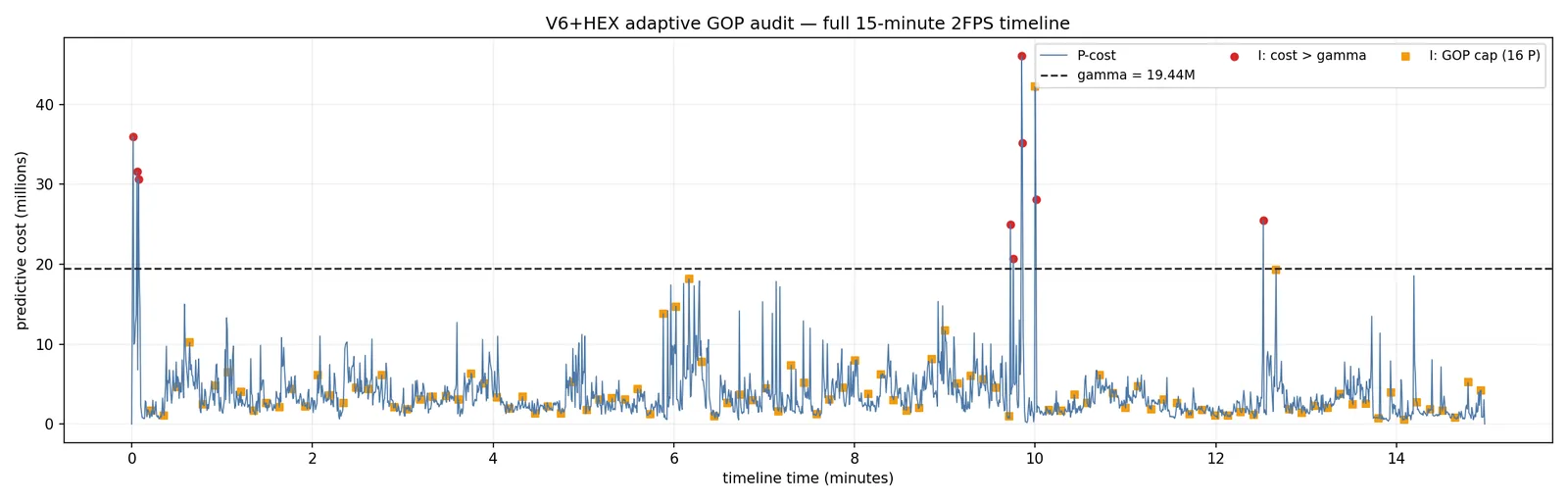
1,798 frames · 898.5 seconds · 2FPS
Cost-triggered I events
10 / 113 I frames
GOP-cap I events
103 / 113 I frames
31-timeline aggregate
1,314 cost-triggered vs 2,168 cap-triggered
Overview only: red markers are cost-triggered I frames; orange squares are GOP-cap boundaries. The videos above are the primary evidence.
4 · What this validates
The cost > gamma rule is visually meaningful on these examples.
The majority of I frames are currently caused by Kmax=16, because the long-video operating point has long GOPs.
The current gamma artifact was calibrated with max_frames=17; recalibrate on long-video costs before final cache generation.
Video clips are silent 2FPS RGB previews generated from the cached timeline; no private source URLs are embedded.