← Back to project

Molmo2 Codec — AdaCodec vs. CoPE vs. LLaVA-OV2

GOP semantics, temporal coverage, and visual-token budgeting · 2026-08-03
AdaCodecCoPELLaVA-OV2GOPlong-video

TL;DR

1 · Raw GOP vs. LLM-visible timeline

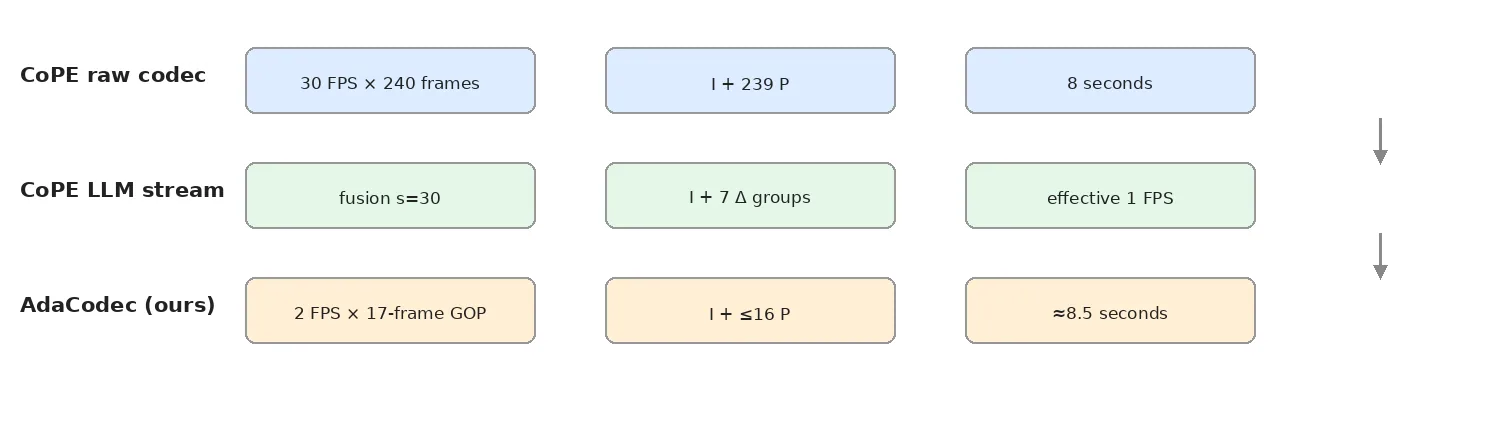
The raw CoPE codec GOP is long, but P-frame fusion reduces the LLM-visible temporal sequence; AdaCodec reaches a similar temporal span with a shorter sampled GOP.

2 · What CoPE found

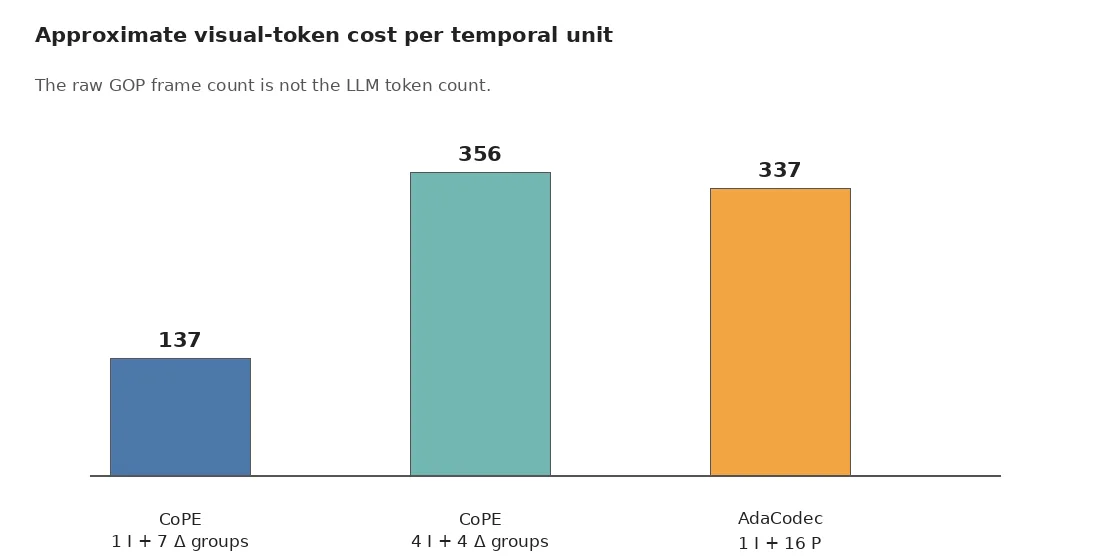
Approximate costs use Molmo-style I=81 and our AdaCodec P=16 only to make the scale intuitive; CoPE’s actual backbone has different dense-token width.

3 · Budget policy: what we should implement

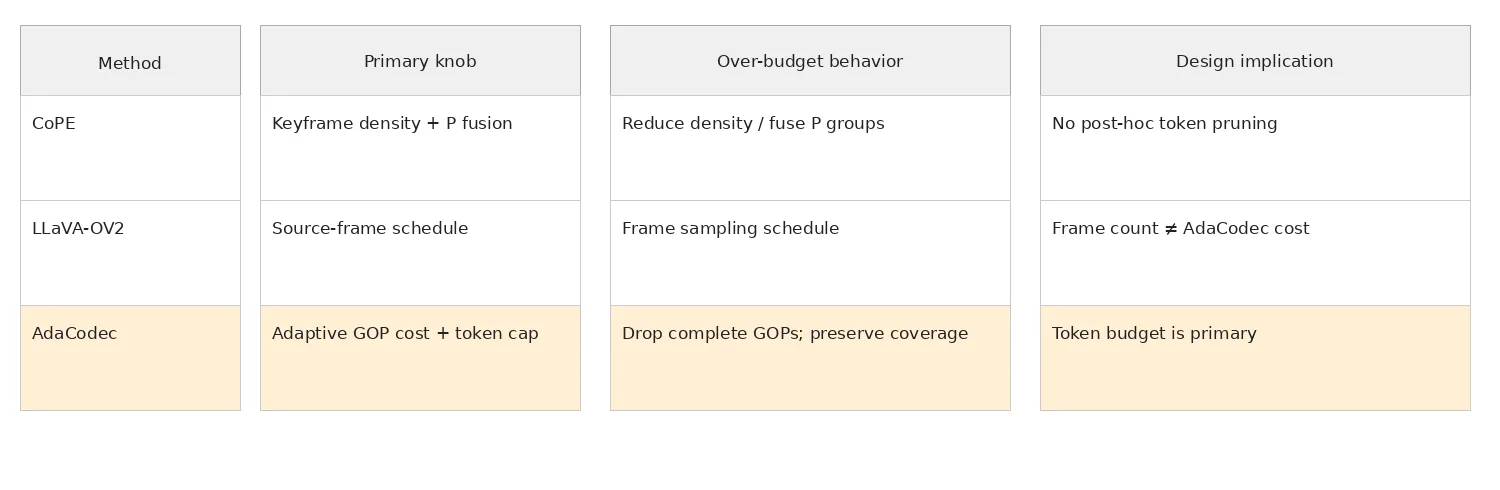
The comparable design decision is the budget policy, not the raw integer used as GOP length.

4 · Coverage and selection mechanics

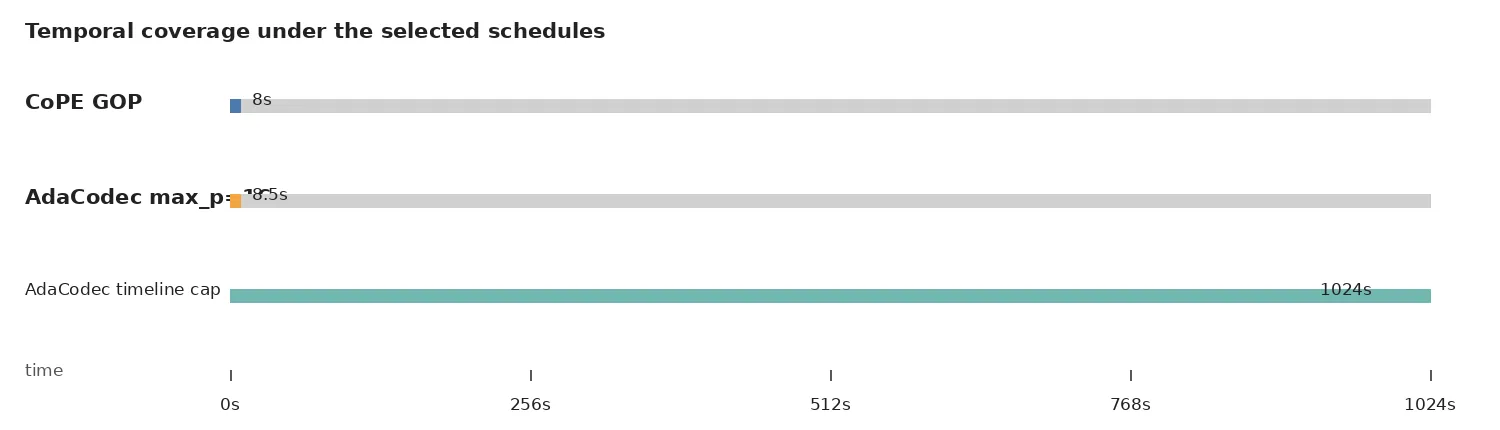
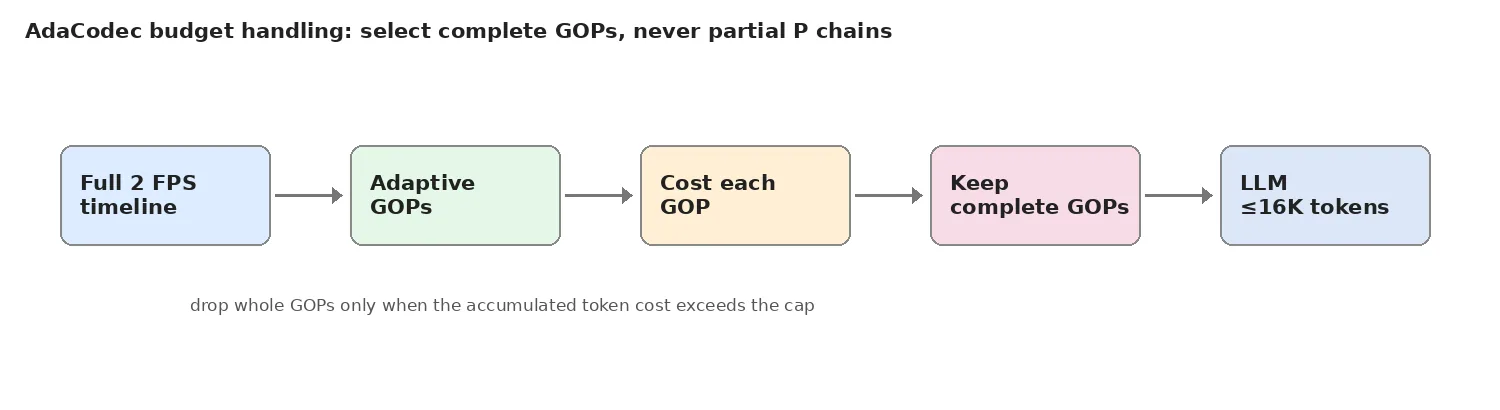
The per-GOP temporal scale is short; the timeline cap controls how much video is searched, while the token cap controls what enters the LLM.
The safe AdaCodec selection path preserves predictive dependencies by dropping only complete GOPs.

5 · Final configuration table

DimensionCoPELLaVA-OV2AdaCodec (ours)
Raw sampling30 FPS re-encodeStage-dependent source-frame schedule2 FPS timeline
Raw GOP240 frames = 8 sCodec-stream schedule; not an AdaCodec GOP definition1 I + up to 16 P ≈ 8.5 s
LLM-visible P unit30-frame fusion → 1 Δ groupCodec-specific visual streamOne P representation per sampled frame
P representation8 Δ-tokens (main setup)Not directly comparable16 P-tokens (current checkpoint)
Primary budget knobKeyframe density + P fusionSource-frame budgetVisual-token cost + adaptive GOP
Over-budget actionReduce density / fuse P groupsSampling scheduleDrop complete GOPs only
Our formal settingReference onlyReference only2 FPS, max 2048 frames, max_p=16, 16K visual / 32K seq

6 · Open A/Bs

Sources: CoPE-VideoLM paper; CoPE project page. AdaCodec configuration is the current Molmo2 Codec design record.