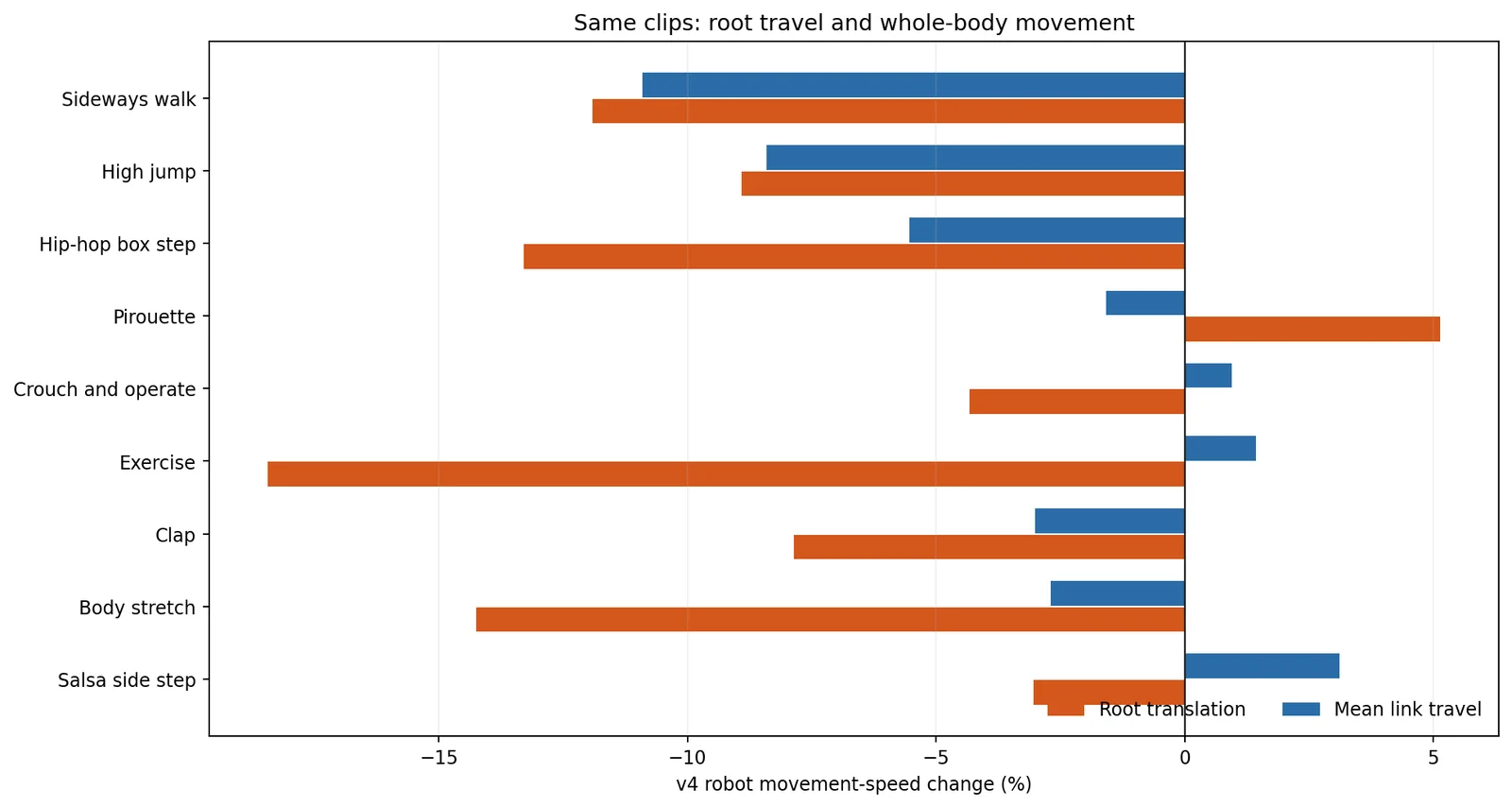
Robot movement speed is defined here as horizontal root path length divided by seconds, in m/s. For motions that stay mostly in place, the gallery also reports mean Cartesian travel speed over the robot’s physical link frames. Matching frame count and FPS is used only as a control so both versions are compared over the same elapsed time.
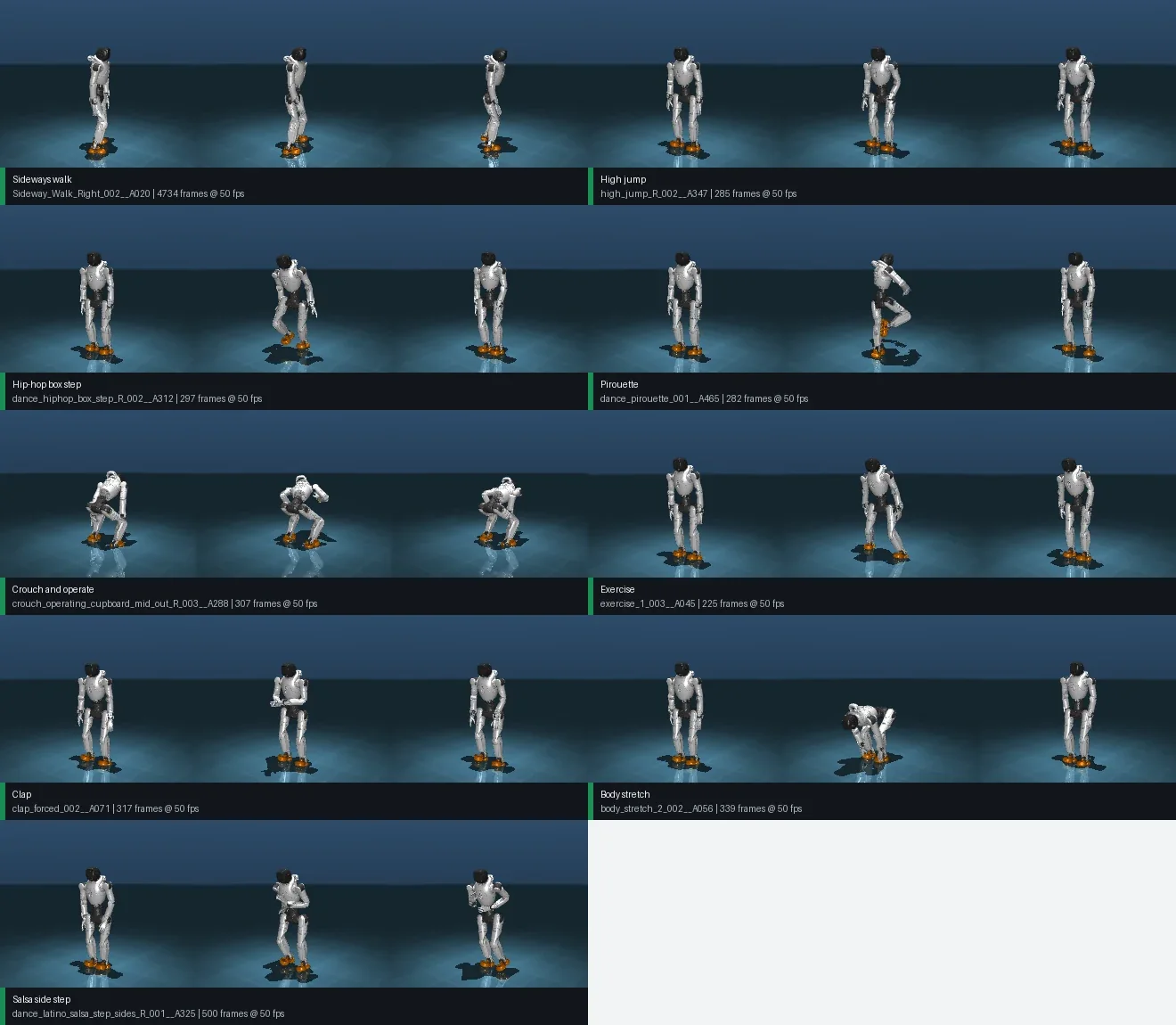
Left is the previous 0.9-scale corpus; right is v4 with 0.787 measured leg scale and sole-point toe targets. Both use the same source frames and timestamps. The model, camera, and viewport are held constant, so displacement per second is directly visible; only the retarget reference changes.
Nine diverse v4 references rendered on the physical-head, 29-DOF X2 model. Each strip shows three moments from the most active six-second window, or the full clip when shorter.
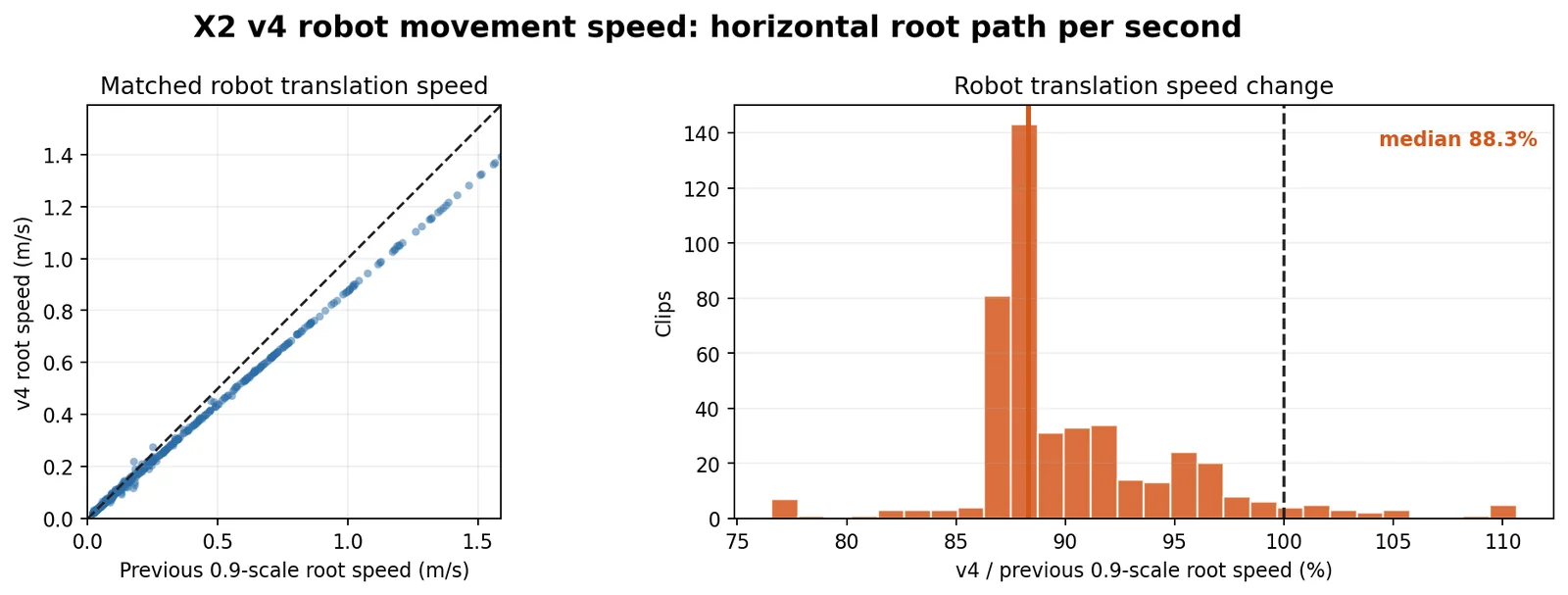
The matched sample was selected deterministically from 121,486 v4/previous 0.9-scale basenames available when this report was built. Root speed uses 452 clips above 0.02 m/s to avoid unstable ratios on stationary motions. Its v4/old ratio has median 88.3%, mean 90.4%, and a 10th–90th percentile range of 87.3%–96.7%.
| Clip | Old root m/s | v4 root m/s | Root change | Old body m/s | v4 body m/s | Body change |
|---|---|---|---|---|---|---|
| Sideways walk | 0.404 | 0.356 | -11.9% | 0.429 | 0.382 | -10.9% |
| High jump | 0.126 | 0.115 | -8.9% | 0.374 | 0.343 | -8.4% |
| Hip-hop box step | 0.486 | 0.422 | -13.3% | 0.852 | 0.805 | -5.5% |
| Pirouette | 0.224 | 0.236 | +5.1% | 0.701 | 0.690 | -1.6% |
| Crouch and operate | 0.054 | 0.052 | -4.3% | 0.196 | 0.198 | +1.0% |
| Exercise | 0.094 | 0.076 | -18.4% | 0.697 | 0.707 | +1.4% |
| Clap | 0.018 | 0.016 | -7.9% | 0.077 | 0.075 | -3.0% |
| Body stretch | 0.087 | 0.075 | -14.2% | 0.217 | 0.211 | -2.7% |
| Salsa side step | 0.142 | 0.138 | -3.0% | 0.285 | 0.294 | +3.1% |
v4 targets two virtual sole points located at [0.10, 0, -0.073] in the ankle-roll frames. They are massless, jointless, geometry-free GMR IK markers. The output remains root plus 29 actuated DOFs; the MotionLib schema and training URDF/MJCF contain no toe marker slots.
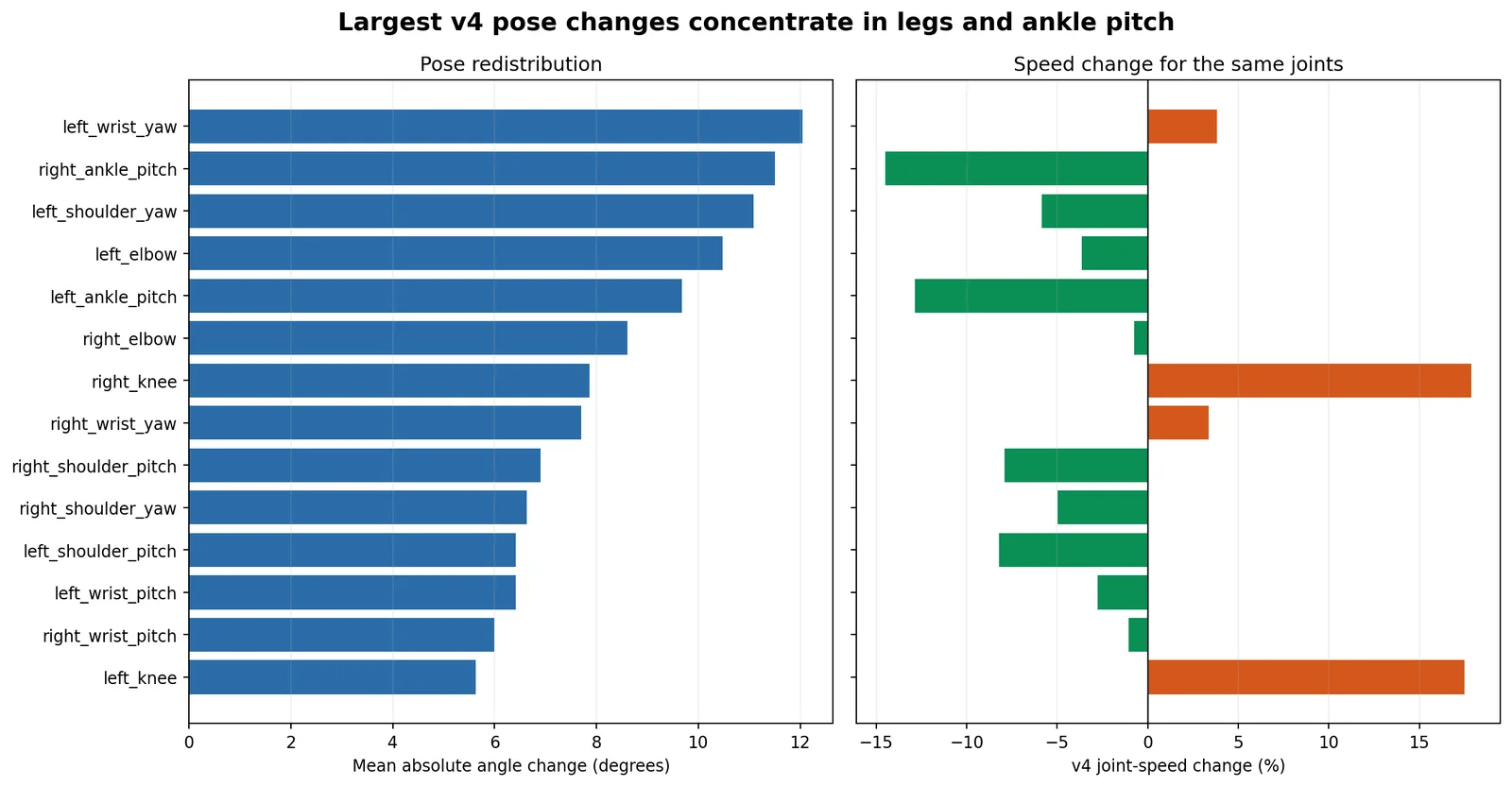
In the gallery sample, the largest knee/ankle-pitch pose change is right_ankle_pitch_joint at 11.5° mean absolute difference. The correction propagates through hip, knee, and ankle pitch because the solver now matches the physical sole point instead of treating the ankle frame as the foot endpoint.
| Property | GMR v4 | SOMA X2 port |
|---|---|---|
| Robot information used | X2 link transforms, joint axes and configuration limits; measured 0.787 lower-body scale; sole-point IK targets | X2 morphology and kinematic mapping, with a custom port from the public G1-oriented path |
| Physics information used in retarget | No dynamics rollout. The MJCF is loaded for FK/IK, but mass, inertia, torque, friction, and contact balance are not optimized. GMR velocity limits are disabled in this pipeline. | No downstream physics tracking guarantee; output is still a kinematic reference |
| Observed X2 result | Validated 29-DOF schema and model match; toe-target geometry fixes the ankle-as-foot-endpoint error | Lower body was plausible, but the tested port produced unusable upper-body behavior around the X2 elbow/shoulder setup; the route was rejected after sufficient testing |
| Current decision | Active retarget path | Rejected; do not revive or graft |
Thus “more suitable for X2” means a better X2-specific kinematic target and a cleaner data contract. It does not mean GMR has become physics-aware. HoloMotion training and rollout evaluation provide that next evidence layer.
The previous SONIC run was trained against the 0.9-scale reference regime with incorrect foot endpoints. Faithful tracking could leave feet about 6.6 cm above the floor at the median, while a separate subset penetrated the floor. The learned policy compensated with conservative step reach and higher cadence, horizontal drift was visible in separate rollout probes, but it was never an official success result.
| Prior evidence | Interpretation for v4 |
|---|---|
| Anchor reward tuning improved horizontal displacement attainment from 0.70 to 0.91; that diagnostic did not define official success. A historical released-default common-v4 replay scored 104/126 = 82.54%; the audited primary 512-motion 50k result is 480/512 = 93.75%. | Reward pressure helped, but could not remove the reference geometry ceiling. Keep the proven anchor recipe while changing only the data. |
| A blanket 0.7-scale experiment reached the requested speed but caused 29/39 falls and only 5–8% success. | v4 is not a global slowdown: it uses measured X2 lower-body scale plus correct sole targets while preserving the rest of the embodiment contract. |
| The v4 reference itself translates about 11–12% slower than the old 0.9 baseline. | A retry must report absolute m/s as well as policy/reference speed ratio, otherwise an easier target could look like a controller improvement. |
x2_native_070 blanket 0.7-scale experiment is deliberately not the comparison baseline. All speed deltas in this report compare v4 against the previous production-like 0.9-scale corpus in x2_native_full.