a8b28f625576be099abc4658ed3e4298dfa1047c092291fcf0659e951291dfbe.| Layer | Contract |
|---|---|
| Robot | 29 actuated DOFs; fixed neck; physical head retained |
| Retarget only | Massless, jointless, geometry-free toe IK markers at [0.10, 0, -0.073] in ankle-roll frames |
| Training | Same 29-DOF physical robot, no toe bodies or toe state slots |
| Hand endpoint | X2 wrist_roll, replacing G1 wrist_yaw consistently in reward, termination, eval, and mass randomization |
Representative MotionLib references rendered directly on the canonical fixed-neck, physical-head X2 MJCF. These are kinematic references, not policy rollouts.
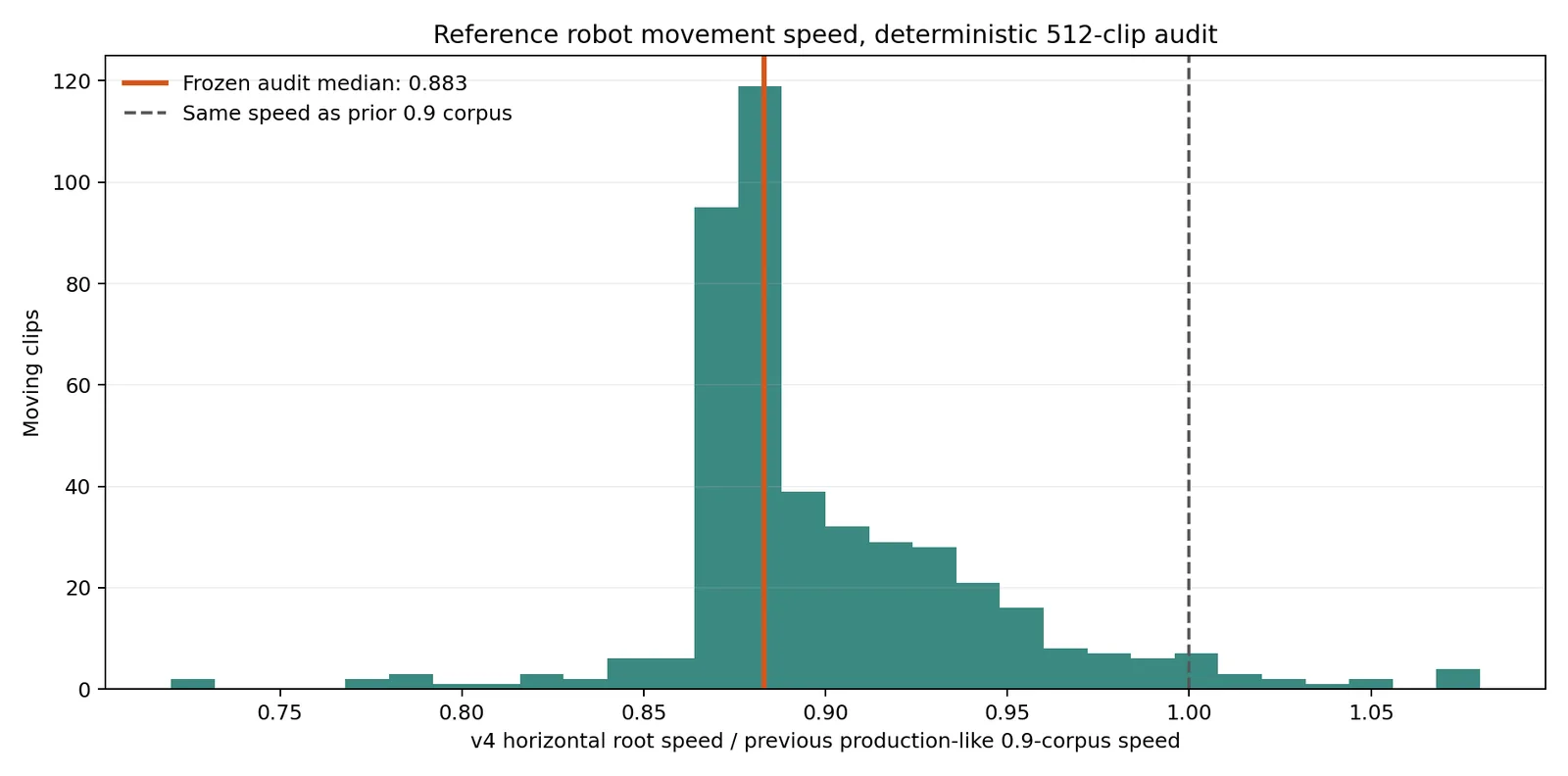
This measures reference robot root displacement per second with source FPS preserved. It is not video duration, playback speed, or trained-policy speed. A seed-0 reproducibility pass selected 512 clips and retained 452 moving clips above 0.02 m/s; its median was 0.884.
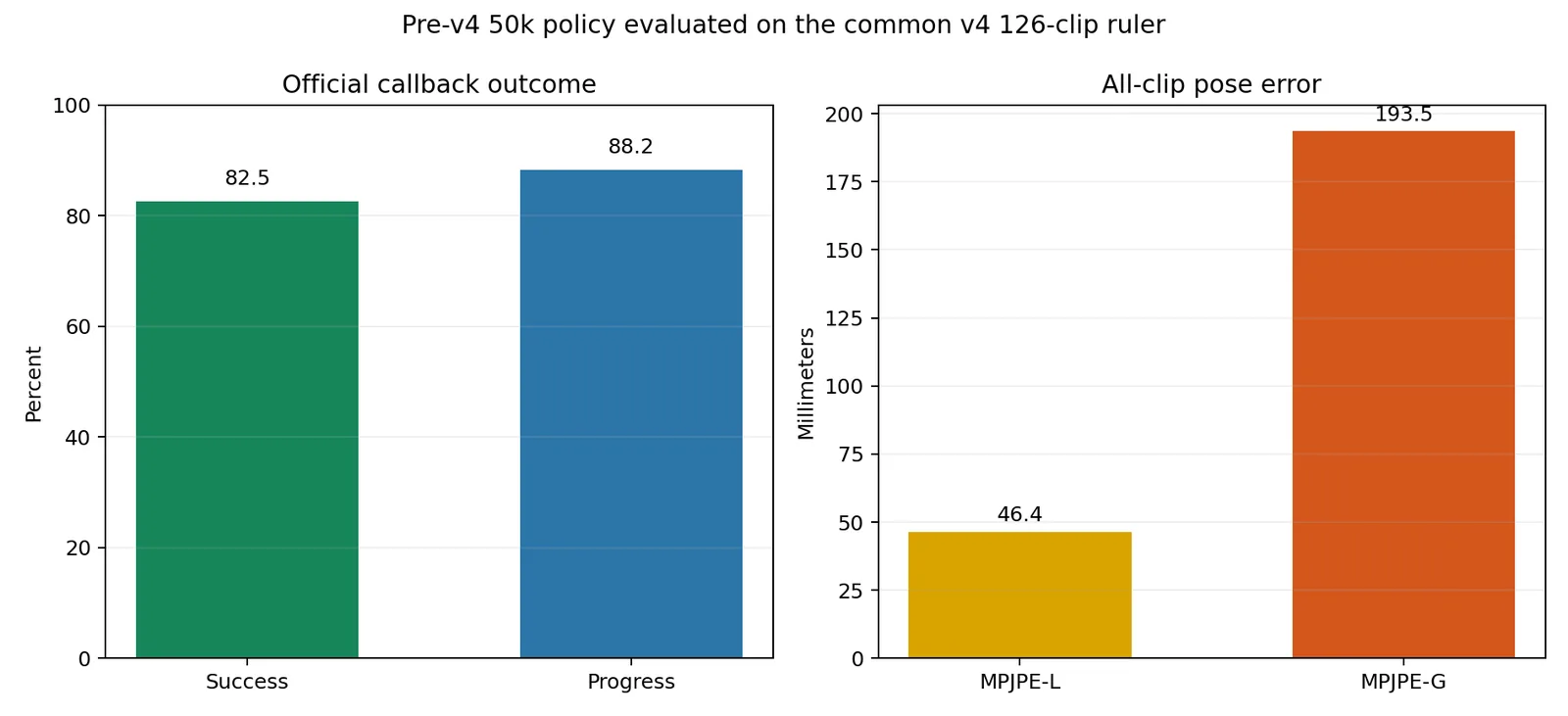
A historical released-default replay on common-v4 scored 104/126 (82.5%), but it mixed encoders, retained the hidden ankle-XYZ termination, and inherited the G1 wrist-mass target. The audited primary 512-motion 50k result is 480/512 (93.75%), with 95.32% progress, successful-only MPJPE-L 44.29 mm, and all-motion MPJPE-L 47.56 mm. This is the checkpoint baseline the new v4-trained policy must beat.
| Item | Audited state |
|---|---|
| Paper/source | arXiv 2511.07820v3; official NVlabs source 4141c34 |
| Initialization | Random policy initialization through the official SONIC code path; checkpoint: null and no pretrained_model |
| Recipe | 50k iterations, 4096 env/GPU, 24 rollout steps, 32 GPUs; controlled X2 anchor/linear-velocity overrides retained |
| Launch | Saturn A100 Beaker experiment 01KYBHC11H7HP9GYX1YKRS8RP7, four synchronized 8-GPU replicas |
| Startup validation | 32/32 ranks loaded all 121,486 motions; PPO entered normally; first scratch last.pt written at iteration 50 |
| Early throughput | About 7.8 seconds/iteration, approximately 112 hours to 50k without preemption |
last.pt, saved every 50 iterations.GMR and SOMA are both kinematic retargeters: neither contains robot dynamics or learns physical feasibility. GMR v4 is selected because its X2 mapping is stable and the toe targets improve ankle/foot geometry without changing the training robot. SOMA and SOMA/GMR grafts are closed for this project after sufficient negative validation.