Current main of art-objaverse-harness (e47ddb3) · setup, shared batches, delivery, trajectory saving · 2026-11-18
harness v5setupdeliverytrajectoriesMJCF
TL;DR
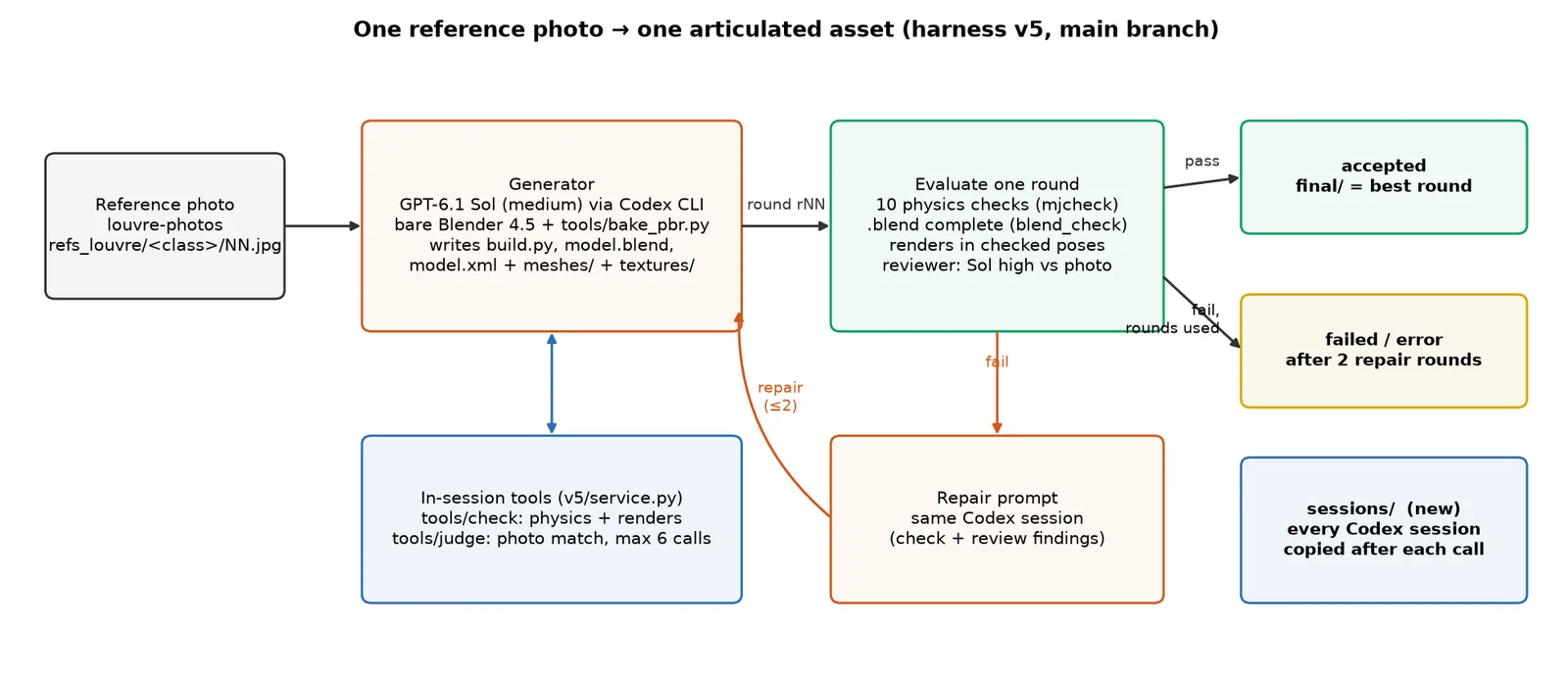
One reference photo → one articulated asset. GPT-6.1 Sol builds it in bare Blender and delivers
build.py + model.blend + an MJCF; 10 physics checks + a photo reviewer gate it; at most 2
repair rounds in the same session. Repo: github.com/weikaih04/art-objaverse-harness (private, main = v5 only).
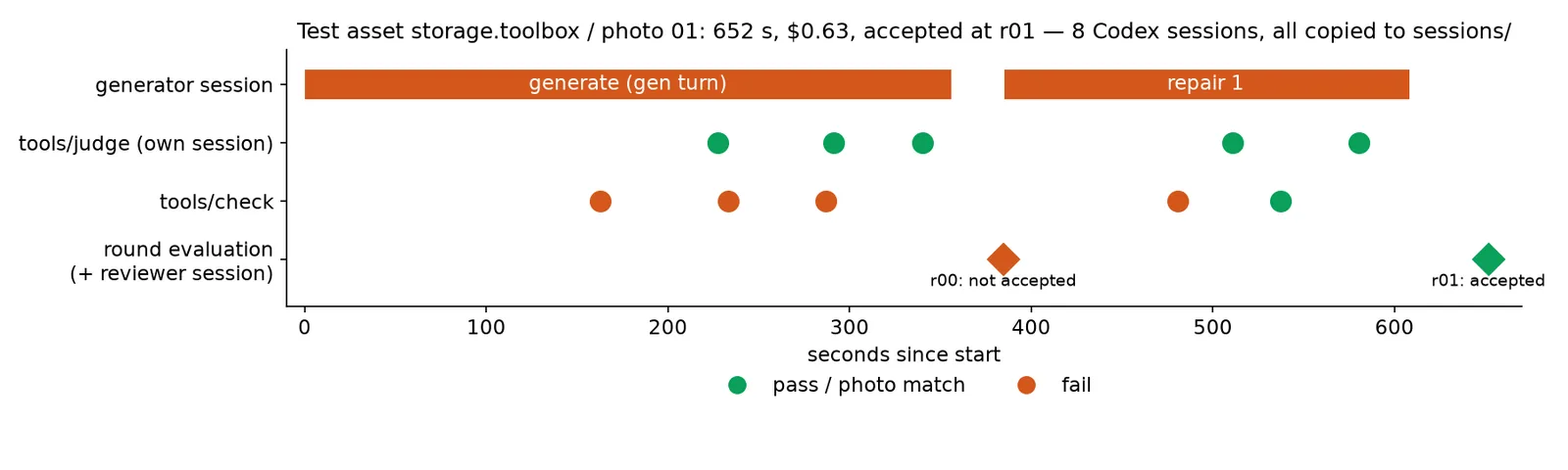
New on 2026-11-18: every asset keeps its own Codex sessions in sessions/ (copied after
each model call), and tools/v5_export.py delivers accepted assets, failed assets and full trajectories in
one verified tree. Tested end to end on a real asset.
Runs made before 2026-11-18 have their trajectories only in ~/.codex/sessions:
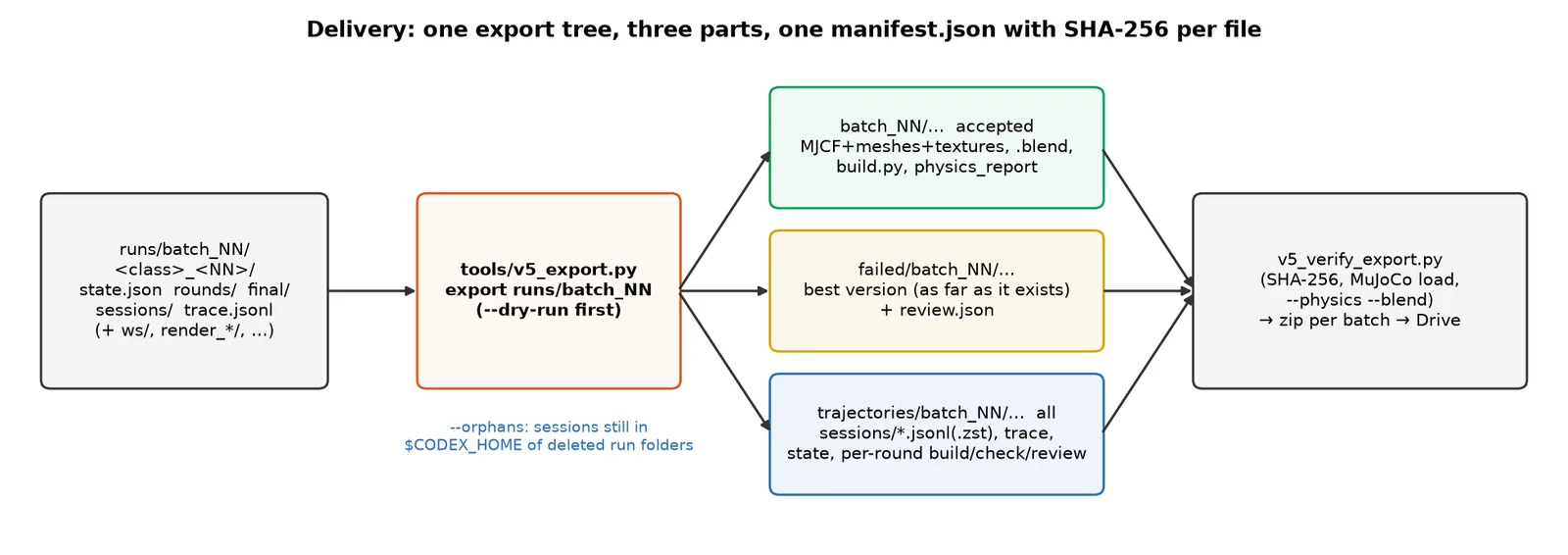
do not delete it; v5_export.py --orphans recovers them even after the run folders are gone.
1 · Pipeline
Input: one photo of a taxonomy v2.2 class (2,719 classes) from weikaih/louvre-photos.
Generator: GPT-6.1 Sol, effort medium, through Codex CLI in a sandboxed workspace. Its only helper is
tools/bake_pbr.py, which bakes procedural materials to base colour / ORM / normal PNGs.
Deliverables:build.py, model.blend (textures packed), and
model.xml + OBJ meshes + PNG textures; closed loops use <equality connect>.
Gate: the 9 gated physics checks of mjcheck/ (mesh_health reported, not gated), a complete
.blend, and a reviewer (Sol high) comparing renders in the checked poses with the photo.
While working the agent can call tools/check (same physics + renders) and
tools/judge (photo match, max 6 calls per asset).
Standard tier only; there is no fast-tier option.
Repairs resume the same Codex session, so the model keeps its context and the photo. The asset's best-scoring round becomes final/, accepted or not.
2 · Setup on a new machine
component
what
how
repo
main of art-objaverse-harness (private: needs collaborator access)
Knobs (environment, v5/config.py): V5_GEN_EFFORT (medium),
V5_REPAIR_ROUNDS (2), V5_JUDGE_BUDGET (6), V5_PARALLEL (16 assets at once),
V5_RENDER_PAR (4 Blender renders at once).
Machine: many CPU cores; Blender renders on the CPU. 16 parallel assets fit one 96-core node.
Cluster note: run it on a compute node, never a login node (Blender + 16 Codex sessions).
3 · Shared batches and the progress log
tools/run_batch.sh 3 alice          # claim batch 03, generate photo 00 of each of its ~170 classes
tools/run_batch.sh 3 alice 2        # later: photos 00 and 01 (finished assets are skipped)
python tools/v5_progress.py board   # who runs what, how far, what it cost
python tools/v5_progress.py existing --owner bob runs/my_old_run   # register assets made before the batches
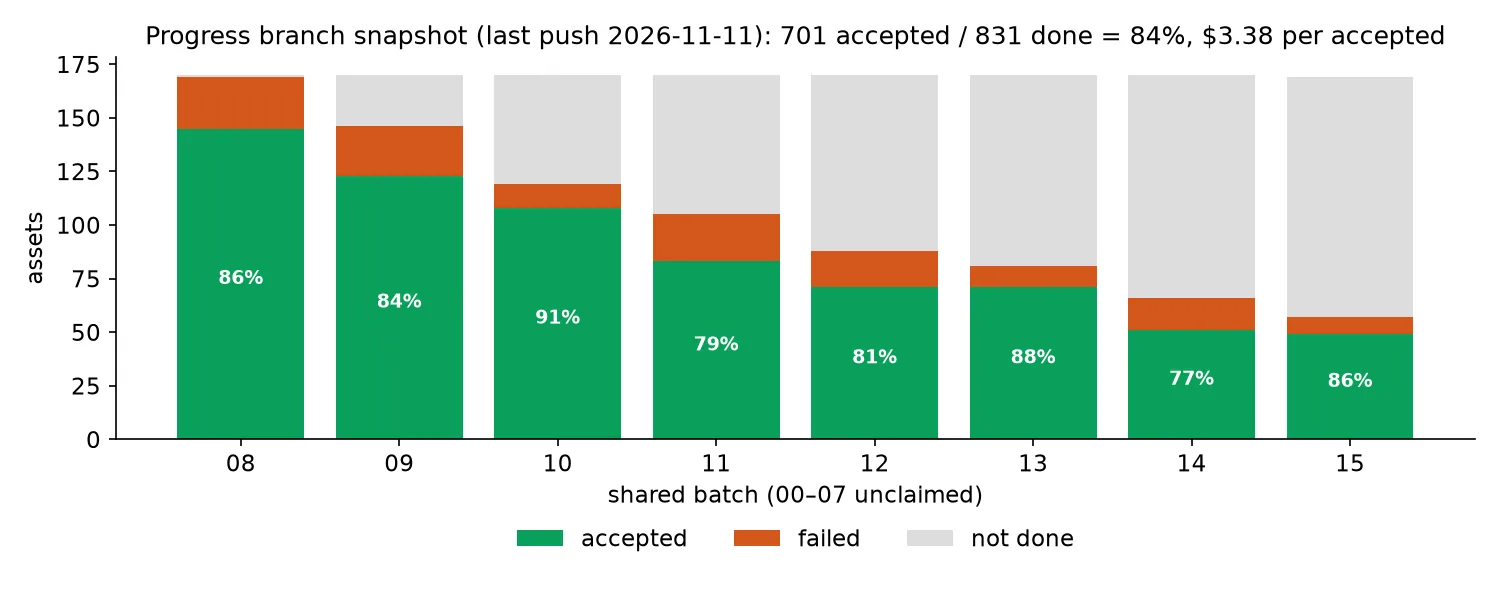
16 batches (batches/batch_NN.txt), each ~170 classes with the same mix of domains.
Claiming is first come, first served on the progress branch; run_batch.sh
pushes progress every 10 minutes and at the end.
Logged per batch: owner, accepted / failed / error / running, dollars (API-equivalent, standard tier),
tokens, agent hours, harness commit.
Resume: rerunning the same command continues an interrupted batch.
Registered before the batches: bowenw 14,002 assets (11,698 accepted, 2,664 classes, $30.2k);
haoquanf-art 62.
Batches 08–15 run by haoquanf-art: 77–91% acceptance per batch, about $3.4 per accepted asset. The board was last pushed 2026-11-11, so it lags the real runs.
4 · What an asset run folder holds
path
what
size
state.json
status (accepted / failed / error), best round, costs, every event
KB
final/
copy of the best round: asset/ with the deliverables
~20–100 MB
rounds/rNN/
the asset as it was at each evaluation
×rounds
check_rNN/report.json, review_rNN.json
physics report and review of each round
KB
sessions/(new)
every Codex session: generator__…, reviewer__…, judge__…
~25 MB
trace.jsonl
the harness's event stream of the generator turns
0.1–0.4 MB
ws/, render_*/, tools/
workspace, renders, in-session tool results
most of the folder
5 · Delivery: export, verify, upload
git pull
python tools/v5_export.py export runs/batch_08 runs/batch_09 --dry-run   # what, and how big
python tools/v5_export.py export runs/batch_08 runs/batch_09             # writes ./export + manifest.json
python tools/v5_verify_export.py export                    # SHA-256 of every file, required files, MuJoCo loads
python tools/v5_verify_export.py export --physics --blend  # rerun the gate (compute node)
cd export && for b in batch_*; do zip -qr0 ../$b.zip $b failed/$b trajectories/$b 2>/dev/null; done
# upload batch_NN.zip + manifest.json + README.txt to one Google Drive folder; keep the runs until we confirm
Accepted → batch_NN/<class>/image_NN/: model.xml + exactly the meshes/textures it
references, model.blend, build.py, NOTES.md, physics_report.json.
Failed / error → failed/…: the best version as far as it exists + review.json. Kept as
recovery data (broken asset + why it failed + what the model tried).
Trajectories → trajectories/… for every asset: the Codex sessions, trace.jsonl, state.json, and
per round build.py + check report + review (broken → feedback → repaired pairs).
manifest.json lists every asset with its status, cost and paths, and the size + SHA-256 of every file; the
same verify script runs on the receiving side.
Full guide:DELIVERY.md in the repo.
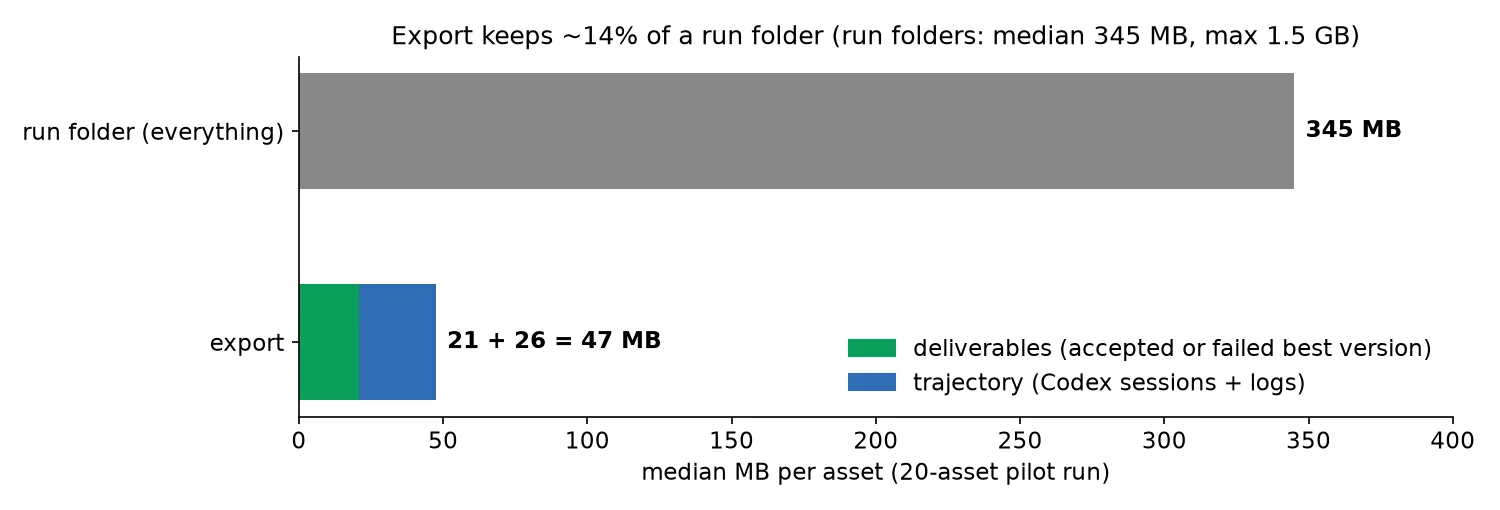
One command per batch; --orphans adds the sessions of run folders that were already deleted.Per asset the export is ~47 MB (deliverables + trajectory) instead of ~345 MB; 8,000 assets ≈ 400–500 GB. Measured on the 20-asset pilot run (18 accepted, 2 failed).
6 · Trajectory saving (new) and its test
Why: Codex writes each session to $CODEX_HOME/sessions/YYYY/MM/DD/rollout-*.jsonl[.zst], outside
the run folder; a cleaned or temporary CODEX_HOME would lose them.
What changed (v5/sessions.py): after every generator, reviewer and judge call the harness copies
that session into <asset>/sessions/, and once more when the asset ends (accepted, failed or error).
Session ids come from Codex's thread.started event; the copy is atomic.
Content of a session: prompts, every tool call with its full input (including the files it writes) and
output, the images the model viewed, its messages, token counts. Reasoning is stored encrypted only (summaries empty).
No behaviour change: prompts, models, gates and costs are untouched.
The generator called tools/check 5× and tools/judge 5× before finishing; each judge call and each round review is its own Codex session, all kept in sessions/.
7 · Open items
Access: the repo is private; external runners (e.g. Billy) must be added as collaborators to pull.
Older runs: the first ~10k assets of the external run had their run folders deleted; their trajectories
can only come from ~/.codex/sessions via --orphans (status unknown per asset).
Discrepancy:transport.landing_gear_nose_steering was accepted on the external run but fails our
motion_collision check; ask which harness commit produced it.
Reasoning text: Codex's model_reasoning_summary setting might give readable summaries for
distillation; not enabled (it changes the generator's settings).
Terms: check the provider's terms before training models on these trajectories.
Numbers measured 2026-11-18 on main e47ddb3 (pilot run v5_batch20 and one fresh test asset); progress snapshot from the progress branch as last pushed 2026-11-11.