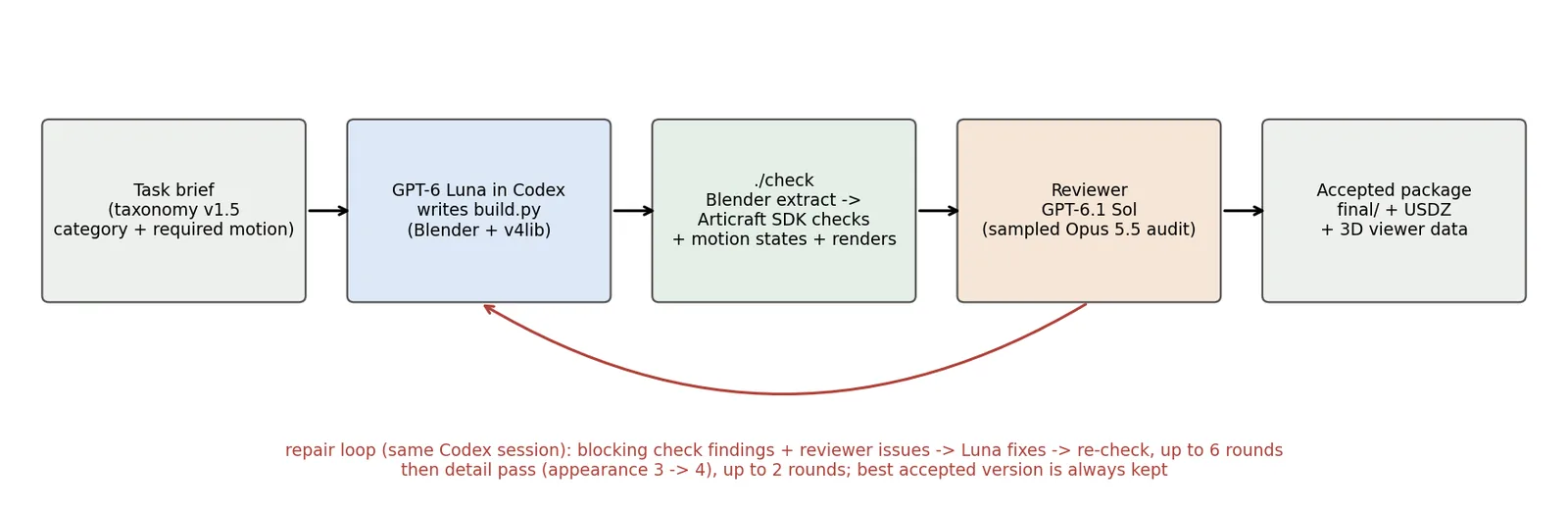
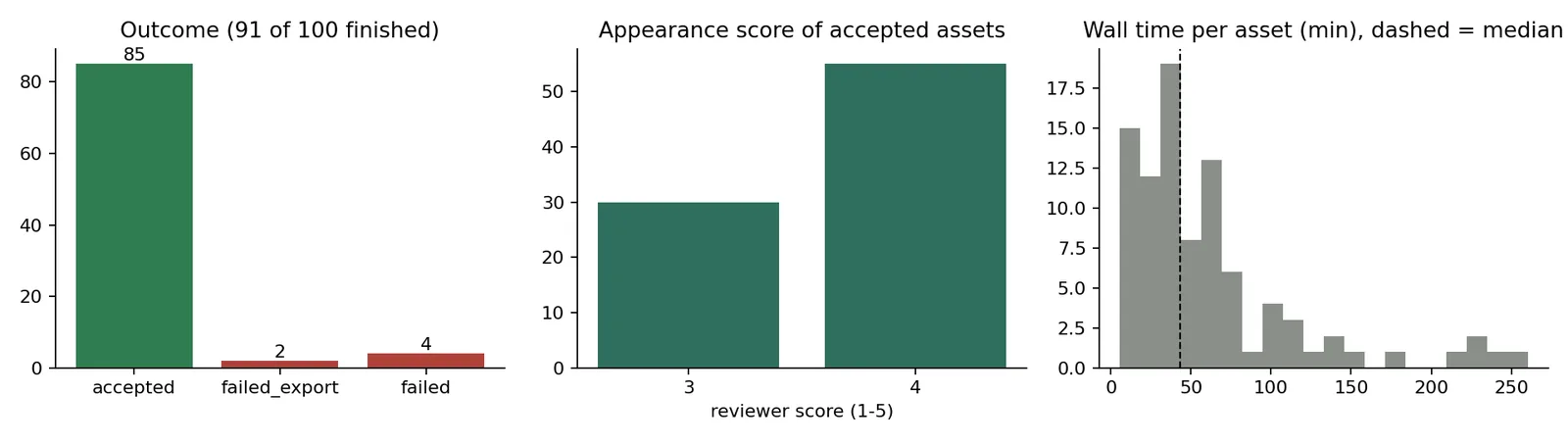
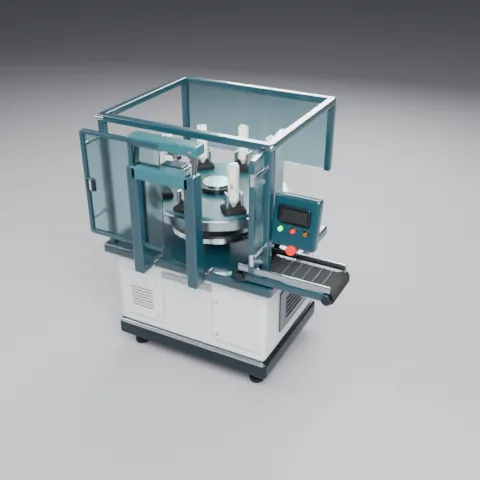
Harness v4: GPT-6 Luna builds each asset in Blender, Articraft's native SDK checks run on the exact geometry, a vision reviewer judges the renders, and failures go back to the same Luna session for repair. Batch100 (one generation per category): 85 of 91 finished assets accepted so far (100 total).
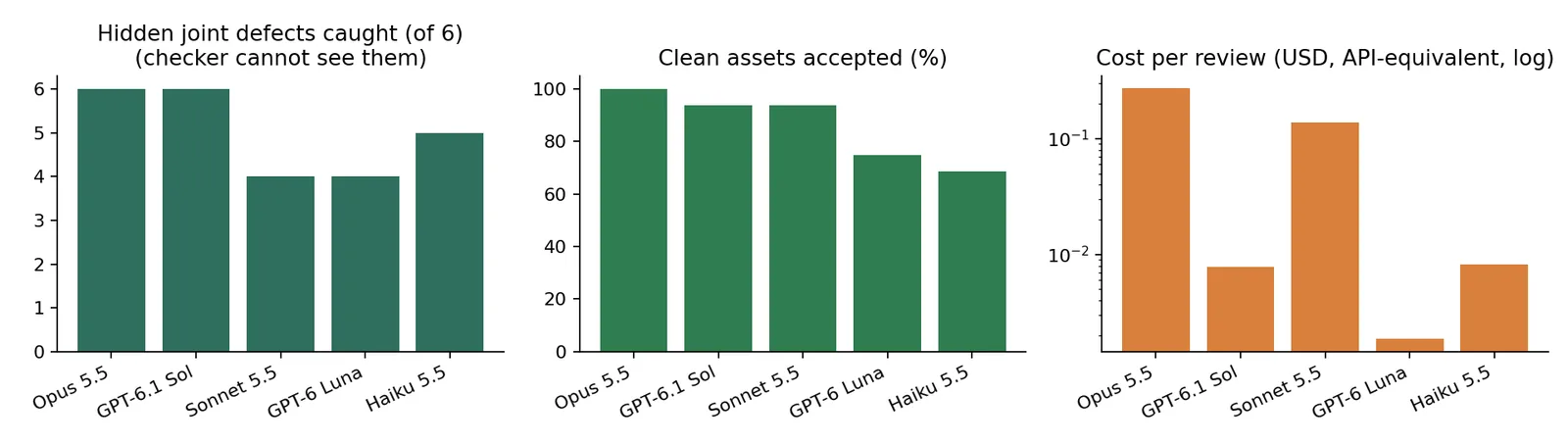
Reviewer switched from Claude Opus 5.5 to GPT-6.1 Sol: it caught all 6 planted joint defects the checker cannot see (as Opus did) at ~1/35 of the cost. On real repair loops it agrees with Opus only ~2/3 of the time, so a sampled Opus audit stays on.
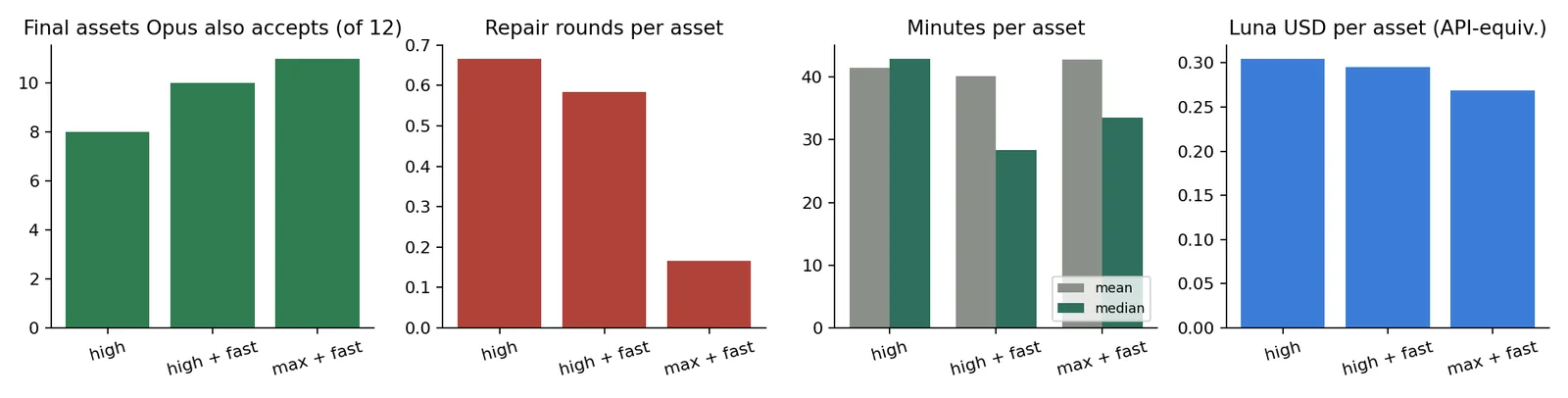
Luna max effort beat high in a 12-category trial: Opus also accepts 11/12 finals (high: 8/12), with fewer repair rounds and no higher cost.
1 · Pipeline
Generator: GPT-6 Luna (Codex CLI) writes build.py against v4lib (bodies, joints, closed loops, materials, geometry helpers) and runs ./check itself.
Checker: Blender extracts evaluated meshes per body; Articraft SDK builds the assembly at rest, runs its native checks (2 mm contact tolerance), solves every joint's limit poses and an all-joints pose, runs native overlap at each pose and renders hero views + a motion sheet.
Reviewer: one JSON verdict (category, function, blocking issues with concrete fixes, appearance 1-5); told explicitly what Articraft can express (rigid joints and rigid loops, no gear/cord couplings).
Policy: one candidate, up to 6 repair rounds, up to 2 detail rounds (appearance 3 -> 4), 4 h wall per asset.
One Codex session per asset: generate, check, review, repair in place; the best accepted version is always kept.
2 · Acceptance rules
Rule
Blocking?
Origin
Model valid; joints reference existing bodies; no empty bodies
yes
Articraft native
No isolated part / no disconnected geometry inside a part (2 mm)
yes
Articraft native (tolerance set by project)
Revolute child does not separate from parent while moving
yes
Articraft native
No new interpenetration at any sampled pose (pairs touching at rest exempt only up to max(2x, +20 mm) of rest depth)
yes
native overlap check run per pose (v4)
Every sampled pose solvable (loop joints advisory)
yes
native FK error; gate inherited from v3.5
Every visible mesh owned by a body
yes
inherited from v3.5
Exactly one root body; unscaled body/joint empties; at least one movable joint; <= 600k triangles
yes
new in v4
Rest-pose overlap, absurd dimensions, tiny motion
advisory
Articraft native warnings / v4
Mesh health
skipped
project decision
Reviewer: category ok, function ok, no blocking issue, appearance >= 3
Umbrella, Kaplan turbine, grand piano: every repair turn hit the 35-min turn limit (many parts, slow checks).
Venetian blind: the reviewer demanded couplings Articraft cannot express (wand drives slats); fixed in the reviewer prompt.
Numbers are a snapshot at 2026-10-12 22:37:08 UTC; acceptance predates the collision and text fixes below and will be re-scored.
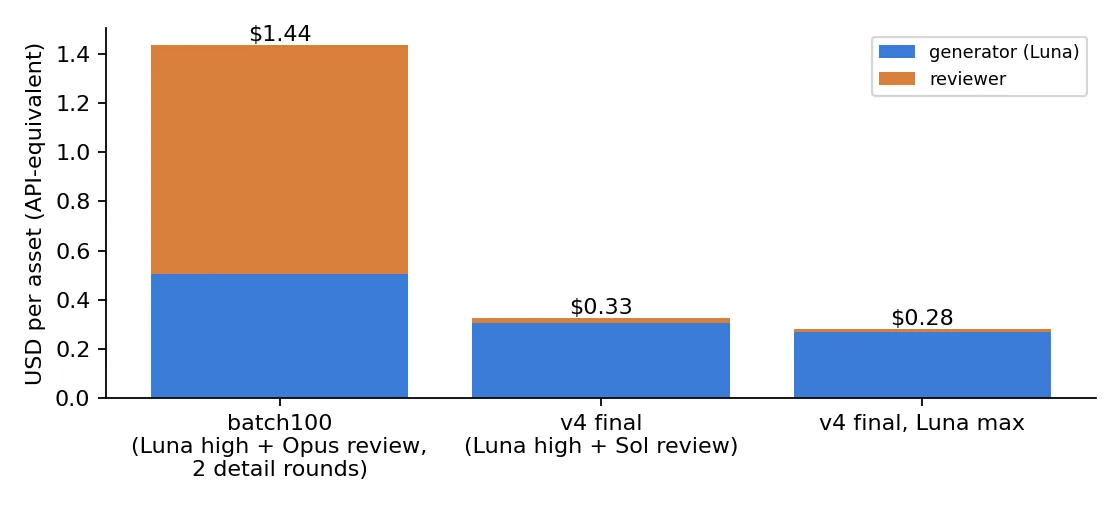
85/91 accepted; median 43 min per asset; 55 accepted assets reached appearance 4.Switching the reviewer to Sol (which also skips most detail rounds) cuts cost per asset ~5x.
Floating / misplaced lettering: 20 of 29 assets with text had floating letters (255 of 773 glyphs). Root cause: the text helper centred text on loc but did not say so; Luna placed it as left-aligned. The helper now snaps every glyph onto its surface, keeps it inside the face, and raises an error when no surface is within 10 mm.
Reviewer asked for impossible couplings (gears, cords, sequence-dependent stacking): the reviewer and the guide now list what Articraft can express; such couplings are modelled as independent joints and never block.
Codex auth: tmux sessions without CODEX_HOME silently used a stale login (401); all launch scripts set it.
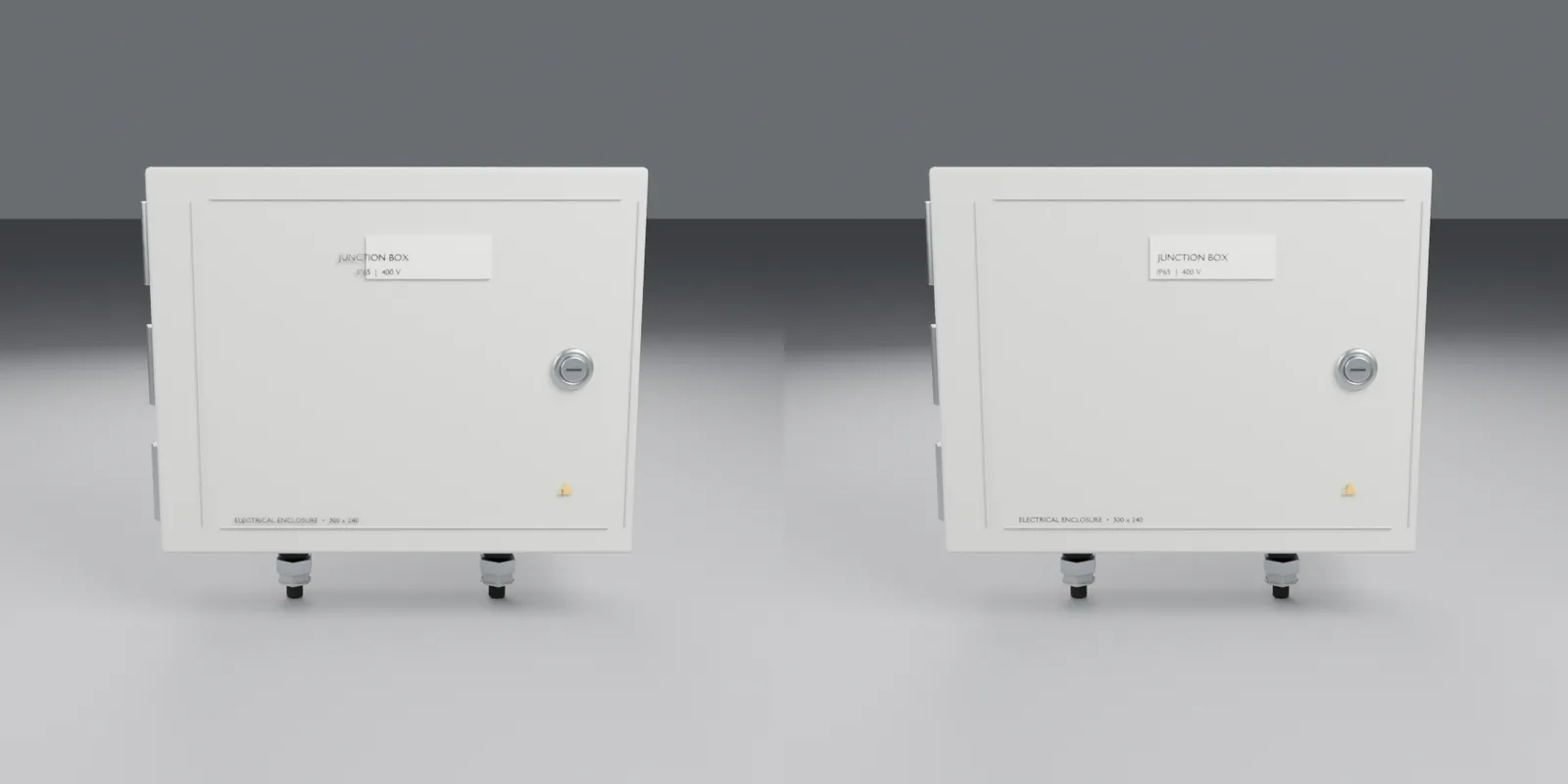
Guard door swinging 357 mm through a post: passed, because the door stile touched the frame at rest and the collision exemption covered the whole body pair. Now exempt only up to the rest depth.Text placement: before (left) the label hangs 17 mm off its plate; after (right) the v4lib text helper snaps letters onto the surface and keeps them inside the face.
5 · Which reviewer? (planted-defect A/B)
16 accepted assets as-is + the same 16 with one planted defect (pivot moved ~30% or axis turned 90 deg, rest pose unchanged); 6 of the defects are invisible to the checker.
All five reviewers saw the same prompt, report and images.
Reviewer
Hidden defects named
Clean accepted
Agrees with Opus
USD / review
Claude Opus 5.5
6/6
100%
100%
0.272
GPT-6.1 Sol
6/6
94%
97%
0.008
Claude Sonnet 5.5
4/6
94%
91%
0.138
GPT-6 Luna
4/6
75%
81%
0.002
Claude Haiku 5.5
5/6
69%
81%
0.008
Caveat: 'clean accepted' favours Opus (those assets were accepted by Opus originally).
On real repair loops (12 assets, every review shadowed) Sol and Opus agreed on 22 of 33 verdicts; each misses things the other catches. Opus itself is not stable across runs.
Only Opus and GPT-6.1 Sol named every hidden joint defect; Sol costs ~1/35 of Opus per review.
6 · Luna reasoning effort (high vs max)
Same 12 new categories, same harness, Sol reviewer, one arm per node.
Arm
Accepted
Opus audit accepts
Repairs / asset
Min mean / median
Luna USD / asset
high
12/12
8/12
0.67
41 / 43
0.30
high + fast
12/12
10/12
0.58
40 / 28
0.29
max + fast
12/12
11/12
0.17
43 / 34
0.27
max spends ~25% more output tokens but ~20% fewer input tokens (fewer repair turns re-reading context).
n = 12: treat as directional.
max: best Opus-audited quality and fewest repairs at no extra cost; fast lowers the median but not the long tail.
7 · Cost and throughput
Batch100 config (Luna high + Opus reviewer): $0.51 + $0.93 per asset (API-equivalent).
v4 final config (Luna + Sol reviewer): ~$0.30 (high) / ~$0.27 (max) + ~$0.02 per asset.
ChatGPT Pro weekly Codex quota, measured from rollout rate-limit events: ~20-25 assets per 1% of the weekly window with the batch100 config; roughly twice that with the final config.
Full taxonomy (2275 categories, one variant): about one week of Pro quota; wall-clock is the real limit (~5 days on one node at 12 concurrent assets, ~2 days on three).
8 · Open issues
Large mechanisms (pianos, turbines) time out per repair turn: needs a quick-check mode or a longer turn limit.
Sol vs Opus disagree on ~1/3 of real verdicts: decide the audit policy after looking at the effort-trial pages.
Re-score batch100 with the collision fix and rebuild its lettering with the new text helper (no new Luna calls).
Transient Codex disconnects are counted as failed repair rounds; retry them instead.