Blender visual quality + Articraft mechanical structure. Reuse the existing asset and motion; repair diagnosed defects; return the corrected result to Blender.
Corrected native-first benchmark. Eight fresh runs use Sol high. Historical mixed-prompt debugging runs are excluded. Results below distinguish generated appearance from accepted mechanics.
1 · BlenderIndependent native generation: object description + Blender physical constraints.No Articraft prompt, SDK or mapping schema at this stage.
2 · Visual approvalInspect representative poses; save the approved appearance.Internal review, no mandatory user checkpoint.
3 · ConvertReuse explicit joints; infer and flag ambiguous mechanics.Keep evidence and stable part bindings.
4 · Check + repairArticraft checks mechanics; the model fixes concrete failures.Recheck changed joints and geometry.
5 · Blender deliveryRender corrected motion with the original materials.Final visual pass → stop.
New assets must define Blender rigid bodies and physical joint constraints with endpoints, pivots/axes and limits. Animation demonstrates these joints.
Legacy animation-only assets retain the candidate-inference route; demonstrated ranges are stored separately from physical limits.
Blender owns editable geometry, UVs, textures and shaders.
Articraft owns the accepted body/joint graph and supplies mechanical diagnostics. The model performs repairs.
Final screenshots show the corrected asset revision, with accepted motion applied to its Blender appearance.
Current acceptance · aligned with Articraft baseline
User-requested correction: return close to the original acceptance bar. Automated overlap reports no longer force repeated geometric repair.
Still blocking
Diagnostic only
Invalid structure or physical mesh; actual joint/limit/motion errors
Reference-pose overlaps and assembly/contact gaps
Lost materials/UVs, wrong part bindings; concrete final visible or functional defects
Missing mass for this kinematic delivery; existing minor mesh/numerical warnings
159 regression tests passed. Motion remains checked across sampled poses; overlap diagnostics inspect the reference pose only. No claim of full-motion collision clearance or dynamics readiness.
Active conversations and assets continue; the next compile uses the new versioned runtime. In-flight older compiles and all historical results retain their original policy labels and costs.
This aligns failure/diagnostic treatment with the native compiler; it is not an identical rerun of the old independent benchmark evaluator. Original hybrid results were 8/8 delivered and 3/8 independently accepted; the earlier v3 0/8 uses a different pipeline and bar.
All eight tasks launched in parallel: seven saved assets under local repair, plus one replacement for the stroller attempt that produced no asset.
Object
Run 1
Run 2
Scissor lift
Local repair · error Added ≥ $2.035
Local repair · Accepted Added ≥ $2.198
Folding stroller
Replacement generation · running Added ≥ $1.859
Local repair · running Added ≥ $1.252
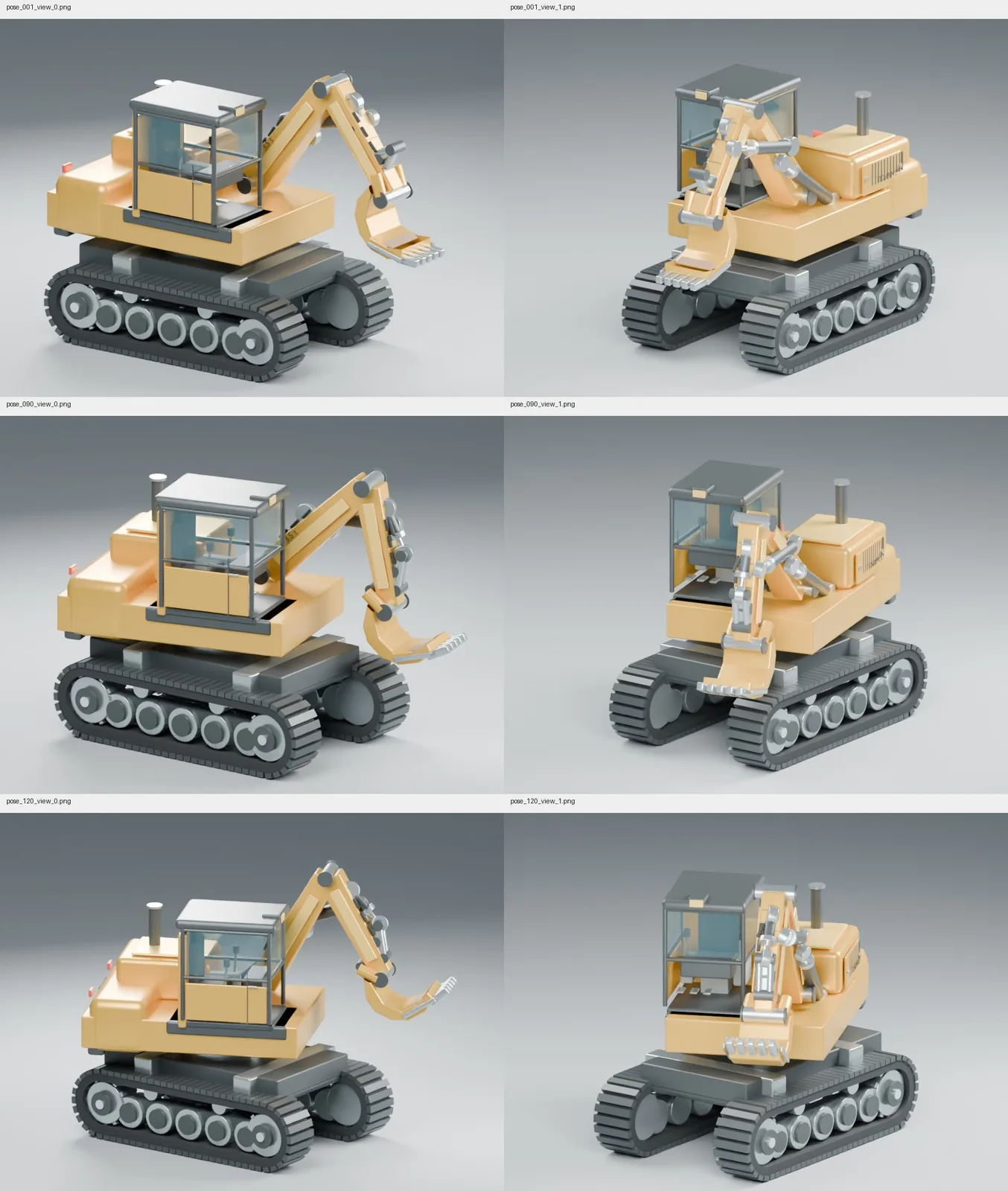
Tracked excavator
Local repair · running Added ≥ $1.396
Local repair · error Added ≥ $0.353
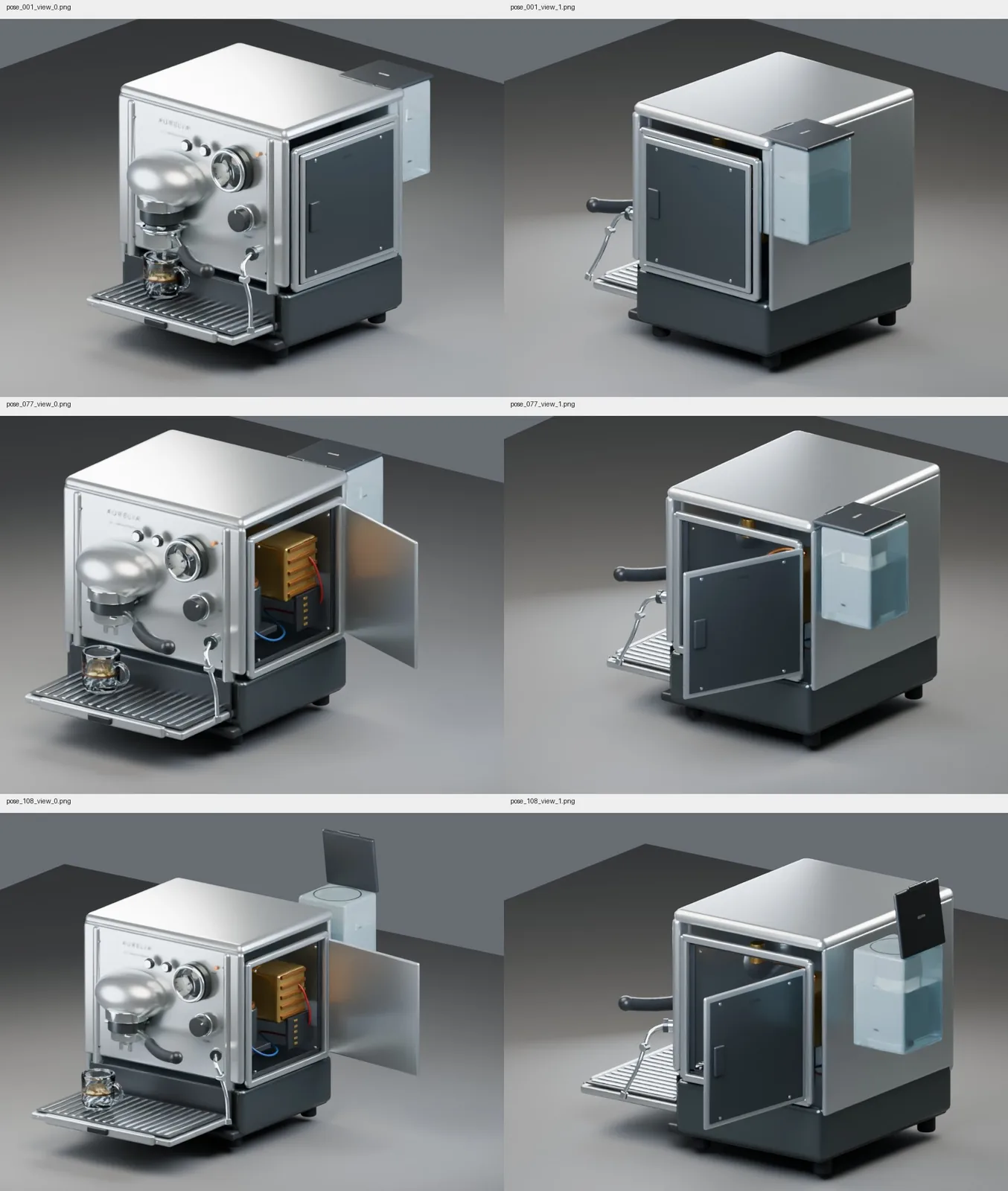
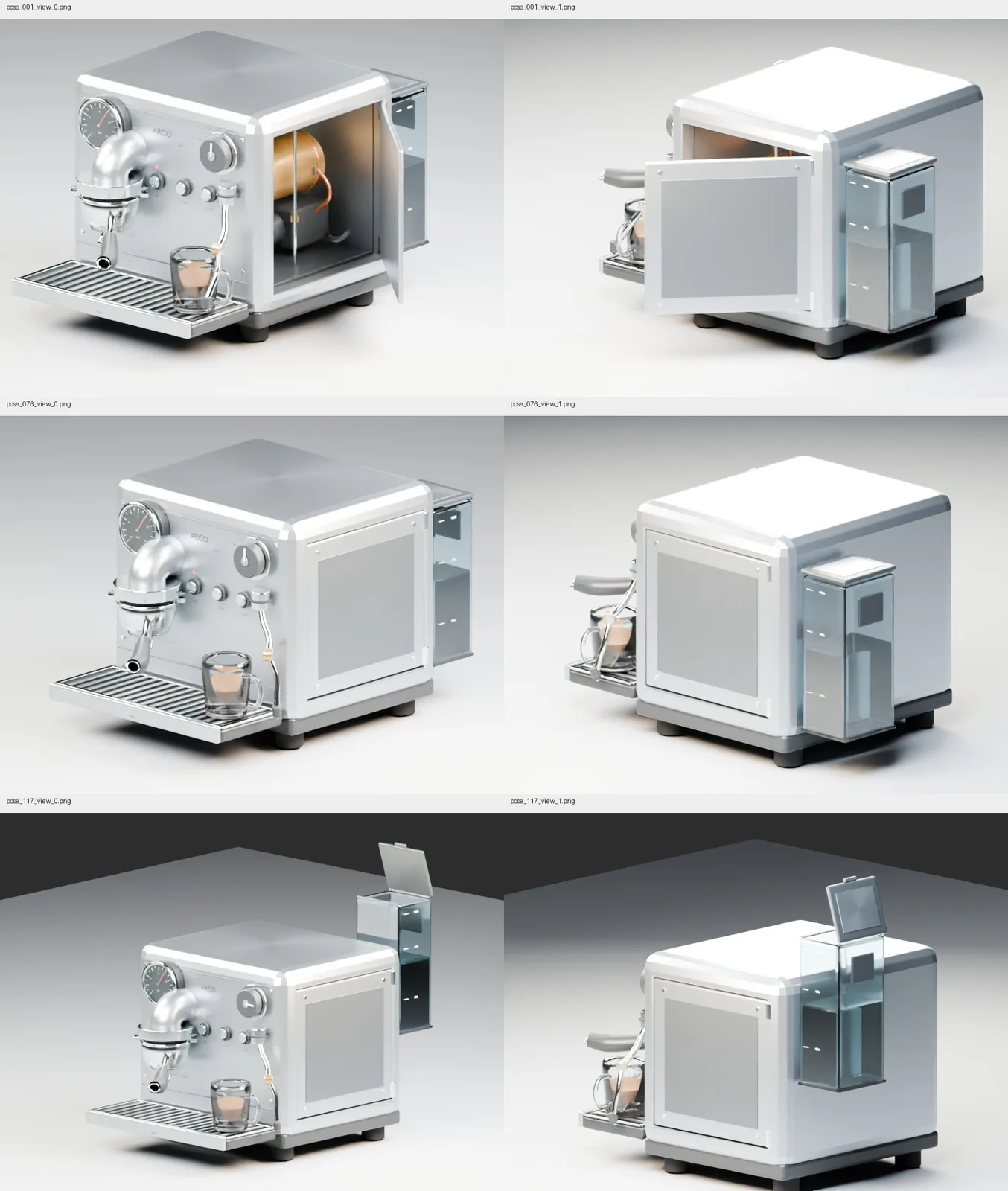
Espresso machine
Local repair · running Added ≥ $0.692
Local repair · running Added ≥ $0.656
Preserve Blender appearance. Fix blocking structure/mesh/motion defects; automated overlap diagnostics alone do not require refinement. Final render and visual pass → stop.
New repair allowance: ordinary requests stop at $2.70, reviews at $3.00 per task. These are request-start thresholds, not hard bill caps.
Historical known cost ≥ $15.664 plus six unknown usage records is retained separately. Terminal relay records permit this explicitly requested new round; missing billing is not treated as zero. New unknown usage still stops that worker.
Snapshot 2026-09-28T21:40:40.247901+00:00. 3/8 finished; 1/8 accepted. This page is a snapshot, not a live dashboard.
Full trajectories and source checkpoints remain private.
Earlier acceptance · functional checks
Default acceptance now distinguishes blocking faults from advisory findings. A warning alone does not trigger another repair cycle.
Blocking
Recorded warning
Broken/missing joint structure; significant constraint or limit violations
Small numerical residuals within the recorded tolerance
Invalid physical mesh or mass; substantial unexplained penetration
Triangle quality details, small seams and exact justified assembly fits
Concrete visible breakage, material loss or missing functionality
Reference contact gaps needing context; no requirement to touch throughout withdrawal
Keep all sampled motion and body-pair collision checks. Repair blockers locally; proceed to one final visual review when only warnings remain.
Small closed-loop residuals may use an explicitly labeled complete SDK state validated within tolerance. This is not an exact strict-FK claim.
Saved-input replays below are separate from the historical eight-run cohort; neither real asset has final acceptance.
Bridge update · visual and collision geometry separated
Current revision: preserve Blender appearance; validate declared physical geometry; repair only the failing component.
Layer
Checks and repair target
Blender visual surfaces
Keep materials, UVs and rigid body bindings. Render-only lettering is inspected visually, including recorded surface offsets.
Articraft physical geometry
Use explicit collision objects. Check correspondence, mesh health, mass assumptions, joint contact and overlaps.
Local feedback loop
Fix the cited joint, physical shape or attachment; compile again; final Blender render/review after the mechanical pass.
No automatic exclusions based on object names. Every role and replacement is explicit in collision.json; changing it invalidates prior acceptance.
Hidden collision proxies stay with the same body. Sampled bidirectional surface correspondence rejects undersized substitutes; all bound visual and physical objects retain rigidity checks.
Final visual review receives the complete role declarations and decoration-offset evidence. A mechanical pass alone cannot accept detached decoration.
Previously reported eight-run outcomes remain unchanged; this update uses offline fixtures and the saved coffee asset, with no additional model calls.
Verification
Result
Regression tests
145 passed
Saved coffee replay
545/545 joint poses and physical mesh health passed; first contact/collision phase failed. No accepted delivery.
Historical pilot: 7/8 native assets generated; 0/8 final deliveries accepted. Six completed requests have unknown usage, so this historical total is a lower bound, not a complete bill. Any newer repair round is reported separately above.
Snapshot: 2026-09-28T11:12:25.341813+00:00. This page does not update automatically.
Same backend, Sol high. Costs include the original native generation, earlier repairs and corrected mechanical continuations; no native regeneration. Soft target: $1–3 per asset.
Appearance alone is not acceptance. Final acceptance requires conversion, mechanical checks, material-preserving return and final visual review.
Full native tool traces, handoff evidence, mechanical feedback and request accounting are retained privately.
Five timeouts, two upstream/error outcomes, and one visual-repair-limit outcome. The original stroller Run 1 produced no asset after an upstream failure. An excavator linkage remained visibly disconnected; other checkpoints failed mesh-health or motion-consistency checks, including small closed-loop numerical residuals. Final aggregate evidence
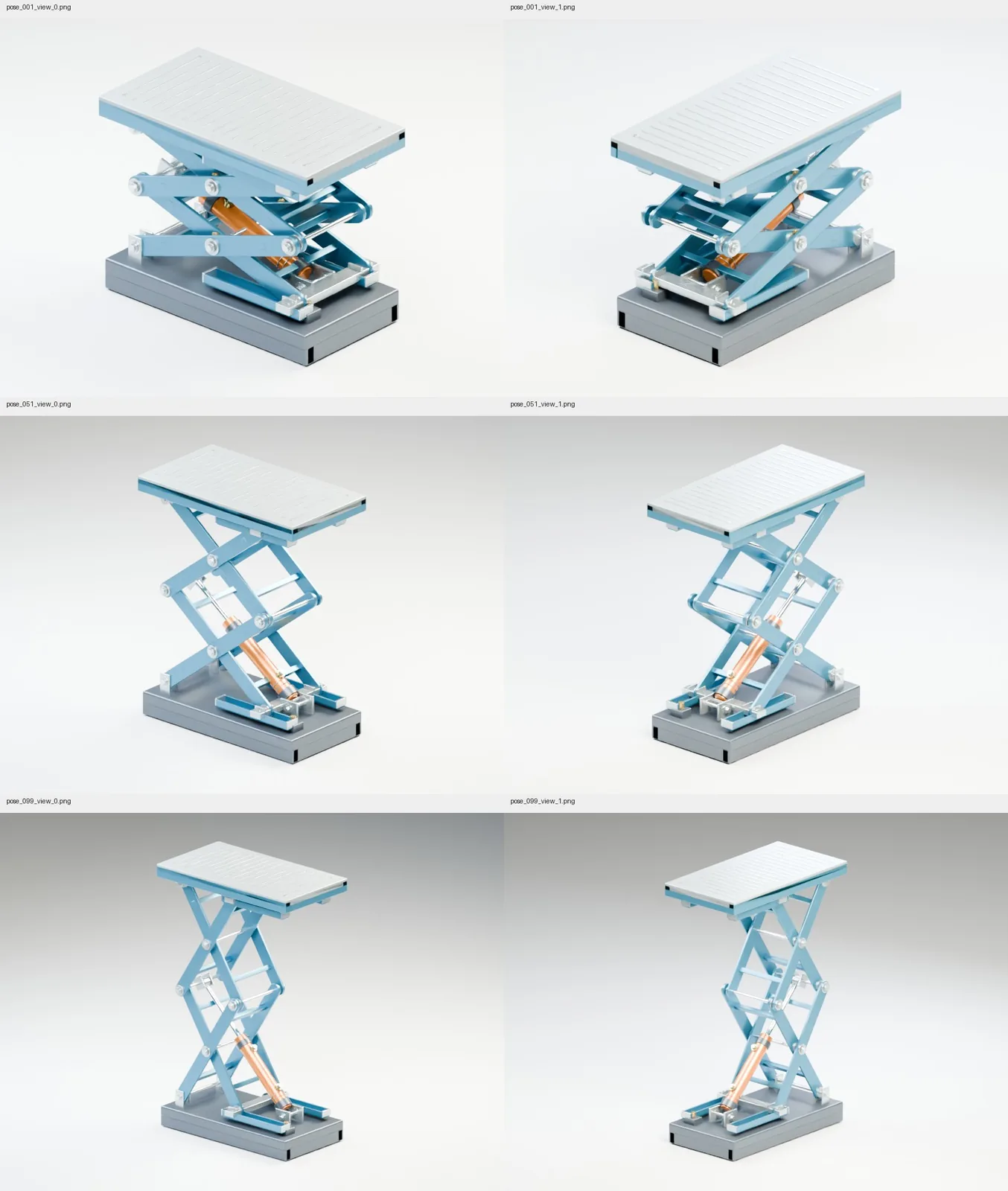
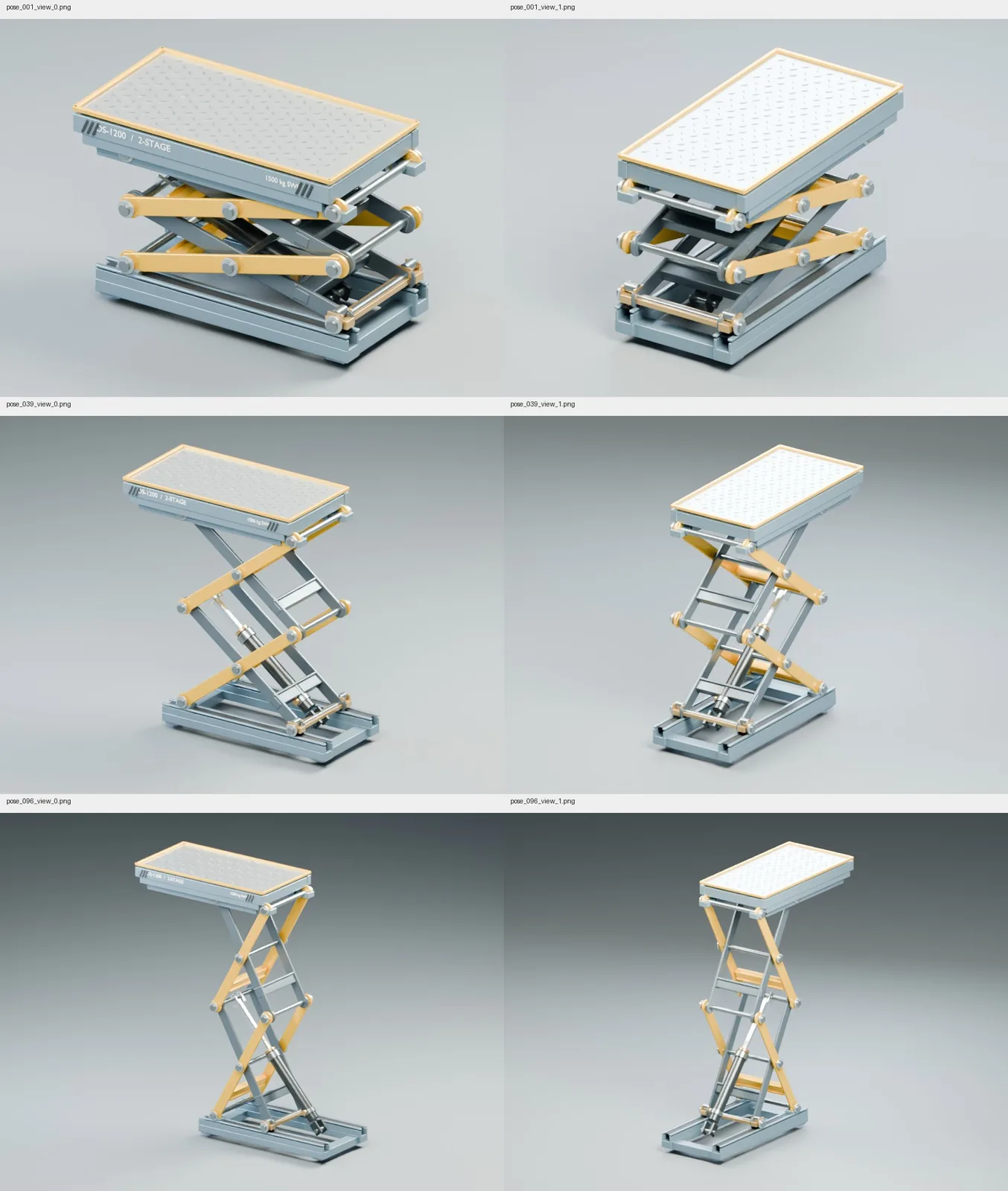
Scissor lift · v3 results
Run 1 · Original native Blender output · corrected pose sampling; not mechanical acceptance.Run 2 · Original native Blender output · corrected pose sampling; not mechanical acceptance.
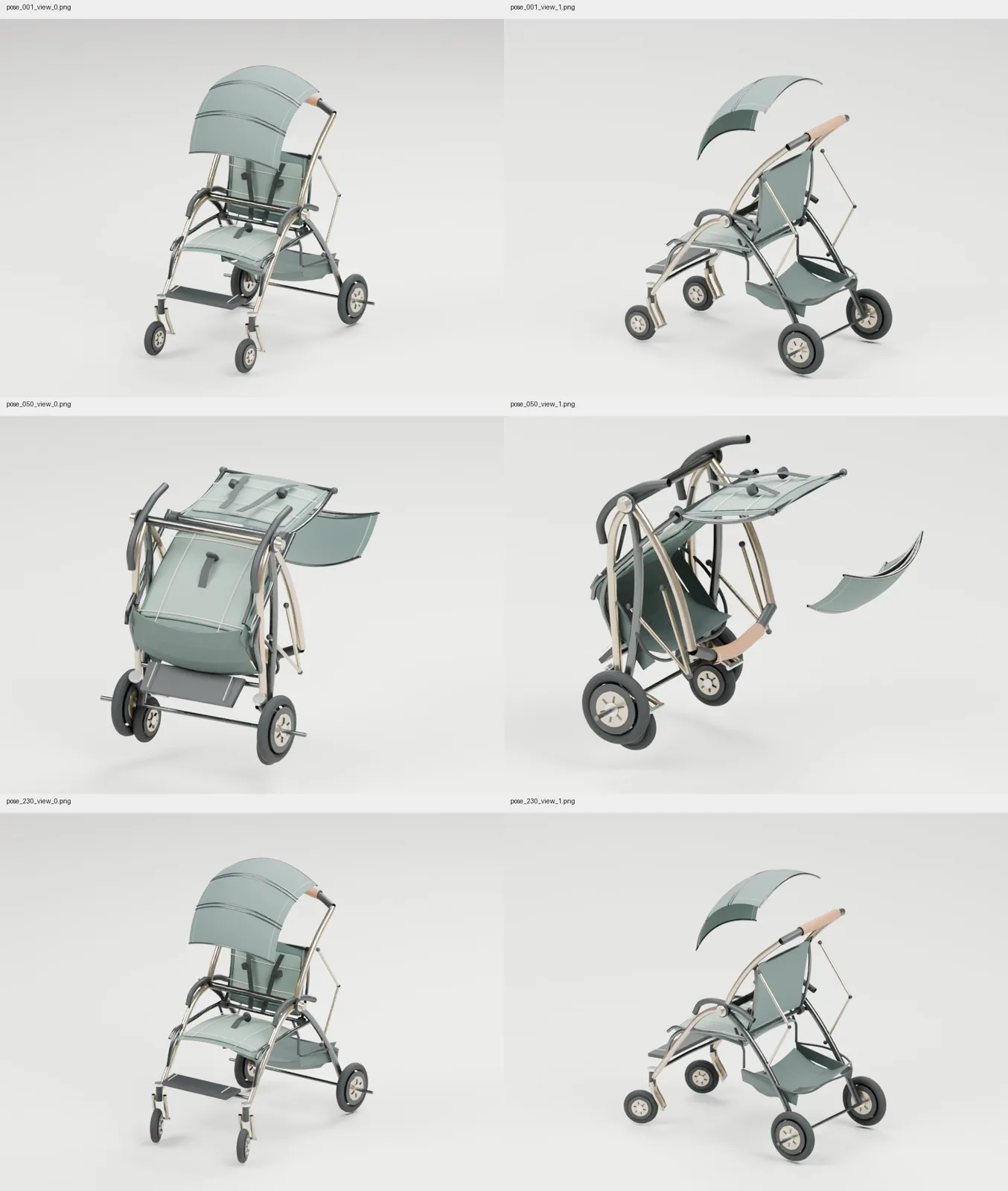
Folding stroller · v3 results
Run 1 · No completed native handoff preview.
Run 2 · Original native Blender output · corrected pose sampling; not mechanical acceptance.
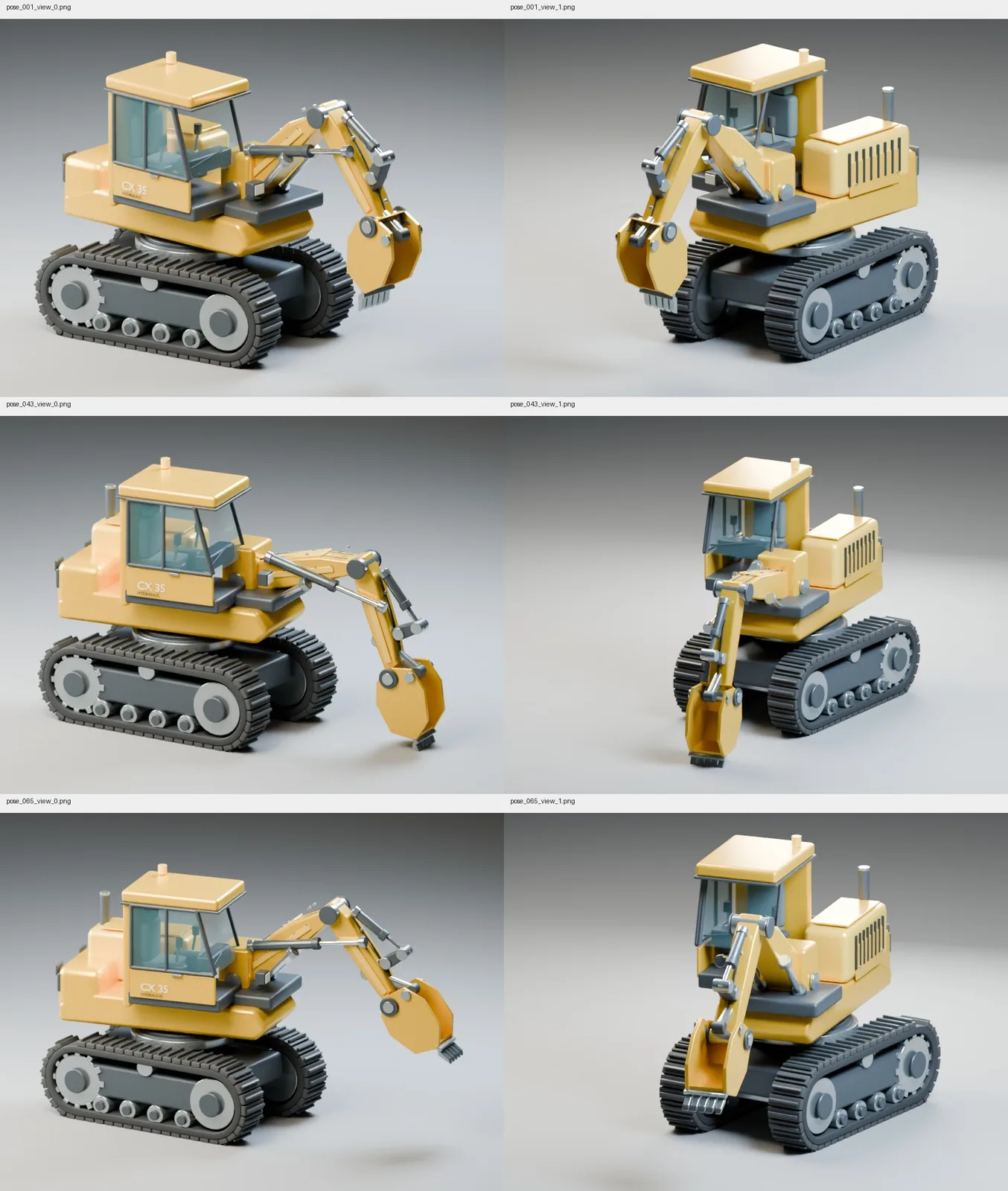
Tracked excavator · v3 results
Run 1 · Original native Blender output · corrected pose sampling; not mechanical acceptance.Run 2 · Original native Blender output · corrected pose sampling; not mechanical acceptance.
Espresso machine · v3 results
Run 1 · Original native Blender output · corrected pose sampling; not mechanical acceptance.Run 2 · Original native Blender output · corrected pose sampling; not mechanical acceptance.
Joint support corrected · SDK contract
The finite scalar-only restriction belonged to our bridge, not Articraft. The corrected bridge preserves every SDK degree of freedom and its original limits.
All 64 subsets of the six SDK axes, including unbounded rotation and multi-axis connections.
Eight Blender→SDK→Blender fixture round trips, 301 poses each; original files, material graphs and UVs preserved. A ninth, intentionally over-limit fixture is correctly rejected.
Standalone build and USDZ manifest retain the same DOFs. Free-root SDK export uses a canonical frame; source world placement is retained in the sidecar and Blender motion.
These are bridge checks, not eight accepted complex benchmark assets. Curve/Text import is now supported; original complex assets still have mesh-health and motion-consistency issues.
Original runs and the first repair cohort used earlier bridge revisions. Five final bounded repairs used the corrected joint/surface bridge. All phases and costs remain in the table; native assets were not regenerated.
Repair: change the cited joint, grouping or Blender geometry. Re-extract affected parts and rerun checks; preserve approved appearance where possible.
First fresh pass: checkpoint → three relevant poses × two views → one final visual review.
Pass: deliver immediately. Concrete defect: at most two final-review repair cycles; then explicit partial/failure.
Render/log output does not invalidate acceptance; source geometry, materials, bindings and mechanics do.
Sampled kinematic acceptance is not dynamics certification. A dynamics-ready claim additionally requires a target-simulator import and interaction/stability test.
One coherent asset package
Deliverable
Responsibility
source.blend + asset.blend
Archived input and repaired editable appearance, including material dependencies.
Articraft build + USDZ
Explicit bodies, joints, limits and recorded mechanical checks. Full Blender shaders remain in Blender.
Bindings + motion reference
Stable part IDs, body-relative rest transforms, conversion evidence and original demonstration.
motion.blend + previews
Accepted SDK motion applied to the repaired Blender appearance; conflicting original animation disabled in this copy.
Delivery report
Matching revision hashes, gate coverage, known limits and reconciled usage. Raw traces stay private.
Preserve UVs, material slots, image textures, shader graphs and texture-coordinate helper objects.
Changing geometry can affect UVs and materials; recheck appearance after necessary repairs.
Use actual object-to-body rest transforms. Do not assume every imported object starts at identity.
Implementation plan
Milestone
Status
Method, type plan and stage boundaries
Specified in v3
Blender intake + supported-joint converter
Implemented: all six SDK axes, bounded/unbounded and multi-DOF joints; candidate extraction and explicit confirmation
Implemented; tested with fixtures and a scripted model in the real Agent loop
Round-trip / fault checks on existing assets
SDK-parity update: 8 real Blender round trips × 301 poses, one genuine limit-overrun rejection; all 64 SDK axis subsets tested. Actual CLI first-payload isolation checked separately
Four complex objects × two independent runs
Fresh native-first cohort; see the measured status below
Reuse the existing bridge, hand-mapped excavator checker, tracked backend and bounded finish hooks.
Do not rename the v2 runner or relabel historical results as v3.
Cost target: $1–3 API equivalent per asset, not yet demonstrated. Soft request boundaries at $2.70 for generation and $3.00 for review; an in-flight request can overshoot.
At least 101 sampled phases per required trajectory, with extra checks around transitions and worst cases; report coverage rather than claiming continuous certification.
Do not exempt every joint-neighbor pair from collision checks. Intended contact needs an explicit, justified interface policy.
Retain actual visible geometry correspondence; report unsupported required mechanisms and unbound surfaces.
Earlier excavator prototype: four manually mapped main joints checked across 193 frames; scale-based pistons and disconnected supports were flagged. No automatic repair was performed.
Eight historical Blender-native files inspected before this cohort contained no Blender physics rigid bodies/constraints. These are separate from the new v3 inputs.
Controlled material check: six paired renders before/after conversion; four pixel-identical, two with mean RGB difference below 0.00014 / 255. This is one procedural-material fixture, not a general material-fidelity claim.
Joint contract now covers all SDK axes, finite or unbounded, continuous phase and free roots. Closed-loop replay has targeted regression coverage; none of the eight complex benchmark attempts passed all delivery gates. Active spring/motor forces, flexible dynamics and animated/UDIM textures are not claimed equivalent. Dense pose sampling is required to reconstruct turns.
Open implementation decisions: target simulator, handling of flexible components, and supported spring/motor semantics. These must be declared before claiming the corresponding capabilities.
Evaluated surfaces and faster failure feedback
Blender curves and text now import as evaluated physical meshes while the source file remains unchanged.
The return bridge preserves object identities, material graphs and UVs. Three paired fixture renders: two pixel-identical; one mean RGB difference of 0.000062 / 255.
Numeric vertex normalization and collapsed-triangle removal are recorded. Other geometry defects remain failures.
All sampled joint states are checked first. Downstream contact/collision checks run only after prerequisite gates pass and stop at a failing phase; full coverage is required for acceptance.
Read-only replay of the original native outputs: zero additional model requests; source files unchanged. This is separate from the repair outcomes above; intermediate replay passes do not certify a later edited revision.
Both scissor lifts reproduce every sampled joint pose but fail mesh health. Other failures include hinge limits, locked-axis motion and closed-loop residuals.
Strict SDK replay counts include small numerical closure residuals; they are not visual-quality or functional-success percentages.
No original complex asset passes the full gate. Completed bounded repairs retain all earlier costs; three unresolved request ledgers prevent further paid calls for the affected runs.
Verified harness corrections during this pilot
The original native-first generation is preserved. Corrected mechanical continuations reuse saved assets and carry all earlier costs forward.
Scalar GENERIC constraints now normalize without editing the asset; hashed SDK shape names prevent whitespace collisions. Three real Blender round trips passed.
Original scissor-lift Run 1 converts and reproduces 109/109 kinematic samples after these encoding fixes. This is not collision acceptance.
Pose sampling now selects distinct observed states. The original stroller folds at frame 50, missed by the old 1/115/230 panels; the improved views also reveal a detached canopy panel.
Feedback now lists actual failure groups before verbose check names. The previous finite scalar-only bridge restriction was an implementation defect. It has been replaced by SDK-axis conversion; earlier cohorts used the restricted bridge; the final five-case repair cohort used the corrected bridge.
Native-first cohort · API-equivalent usage, not a billing statement · raw traces remain private