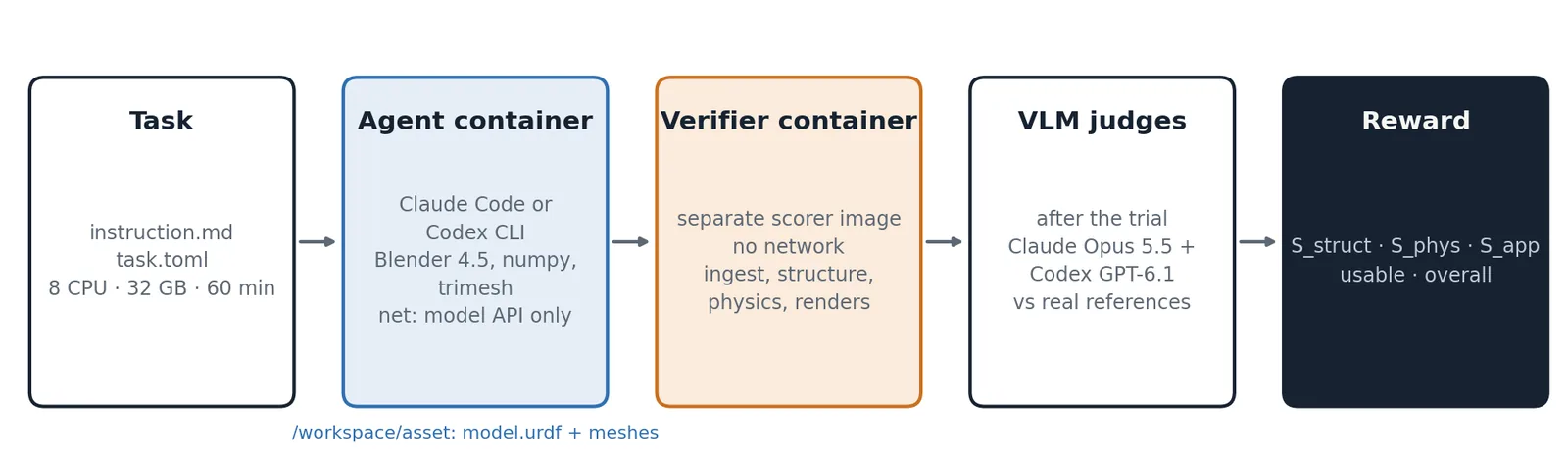
art-bench asks a coding agent to build a working articulated object: one model.urdf plus its meshes (metres, +Z up, every moving part its own link with a typed, limited joint, rest pose closed, at most 1M triangles). The agent runs in a sandbox with Blender 4.5 LTS (headless), Python with numpy and trimesh, and network access only to its model API. It never sees the scorer, thresholds or reference assets.
| Track | Input | Status |
|---|---|---|
| Text, L0 | Class name only ("Build an articulated 3D model of a laptop.") plus the deliverable and tools sections | running |
| Text, L1 | L0 plus the class's kinematic graph in words ("screen x1: hinges on hinge_block; key x1-120: slides on keyboard_deck; ...") | running |
| Image | One render of a held-out real louvre asset of the class (its mesh is the ground truth) | planned |
L0 tests whether the model knows what moves on the object; L1 tests whether it can build a given mechanism. Agents in the pilot: Claude Code 2.1.304 (Claude Opus 5.5) and Codex CLI 0.163.0 (GPT-6.1, medium effort), both on subscriptions.
Each axis is measured against our own data, the way FID needs a set of real images: the taxonomy for structure, a simulator for physics, real assets for appearance. Only appearance uses a VLM.
| Measure | What it checks |
|---|---|
| exact | A homomorphism from the URDF's moving tree (fixed joints folded) onto the class's kinematic graph: joint types, depths, and per-part counts within the template's ranges, required parts present |
| typed | Same, minimum counts waived |
| topology | Typed, with revolute and continuous joints treated as one family |
| TED | Tree edit distance to the nearest instance of the template, normalised (0 when exact passes) |
| partsim | Link names vs the matched part roles (synonym-aware), L1 only |
The matcher is validated on ~13k real articulated assets: under taxonomy v1.9 exact passes 86% of PartNet-Mobility and 82% of Artiverse.
| Check | Pass when |
|---|---|
| MuJoCo load | Strict load succeeds; missing inertia is measured from geometry, authored inertia must be physically valid |
| Per-pose collision | No part pair interpenetrates beyond 5 mm across 48 joint poses, limits included |
| Floating pivot | Every joint axis lies within 1 cm of both parts it connects |
| Buried parts | No part is hidden inside another |
Articraft drop / tilt / release tests are reported but not scored.
Judges: Claude Opus 5.5 and Codex GPT-6.1; verdicts are cached by image bytes and prompt version.
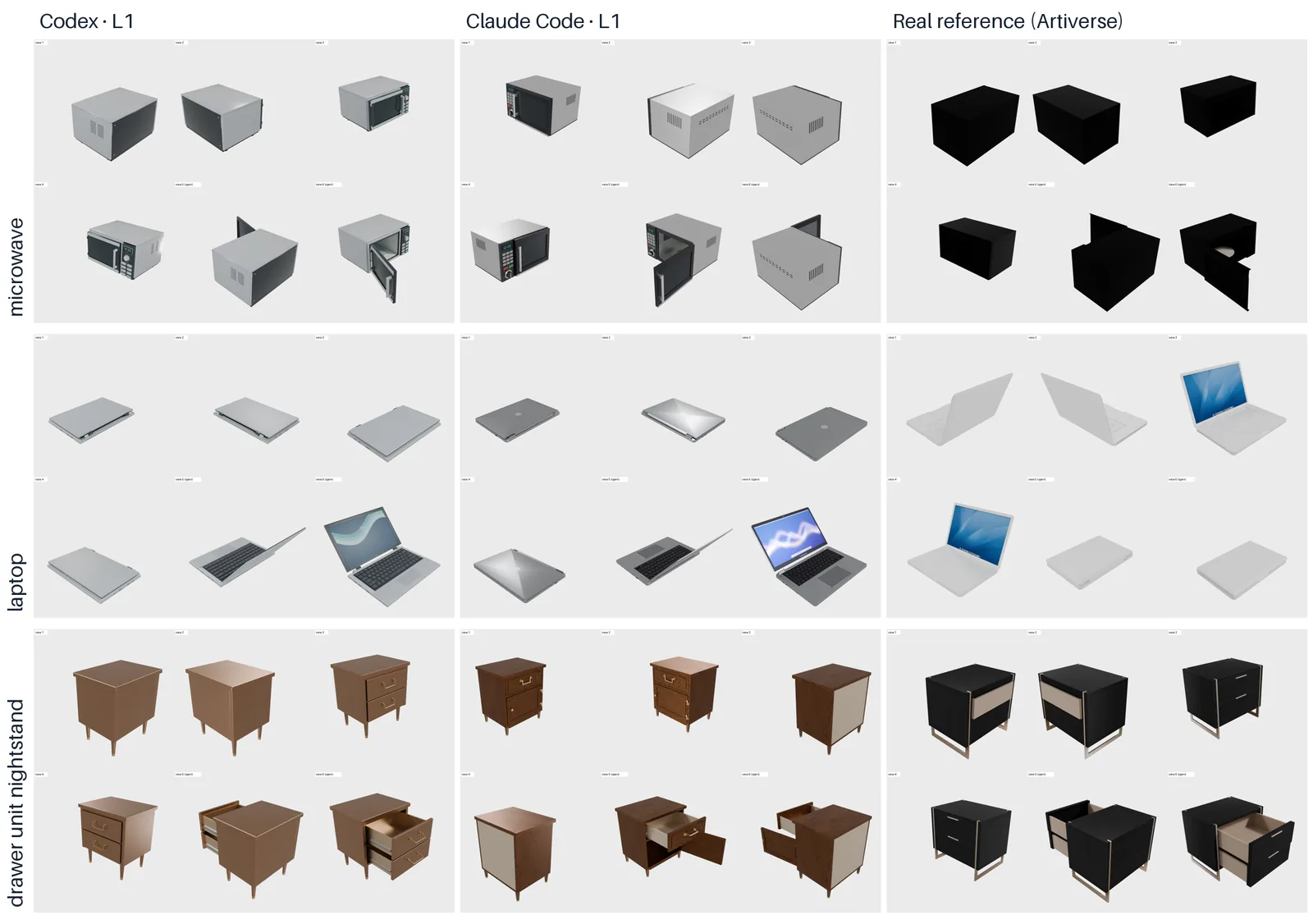
Structure and physics as above. Appearance becomes fidelity to the input: DINO / SigLIP similarity on matched views and Chamfer distance to the ground-truth mesh after normalisation, plus a pairwise judge that is shown the input image.
| Metric | Definition |
|---|---|
| S_struct | L1: mean(exact, 1 − TED, partsim). L0: mean(exact, 1 − TED); part names are not scored at L0 because the model never saw our part vocabulary |
| S_phys | Fraction of the four core physics checks passed |
| S_app | Real-Win-Rate averaged over judges; 0 for a judge whose blind gate fails |
| usable | Parses, topology tier passes, all four physics checks pass, recognisable by every judge |
| overall | mean(S_struct, S_phys, S_app); 0 if the asset does not ingest |
Leaderboard per setting (L0, L1, image): overall, usable rate, the three axis scores, model-vs-model Elo (Bradley–Terry from pairwise judge verdicts, class-cluster bootstrap CIs), time and cost per task. Judge failures are flagged, never counted as losses.
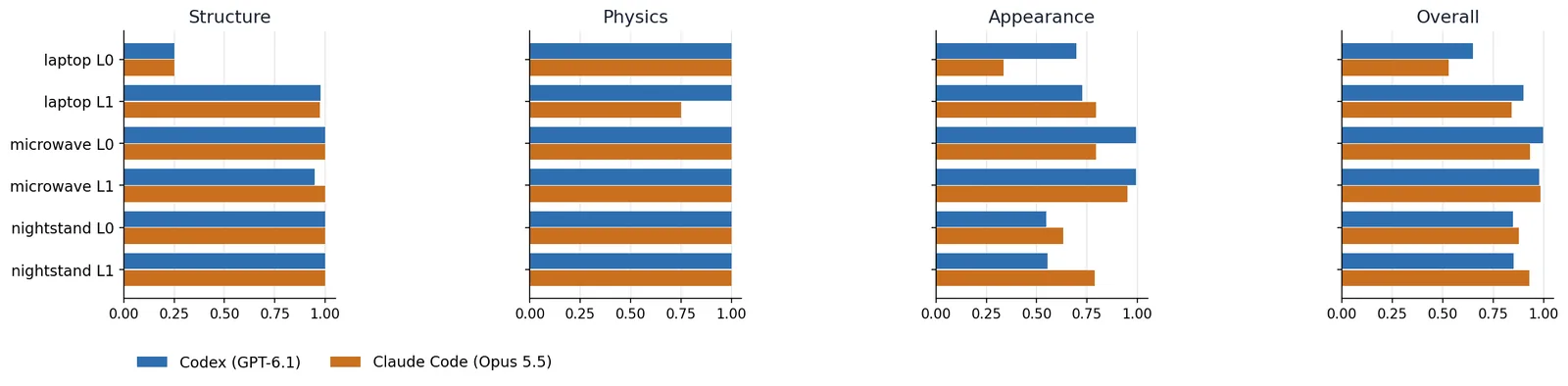
Microwave, laptop and nightstand × L0/L1, one trial each, in the Harbor + udocker setup. References: Artiverse / PartNet-Mobility assets that pass every gate.
| Task | Codex S / P / A | Codex overall | Claude S / P / A | Claude overall |
|---|---|---|---|---|
| microwave L0 | 1.00 / 1.00 / 0.99 | 0.997 | 1.00 / 1.00 / 0.80 | 0.932 |
| microwave L1 | 0.95 / 1.00 / 0.99 | 0.980 | 1.00 / 1.00 / 0.95 | 0.984 |
| laptop L0 | 0.25 / 1.00 / 0.70 | 0.649 | 0.25 / 1.00 / 0.34 | 0.528 |
| laptop L1 | 0.98 / 1.00 / 0.73 | 0.900 | 0.97 / 0.75 / 0.80 | 0.840 (not usable) |
| nightstand L0 | 1.00 / 1.00 / 0.55 | 0.849 | 1.00 / 1.00 / 0.63 | 0.878 |
| nightstand L1 | 1.00 / 1.00 / 0.55 | 0.851 | 1.00 / 1.00 / 0.79 | 0.930 |
| mean | usable 6/6, 409 s/task | 0.871 | usable 5/6, 547 s/task | 0.849 |
| Step | Classes |
|---|---|
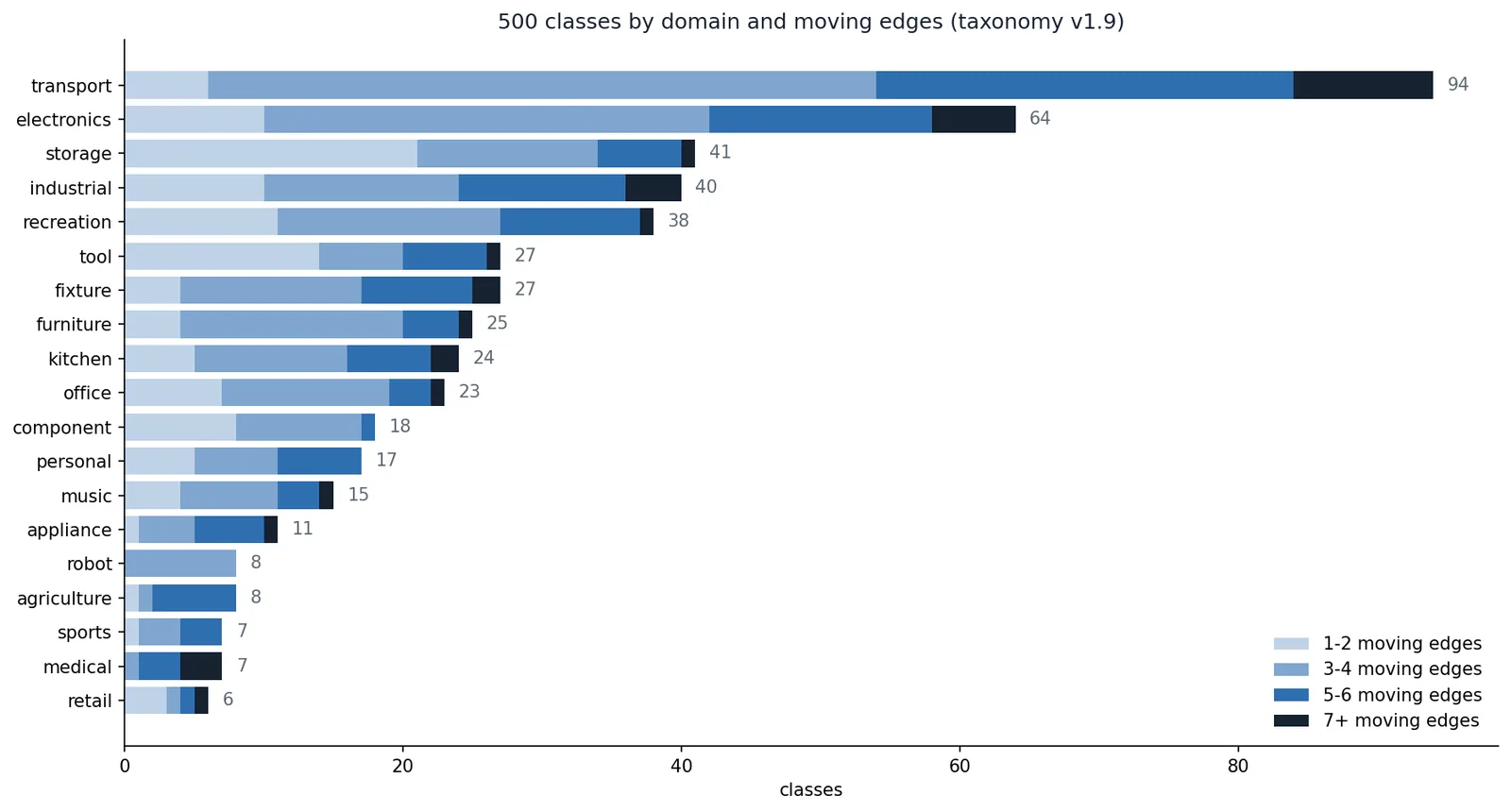
| Taxonomy v1.9 classes with at least one moving edge | 2,287 |
| … with ≥ 7 louvre assets that have an exact class label, medium/high quality, original texture, single GLB | 697 |
| Stratified by domain × number of moving edges (seeded) | 500 |
| Pilot subset, stratified the same way | 50 |
| For comparison: classes with real articulated references (Artiverse + PartNet-Mobility, exact pass) | ~60 |
Per class, one asset is held out as the image-track input and six serve as text-track references.
input.png, fidelity metrics, image-conditioned judge.Open: static vs articulated references; whether to relax fine-grained template minimums (laptop keys, microwave buttons) that L0 models rarely build.